
Booking models

Rental management software built on the units you actually own

The rental model is for anything that leaves with the customer and comes back: cars, scooters, bikes, boards, tools, equipment, party gear. Two things separate it from every other kind of booking. Availability comes from the specific units you own rather than from a category, and the object comes back — which means preparation time between hires, a handover both sides can point at afterwards, and a return that records what actually happened.

  1. Publish inventory and availability

  2. Price the selected period and extras

  3. Prepare pickup with documents

  4. Record return, condition and follow-up

Rental operations platform for inventory, date ranges, extras, deposits, pickup and return.

What it solves

  • Vehicles and marine inventory
  • Equipment and event stock
  • Daily or multi-day rentals
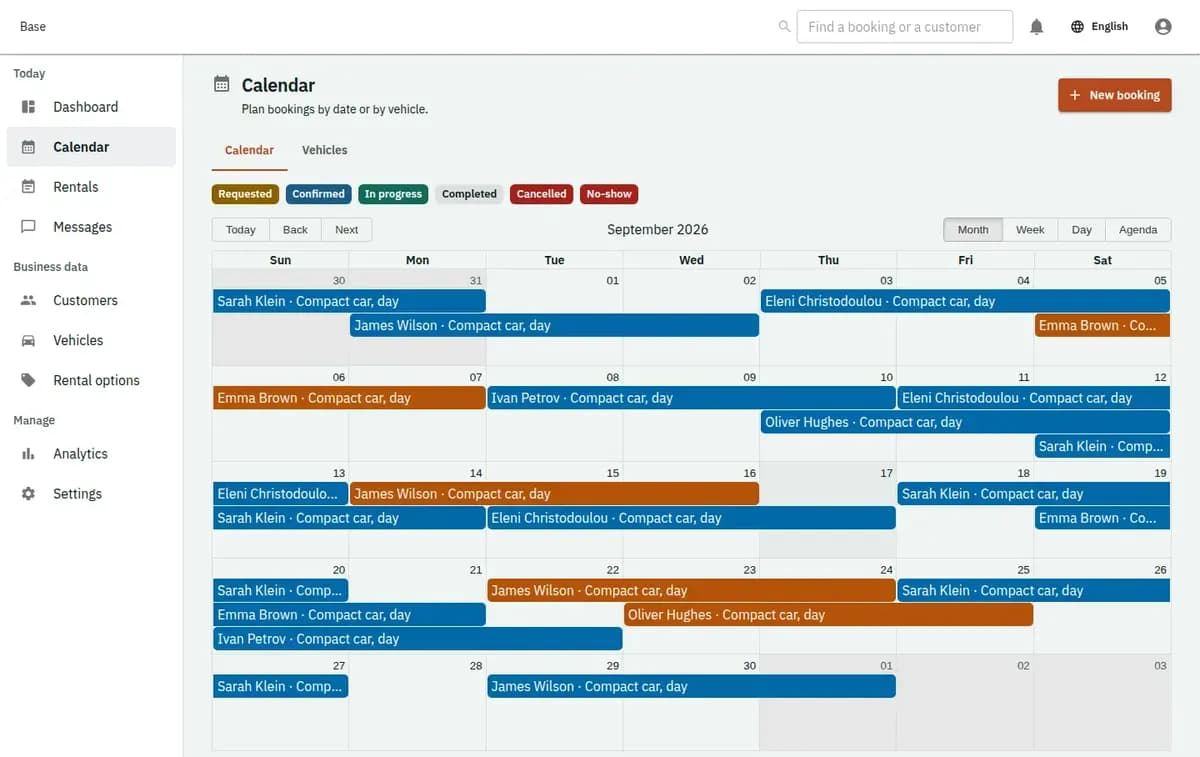
The booking console, with invented records — Rental management
A real console. The records in it are invented.

When rental software fits your business

Use it when the customer takes something away for hours, days or weeks: a car or scooter fleet, bikes and e-bikes, boats and watercraft, sunbeds and beach gear, tools, cameras, staging and event equipment. It suits one van hired out weekly and a yard of forty scooters, and it holds up when identical-looking items are not interchangeable, when the same item goes out twice in a day, and when what happens at return is the part that costs money.

When another model fits better

If the thing stays where it is and the customer uses it on site, that is resource booking, without a handover. If a person delivers a service, that is an appointment or a class. Nights in a property are accommodation, which is measured in changeovers rather than in fuel and condition.

What a hire desk faces that a diary cannot

Four things, and every one of them is discovered at the counter if it is not in the calendar.

A category is not availability

Three cars of the same model are three separate calendars. One is out until Thursday, one is in for a service and one is available. Booking against the category means somebody works out at the counter which actual unit the customer gets — and sometimes finds that the answer is none. Availability is computed from the units, so the answer is known before the promise is made.

The gap between two hires is real work

Fuel, cleaning, a look at the tyres, a charge, a check of what came back in the box. That is preparation time, it belongs to the unit, and it is subtracted from availability. Without it a calendar sells an item that has technically returned and is not ready, which is the same as not having it.

Extras run out before the main item does

Helmets in the right size, child seats, life jackets, chargers, trailers. They are counted stock, they go out with a hire and they come back with it, and a booking for three riders needs three helmets for the same period. Kept in somebody’s head, they are missing on the busiest morning of the year.

The disagreement happens at return, so the facts belong at handover

Fuel level, mileage, existing damage, what was in the box, who checked it and when. Recorded when the item goes out, all of it makes the conversation at return short. Recorded nowhere, the argument is about memory, and the business usually loses it.

Running a hire week with rental management software

Four steps, and the last one is where the money is.

1. Enter the actual units

Each item goes in with its identity — registration, serial, name — plus its own preparation time and its own maintenance blocks. A unit out for repair is blocked rather than deleted, so the fleet stays honest and the item comes back when the work is done.

2. Set prices, periods and extras

Hourly, daily and weekly rates, minimum and maximum hire lengths, and the extras you actually carry, counted by size where size matters. Say what your rules are — the deposit you take, the notice you need, what happens on a late return — and keep them where they are shown, not in a drawer.

3. Confirm a specific unit for a specific period

A booking holds that unit for the whole period plus its turnaround, together with the extras it takes with it. Requests from the website, the phone and the counter arrive in the same queue, so nothing is promised twice.

4. Hand over and take back with facts

At handover: condition, fuel or charge, mileage, the extras that left, the person who checked and the time. At return: the same fields again, plus anything that changed. Base records the deposit as a fact — that it was taken, when and by whom — and leaves the money itself to you.

Three rules that keep a busy Saturday on track

Three rules, each of them the answer to a busy Saturday.

Availability is computed from units, not from a count

A hire holds one identified item for its period. When every unit of a type is out, the request is refused with the next free date rather than confirmed against a number that turns out to be optimistic.

Turnaround belongs to the unit

The preparation time is per item, because a scooter and a minibus are not the same job. It is subtracted from availability, so the calendar stops promising the ten minutes in which nothing could actually be done.

Extras are held for the same period

Three helmets on a hire for three riders are three helmets nobody else can be promised. When the sizes run out, the booking is refused for that reason and the desk can say what is possible instead.

The same scooter twice and a late return

The same scooter twice in a day, and the item that came back late.

One scooter, two hires in a day

The morning hire returns at one, and the afternoon one starts at two. The forty-five minutes in between are the unit’s preparation time, so the calendar never offered half past one. Both customers get a working machine, and nobody is fuelling it while somebody waits.

A late return on a booked-out day

The car due back at four is not back. The next hire is at five and shows the conflict while there is still time to call both customers — the one on the road and the one who is coming. The alternative is finding out at five past five, with a family standing at the desk.

What the rental record proves and what it cannot

A rental generates evidence, and evidence has limits worth stating plainly.

Notes and photographs, not a verdict

Base stores what your staff recorded at handover and at return, with who and when. It does not decide who caused a scratch, does not calculate liability, does not charge a card and does not settle an insurance question. It gives both sides the same record to talk about, which is usually enough.

Documents are recorded, not verified

Where a hire depends on a licence category or an age, staff record what they read from the document in front of them and Base uses it to refuse a mismatch. It does not check anything with an authority and is not proof that a check took place; the responsibility stays with the person who looked.

Preparing rental booking software before the season

Enter every unit with its identity and its own preparation time — the fifteen minutes you always take is what keeps the day from sliding. Enter extras as counted stock, by size where size matters. Write your rates for the periods you really sell, and your rules for deposits, late returns and cancellations, because those three are the ones you will be asked to apply under pressure. Decide who may confirm, who may hand over and who may close a return. Then put the season’s existing bookings in before you go live: the ones that will not fit are the ones already promised to the same unit twice.

Outside the calendar once the item leaves

The item leaves and comes back. What happens to it out there is not something a calendar can see.

Not tracking, telematics or immobilisation

Base does not follow a vehicle, does not read a tracker, does not build geofences and cannot stop an engine. It knows what was hired, to whom, until when and in what condition it left.

No money and no fines

Payments, deposits held, refunds, traffic fines and correspondence with authorities are yours. Base records that a deposit was taken or returned as a fact; it never moves the money and never decides what somebody owes.

A refusal is a valid result

Every unit out, a period that crosses maintenance or preparation, missing extras, a recorded licence category that does not match, or a request inside your notice period stops the hire. The previous state stands, the reason is named, and a date that exists is offered instead.

Rental software questions

Do online, phone and counter rentals end up in one calendar?

Yes. Rental booking software only helps if every request lands in the same place, so bookings from the website, the phone and the counter arrive in one queue and are checked against the specific unit, its turnaround time and the counted extras. That keeps your rental management software the single record of which car, scooter or board is free on which day, and nothing is promised twice.

Is availability per item or per category?

Per item. Each unit has its own calendar, and a hire holds a specific one, so the desk knows which object the customer is getting before anything is promised.

Can preparation time differ between units?

Yes. Turnaround is set per unit and subtracted from availability, because a scooter and a minibus do not need the same amount of work between hires.

How are helmets, seats and chargers handled?

As counted stock, by size where that matters. They are held for the period of the hire and released when it returns, and a booking is refused when they run out.

What is recorded at handover and return?

Condition, fuel or charge, mileage, extras, notes and who checked, at both ends. That is the record both sides look at when something is disputed.

Does Base hold the deposit?

No. The deposit is recorded as a fact — taken, when, by whom, and returned if it was. The money itself stays in your own process.

Next step

Open a workspace and set up one booking flow

Registration takes an email address. The operating model, services and resources are configured afterwards, in the console.