
Rental management

Car rental software for car hire companies in Cyprus

  • No car promised to two customers
  • Maintenance and turnaround time are already counted
  • A car with expired papers is not handed over by mistake

No card asked for · nothing taken from a booking · your data exports

Operating model
Rental management
What is booked
Item → From / To → Return
Getting started
Preparing your fleet in the car rental software

Base gives an independent car rental team one place to answer requests, confirm a specific vehicle and carry the rental through pickup and return. It is designed for Cyprus operators who currently join together calls, messages, a calendar and spreadsheets. A request does not silently remove a car from sale: availability changes only when staff confirm an eligible named vehicle for the exact blocking period.

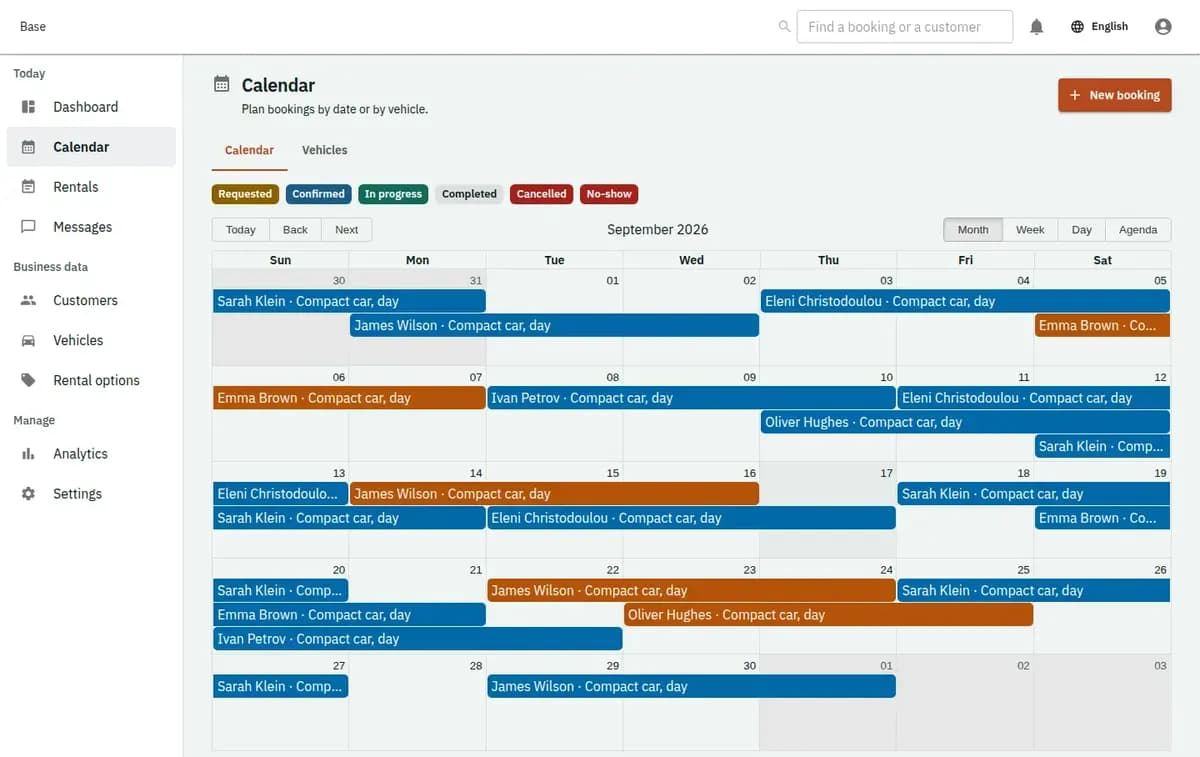
Base calendar showing named vehicles and car rental pickup and return times
A real console. The records in it are invented.

Who this car hire software fits

This profile fits an owner-led rental company with a real fleet, defined rental options and staff who confirm requests. It is useful when the team must know which exact car is free, quote an all-in set of price lines, retain accepted terms, check driver and vehicle credentials, and leave a clear pickup and return trail. Staff may serve customers who enquire by website, phone, email or messaging and enter those bookings into the same workflow.

Car rental reservation software from request to return

One booking owns the lifecycle, so pricing, allocation and handover contributors do not create competing versions of the rental.

  1. 1. Publish real fleet and rental choices

    The owner imports or creates vehicles, offerings, operating schedules, rates, locations and reviewed policies. Base does not generate fake cars or legal text during setup. Each vehicle can carry the fields and credential validity the team needs for eligibility, while the rental option defines duration, buffers and published price lines.

  2. 2. Receive and verify a request

    A customer submits dates and relevant driver details, or staff enter a phone booking. Verification produces a requested booking, not a reservation. The team can review availability, price, policy evidence and requirements without a speculative enquiry blocking the last suitable car.

  3. 3. Confirm one eligible named vehicle

    Staff select the exact car and confirm it inside one transaction. Base checks location, dates, buffers, maintenance blocks, active reservations, required vehicle credentials, relevant driver category and expiry, and accepted policies. The confirmed price and terms are snapshotted with the assignment.

  4. 4. Record pickup as it happens

    At handover, staff verify the primary driver and credentials, record fuel and mileage, add initial condition or damage observations, and keep the actor and time. External payment or deposit events may be entered as manual facts. The booking then moves to in progress without storing card details or claiming a bank reconciliation.

  5. 5. Complete return or handle an exception

    Return captures time, staff member, fuel, mileage, condition changes, evidence and the factual deposit result, then releases the vehicle reservation. Cancellation and no-show paths also release active capacity. An extension rechecks price, acceptance and availability atomically; a conflict leaves the existing dates and reservation unchanged.

Daily car hire problems kept in one record

The page is organised around the points where a small rental operation usually loses context or creates a collision.

Availability split across messages and sheets

A promised date range is risky when the vehicle calendar, maintenance blocks and current rentals live in different places. Base calculates availability from the named vehicle schedule, exceptions, turnaround buffers and active confirmed reservations. Unverified and merely requested enquiries remain visible without pretending the car has been allocated.
Price and terms change between quote and counter

The confirmed rental keeps a versioned snapshot of the accepted rate, mandatory fees, selected extras, discount or manual override, currency meaning and any deposit requirement. A later catalogue edit does not rewrite the customer record. If staff change an accepted price, the request waits for fresh acceptance instead of presenting the change as agreed.

Pickup and return evidence is incomplete

Staff can keep the primary driver, credential check, fuel, mileage, observed condition, damage notes, actor and time with the handover. Return records the same operational facts and the deposit outcome. These are observations for a traceable discussion; the platform does not infer fault, liability or an automatic charge.

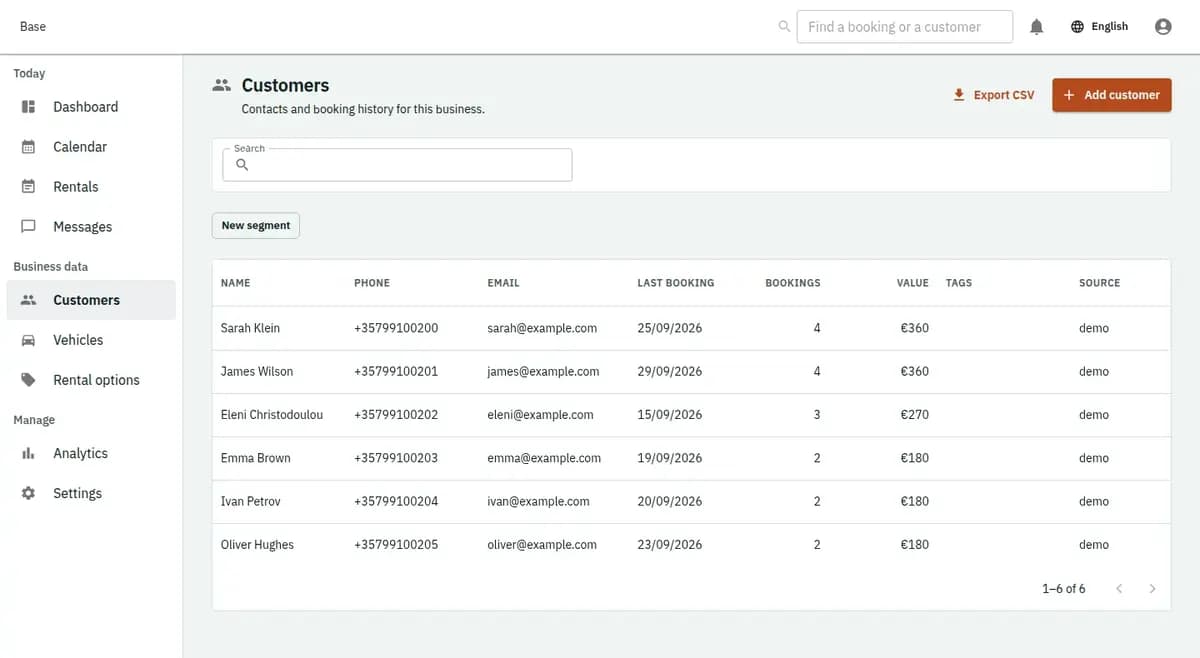
The booking console, with invented records: the customer list

No car promised to two customers

Car rental uses named-unit allocation, not a pooled count. The question is whether this particular vehicle can cover the whole promised period.

Maintenance and turnaround time are already counted

Weekly availability is reduced by exceptions, maintenance and confirmed reservations, including configured before and after buffers. Confirmation creates one active reservation for the selected vehicle. Two staff members cannot successfully confirm overlapping rentals for that same car; the final concurrent attempt is refused without a partial booking change.

A car with expired papers is not handed over by mistake

A free rectangle in the calendar is not enough. The vehicle must be active at the right location and carry required valid credentials, while the recorded driver details and accepted policy evidence must satisfy the released rules for the rental period. Unknown or unresolved legal requirements stay an operator decision rather than a marketing promise.

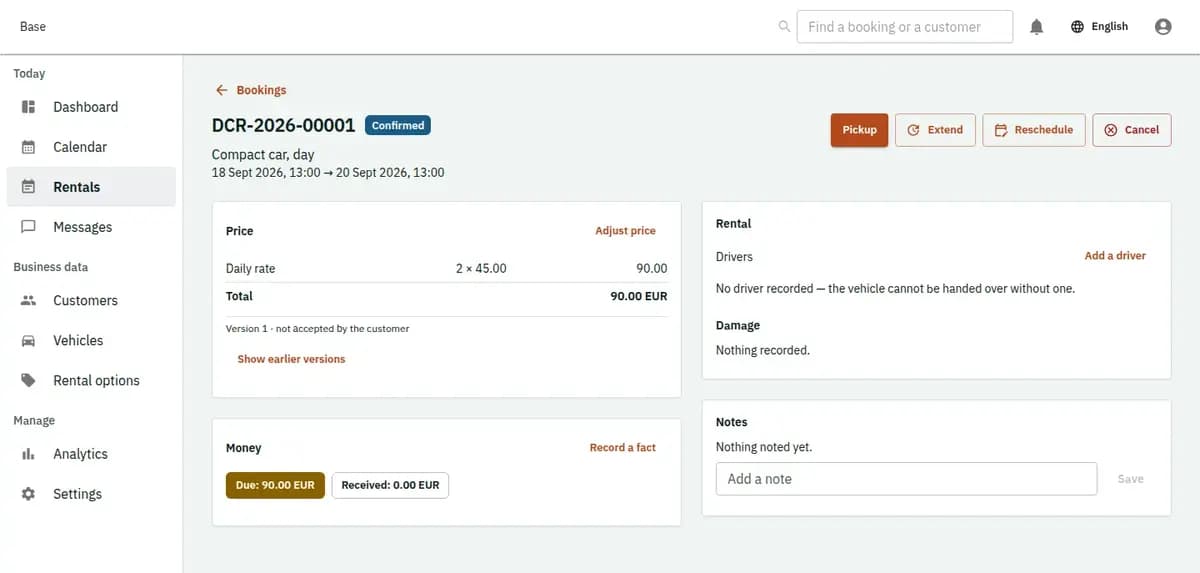
The booking console, with invented records: one booking with its price lines and history

Everyday bookings and failure paths in car rental

The same rules cover an ordinary booking and the failure paths that usually force staff back into a spreadsheet.

A confirmed airport pickup

A manager reviews a verified request, selects a vehicle that is free through its return buffer, confirms the agreed price and policy version, and sees the pickup in the operational queue. At the desk, staff record driver verification, fuel, mileage and condition before starting the rental. The return closes the evidence trail and releases the car.

Two people try to allocate the same car

Two requests overlap and two staff members confirm at nearly the same time. The first valid transaction reserves the vehicle. The second receives a conflict and changes nothing: no misleading confirmation, no orphan reservation and no altered price snapshot. Staff can return the second request to review and offer another eligible vehicle.

A credential blocks the handover

The dates are free, but a required vehicle or driver credential expires before the rental ends. Base refuses the guarded transition rather than letting staff mark the rental as started. The team corrects the evidence, chooses an eligible alternative, or declines the request; the system does not decide a legal exemption.

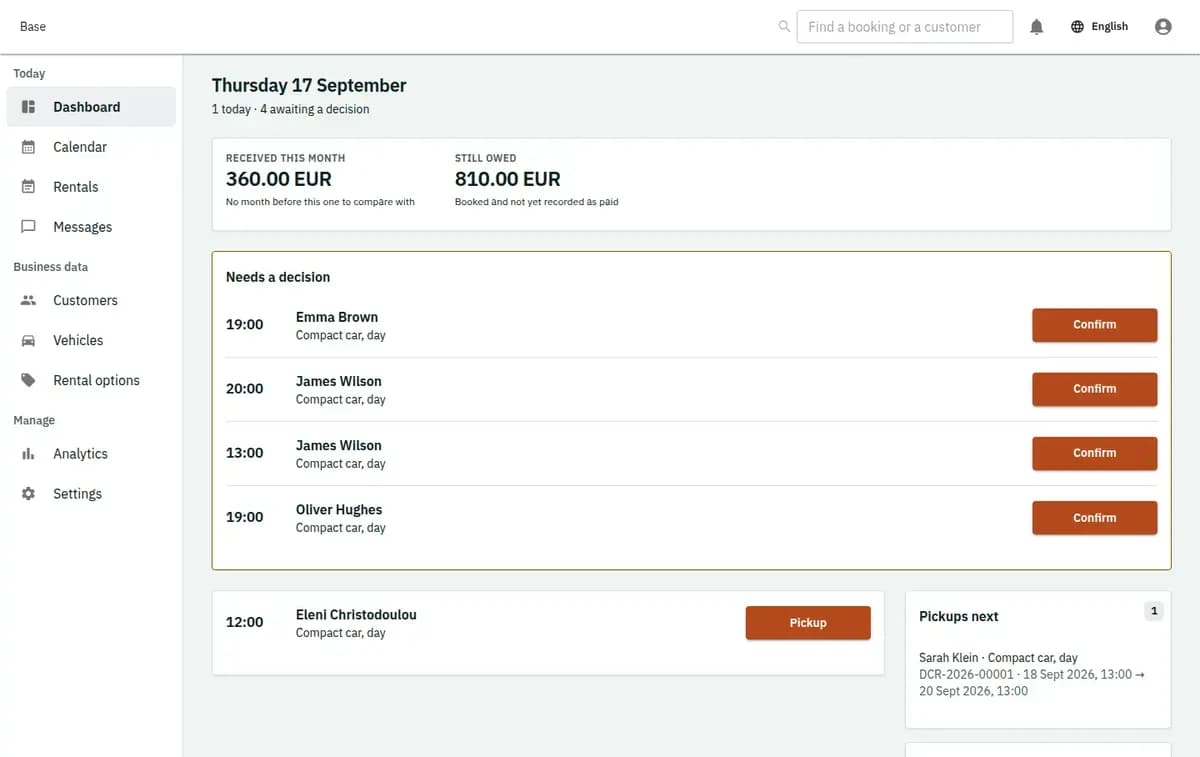
The booking console, with invented records: the day’s requests and money

Evidence, access and limits of car rental management software

Useful records support staff decisions, but they do not replace the business, legal or financial responsibilities of the rental company.

Snapshots preserve what was agreed

Bookings retain the relevant price, rental terms and policy acceptance versions instead of inheriting later edits. Pickup, return, damage and manual money corrections keep actor, time and reason. Uploaded evidence must pass the product attachment controls before it is made available, and access should remain limited to staff who need it.

The operator owns sensitive-data choices

Driver identity and credential evidence should be collected minimally and retained under the tenant’s lawful policy. Base records observed fuel, mileage and damage but never declares liability. The business handles end-customer funds outside Base and remains responsible for agreements, jurisdiction rules, retention and customer communication.

Preparing your fleet in the car rental software

Create or import the real fleet, vehicle-specific details, offerings, rates, mandatory and optional price lines, locations, schedules, turnaround buffers and maintenance blocks. Add reviewed rental, cancellation and privacy policy versions, decide which credentials are required, and configure staff access and reminders. Preview spreadsheet imports before committing them: confirmed rows still pass collision and evidence rules, while invalid rows remain in an error report. Keep the full export as part of the operating process.

What car rental teams should not expect

These boundaries keep the profile useful without turning an operations calendar into an unsupported fleet or finance product.

When a different product is needed

Base is not a consumer rental marketplace, card checkout, fleet-accounting package, workshop ERP or OTA distributor. It does not unlock or track cars, process fines, decide liability, or automate Cyprus legal judgments. End-customer payment takes place outside Base; staff record only the operational money facts that actually occurred.

Money stays with the rental business

There is no card acquiring, checkout or payout flow. Staff may record payment received, refund issued, deposit received, released or withheld after those events happen elsewhere. A withheld deposit needs a reason, and a correction is a void plus replacement, not deletion of history.

Vehicles are not connected devices

The profile offers no telematics, GPS tracking, remote unlock, automatic fuel reading, fine processing or workshop control. Condition and mileage are staff observations. OTA distribution and a consumer marketplace are also outside this profile.

Requests can be refused

No eligible exact vehicle, an overlapping confirmed reservation, stale accepted price, missing policy acceptance or an expired required credential can stop confirmation or start. The failed action leaves the earlier valid record intact, so staff can resolve the issue or transparently decline the booking.

Car rental software questions

Is there a free version for a small Cyprus car hire company?

Yes. As car hire software, Base has a Free plan at €0 with 2 staff accounts and 5 bookable items, so a small fleet can run its reservations without a contract. Larger fleets move to Standard at €19 or Pro at €39 a month per business. Whichever plan you use, this car rental management software takes no commission, and customer payments stay outside Base.

Does a new request immediately block a vehicle?

No. Awaiting-verification and requested bookings remain non-blocking. A vehicle becomes unavailable only after staff confirm one eligible named car and the active reservation is created for its exact blocking period.

Can Base prevent two confirmed rentals for one car?

Yes, the allocation model protects a named vehicle against overlapping active reservations. If concurrent confirmations race for the same period, one succeeds and the other is refused without leaving a partial change.

Can staff record pickup, return and deposit facts?

Staff can record driver verification, fuel, mileage, condition observations, evidence, pickup and return actors and times, plus factual external payment or deposit events. Base does not process the money or automatically decide damage liability.

What happens when a customer asks to extend?

An extension rechecks the selected vehicle’s full availability, the current price version and any required acceptance in one transaction. If the new dates collide, the extension fails and the existing rental remains unchanged.

Can we import an existing rental spreadsheet?

The supported workflow previews customer, vehicle, offering and active or future booking rows before commit. Mappings and collisions are validated; invalid rows stay visible for correction, and imported confirmed bookings cannot bypass normal allocation rules.

Next step

Open a workspace and set up one booking flow

Registration takes an email address. The operating model, services and resources are configured afterwards, in the console.