
Rental management

Boat rental software for named vessels and crew

  • Yacht charter software that books vessel and skipper together
  • The vessel and the person are reserved together
  • Capacity and jackets are checked, not assumed

No card asked for · nothing taken from a booking · your data exports

Operating model
Rental management
What is booked
Item → From / To → Return
Getting started
Vessels, skippers and service blocks to enter first

A boat is not free just because nobody else has booked it. It is free when the vessel, the skipper it legally needs, the berth it leaves from and enough daylight all line up — and when the party fits the capacity written on the certificate rather than the one the customer hoped for. Base confirms those together or not at all, keeps the safety briefing and jacket issue on the same record as fuel and engine hours, and leaves the weather call to the person who has to make it.

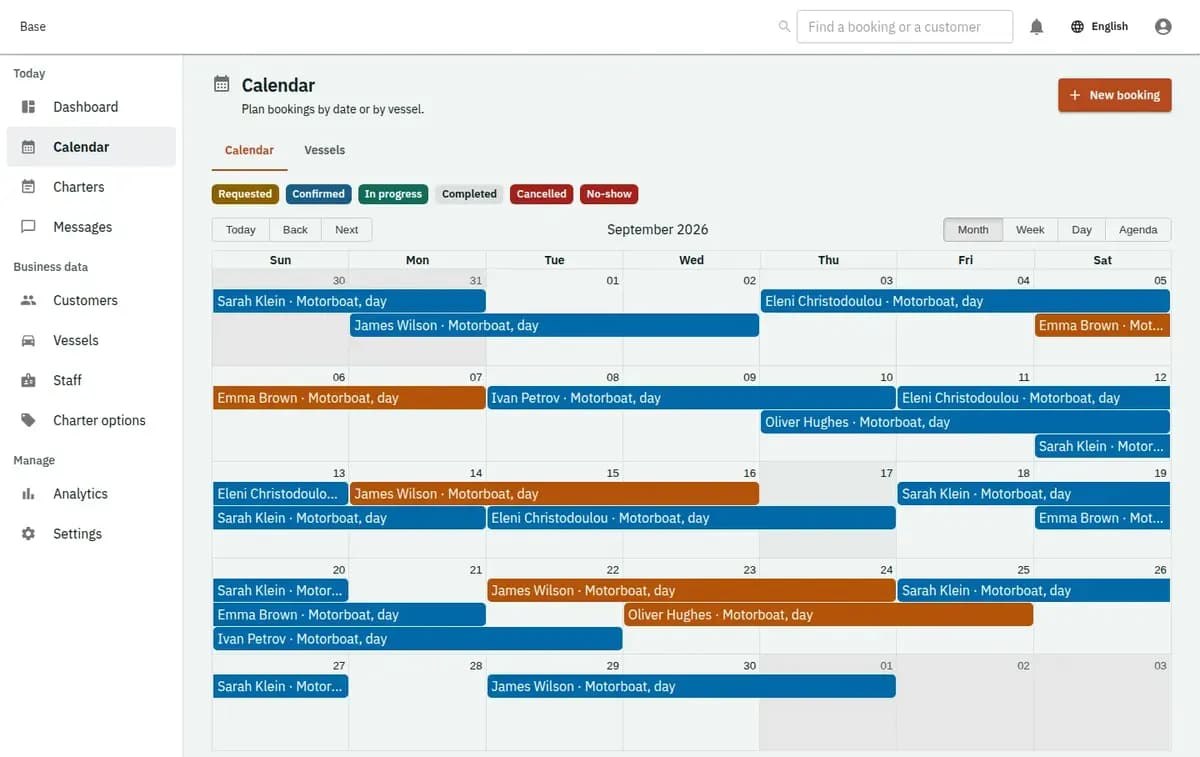
Base calendar showing named vessels with assigned skippers, departure times and return slots
A real console. The records in it are invented.

Who this boat and jet ski rental software fits

It fits an operator with a real quay or beach base: day boats, RIBs, small yachts, jet skis, with or without a skipper. It is useful when a hire depends on more than a hull — a certificated skipper for the vessels that need one, a party that fits the capacity, jackets in children’s sizes, a berth to leave from and a return before dark. It suits an operator that runs several departures a day per hull, refuels between them, and needs the briefing and the fuel and engine-hour readings to sit with the hire rather than on a clipboard that goes home in someone’s bag.

How the boat rental booking system builds a departure

One record carries the hire from the enquiry to the engine-hour reading at return.

  1. 1. Register vessels, crew and the base they leave from

    Each vessel is entered with its capacity, whether it may go out bareboat, what certificate a customer must hold if it can, its turnaround and its own maintenance and haul-out blocks. Skippers and instructors are entered with their working hours and the vessels they may take. Life jackets are counted by size, adult and child. Rates are set per departure, per hour or per day, with the fuel rule and deposit the operator actually applies.

  2. 2. Take the request with the party in it

    The enquiry records how many adults and children, the departure wanted, and whether a skipper is required or the customer intends to take the vessel themselves. Nothing is held yet. Staff can enter a hotel call or a walk-up with the same fields, so a Saturday morning is not quietly consumed by an enquiry that never becomes a hire.

  3. 3. Confirm vessel, skipper and jackets as one action

    Confirmation checks the vessel for the full period including its turnaround, the skipper’s availability and permission for that vessel, the party against capacity, the jacket counts by size, and the certificate reference recorded where the vessel goes out bareboat. If any part fails the hire is not partly confirmed — staff see which one, and swap the vessel, move the time or offer a skippered trip instead.

  4. 4. Brief, fuel and cast off

    At departure staff record the briefing given and who gave it, the jackets issued, fuel level and engine hours, and the condition seen on the walk-around. Where a customer takes the vessel themselves, the certificate staff actually read is recorded as read. The deposit taken outside Base is noted as a fact, and the hire moves to out.

  5. 5. Close on return, or record the day that did not happen

    Return captures the time, fuel, engine hours, jackets back, and any damage against the condition noted at departure, then releases the vessel after its turnaround. A cancellation for weather is recorded as an operator decision with a reason and a person attached, not as something the system worked out. Refunds and deposit outcomes are entered as facts after the operator has handled them.

What a quay loses track of between departures

Three constraints decide whether a departure happens, and none of them is visible in an ordinary calendar.

A hull without its skipper is not a hire

Some vessels can go out bareboat to a customer who holds the right certificate; others may not leave without a skipper on board. Base treats the skipper as a resource of the same weight as the vessel: confirmation checks both for the whole period, including the time before and after a trip that the skipper is not available for another one. A boat with nobody licensed to take it is not availability, and the calendar should not draw it as though it were.
Capacity is a number on a certificate, not a preference

A party of nine on an eight-person vessel is not a rounding question. The party size is entered with the request and checked against the vessel’s stated capacity at confirmation, so it is refused at the point where an alternative can still be offered rather than at the pontoon with the family already there. Life jackets, including child sizes, are counted stock issued against the hire, which is where a party of two adults and three children usually meets its real limit.

The last departure of the day is not like the others

A four-hour hire leaving at four in the afternoon is a different promise from the same hire leaving at ten. Departures are configured against the operating window and the turnaround the vessel needs — refuel, rinse, the walk-around, the briefing for the next party — so the day cannot be sold past the point where the boat comes back in the dark. A late return shows against the next departure while there is still time to move it.

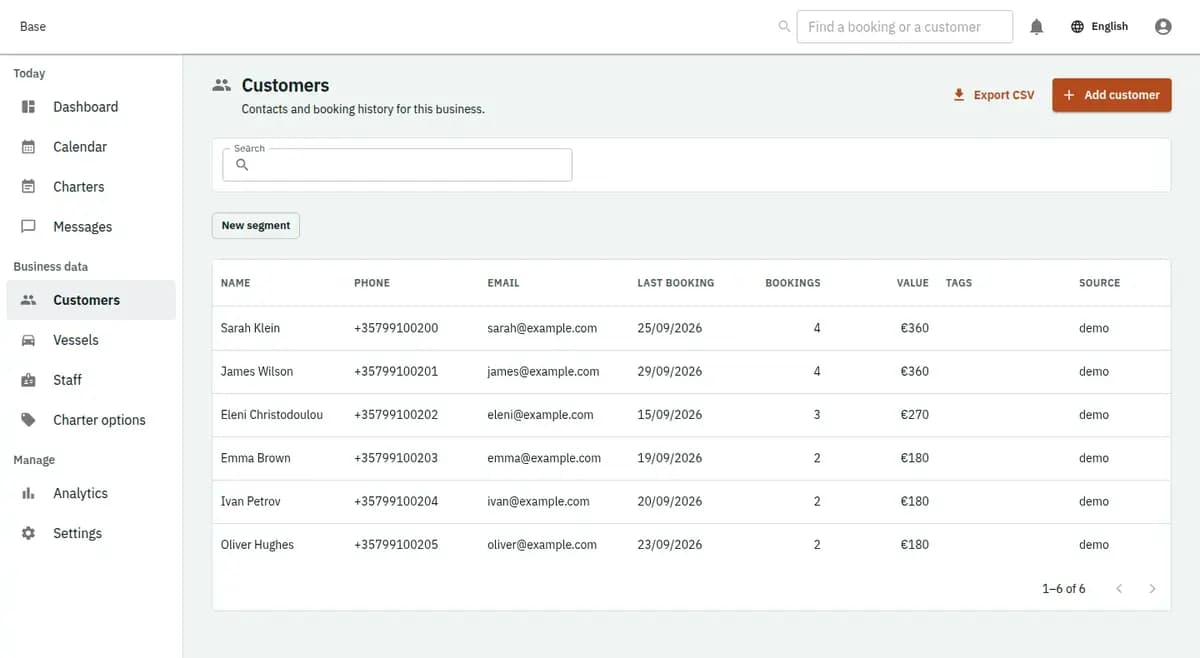
The booking console, with invented records: the customer list

Yacht charter software that books vessel and skipper together

The allocation rule is what separates this profile from a hire point where only the machine matters.

The vessel and the person are reserved together

Confirmation reserves the hull and every crew member the departure requires in one transaction, for the full period plus the vessel’s turnaround. Two staff members cannot both succeed in giving the same skipper two boats at eleven, and a hull cannot be confirmed for a bareboat hire when the recorded certificate does not cover it. The refusal is complete: nothing half-written, no skipper left assigned to a hire that failed.

Capacity and jackets are checked, not assumed

The party size is compared with the vessel’s certified capacity, and jackets are drawn from counted stock by size for the departure. An operator with two child jackets can take one family that afternoon, and the second family is refused while there is still time to say so. These are configured limits, checked mechanically; the judgement about conditions, competence and whether a particular party should go out remains the operator’s.

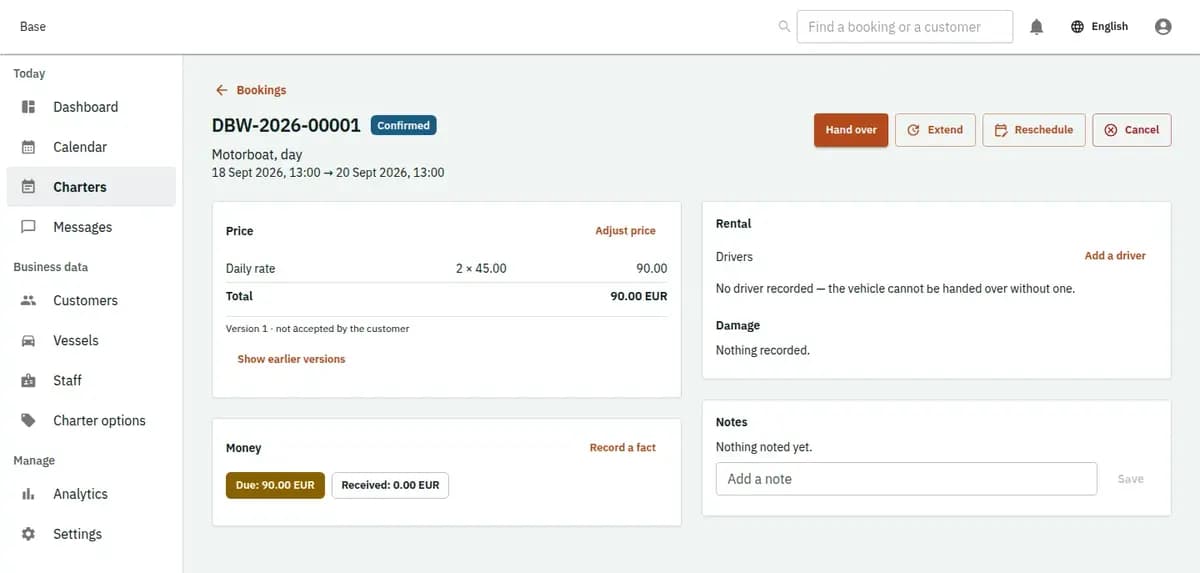
The booking console, with invented records: one booking with its price lines and history

Ordinary departures, clashes and wind-cancelled mornings

One ordinary departure, one collision and the case every boat operator has: the morning the wind decides.

A skippered half-day for six

A family requests the morning departure. Staff confirm the RIB, the skipper who may take it, six jackets including two child sizes, and the price and policy as accepted. At the pontoon the briefing, fuel and engine hours go on the record. The boat is back at one, and the turnaround protects the afternoon departure that was booked a week ago.

One skipper, two boats, one eleven o’clock

Two staff members confirm departures that both need the same skipper. The first valid confirmation takes them; the second is refused as a conflict and leaves its request in the queue. Staff can assign the other skipper, move the departure by an hour, or tell the customer honestly that the morning is full — instead of both parties arriving to find one person expected on two boats.

The wind gets up overnight

The forecast is poor and the operator decides not to sail. That decision is recorded against the affected hires by the person who made it, with a reason, and the vessels are released. Base does not read a forecast, does not cancel anything by itself and does not refund anybody: it makes the operator’s decision visible to every staff member at once, so nobody sends a party to the quay while the office is phoning them.

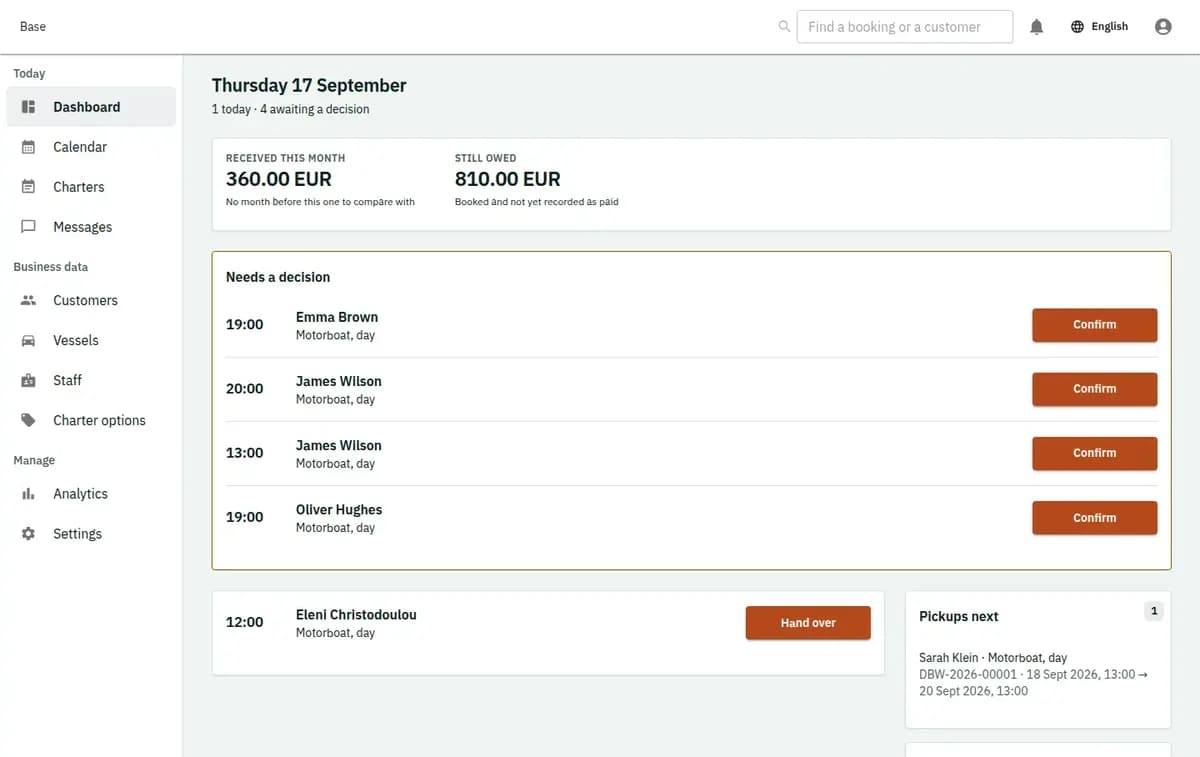
The booking console, with invented records: the day’s requests and money

Records that settle damage and cancellation disputes

Boat hires produce two arguments — damage and a cancelled day. Both are easier when what happened was written down at the time.

The briefing and the check are facts with a name on them

The record holds who gave the safety briefing and when, which jackets went out, and the certificate reference staff read for a bareboat hire. It does not validate that certificate against any register, does not store the document unless the operator has decided to, and does not assert that the party was competent. It records that the check was made, by whom, at what time — which is the part a clipboard usually loses.

Fuel and engine hours are readings, not a bill

The readings at departure and at return sit on the same record with the person who took them. Base does not calculate a fuel charge, does not price damage and does not touch the deposit. The operator applies its own rule and records the outcome as a fact. A later correction adds to the history instead of overwriting it, so the sequence still makes sense when someone disputes it in October.

Vessels, skippers and service blocks to enter first

Enter each vessel with its certified capacity, whether it may go out bareboat and what the customer must hold if so, its turnaround and its haul-out and service blocks. Add skippers and instructors with real working hours and the vessels each may take. Count life jackets by size, adults and children separately. Set the operating window so the last departure returns in daylight, and define the fuel rule, deposit and cancellation policy you will actually apply — including who decides a weather cancellation and how customers are told. Import the season’s existing bookings before going live: the rows that fail are the ones already double-promised.

What this boat rental software does not do

Everything below is deliberately absent, because each one needs a different system and a different kind of responsibility.

When a different product is needed

Base is not a marina management system, a navigation or chartplotter tool, an AIS or tracking service, a maritime compliance package or a weather service. It does not file with a port authority, does not maintain a vessel’s certification, does not plan a passage and does not decide whether it is safe to sail. Charter money is handled by the operator outside Base; the record keeps only what actually happened.

No weather automation

Base does not fetch a forecast, does not cancel a departure from a wind reading and does not advise on conditions. The operator decides, and the system records that decision with its author, its time and its reason so the whole team is working from the same answer.

No maritime compliance, no marina operations

Vessel certification, insurance, port dues, berth allocation beyond the base you configure, crew licensing and any reporting duty stay with the operator and its own records. Base checks the fields you have entered; it does not know whether a certificate is genuine, current or sufficient for the waters you are in.

A refusal is a valid result

An overlapping hire, a vessel still in turnaround, a maintenance block, no available skipper, a party over capacity, a missing jacket size or an unrecorded certificate stops confirmation or departure. The last valid state is untouched, the reason is in words, and staff can offer another vessel, another time or an honest no.

Boat rental questions

Do you take a percentage of each boat hire or charter?

No. Base charges a flat plan per business — Free at €0, Standard at €19 or Pro at €39 a month — and no commission on hires. Charter money is handled by you outside Base, and the record keeps only what actually happened. The same terms apply whether you use it as a boat rental booking system for day boats and RIBs or as jet ski rental software.

Can a hire require a skipper and refuse to confirm without one?

Yes. A vessel can be marked as not available bareboat, and confirmation then needs an available skipper who is permitted to take that vessel. Both are reserved in the same action, so a boat is never promised with nobody licensed to take it out.

What happens when the party is larger than the boat allows?

The party size is checked against the vessel’s certified capacity at confirmation and the hire is refused, with the reason visible while staff can still offer a larger vessel or a second departure. It is not a warning that can be clicked past.

Does Base cancel departures when the forecast is bad?

No. Weather is the operator’s decision. Base records that decision against the affected hires with the person, the time and the reason, and releases the vessels — so the whole team sees the same answer at once.

Are jet skis handled the same way as boats?

Yes, as named units with their own turnaround, capacity and jacket requirement. What differs is what you configure: shorter slots, tighter turnarounds and a briefing that is usually per departure rather than per party.

Can the same skipper be booked for two boats at once?

No. The skipper is a reserved resource for the whole departure plus the vessel’s turnaround. A second confirmation for an overlapping departure is refused outright rather than creating a conflict somebody discovers on the quay.

Does the record prove a customer was qualified?

No. It records that staff read a certificate reference and when, which is an operational fact. Verifying a certificate against a register, deciding whether it is sufficient and judging whether a party should go out remain the operator’s responsibility.

Next step

Open a workspace and set up one booking flow

Registration takes an email address. The operating model, services and resources are configured afterwards, in the console.