Field service scheduling

Cleaning business software for teams and recurring visits

  • From quote to job to visit with crews
  • A crew is reserved as one promise
  • Recurring schedules remain finite and versioned

No card asked for · nothing taken from a booking · your data exports

Operating model
Field service scheduling
What is booked
Service → Address → Team
Getting started
What to prepare in cleaning scheduling software

Base helps residential and commercial cleaning businesses qualify a site, agree the scope, obtain acceptance for a quote, create the job and schedule the right crew. A visit reserves all required team members and named resources together. Requests outside the service area stay requests, while an unavailable team leaves the visit unscheduled. Completion evidence and approved return work remain connected to the accepted scope.

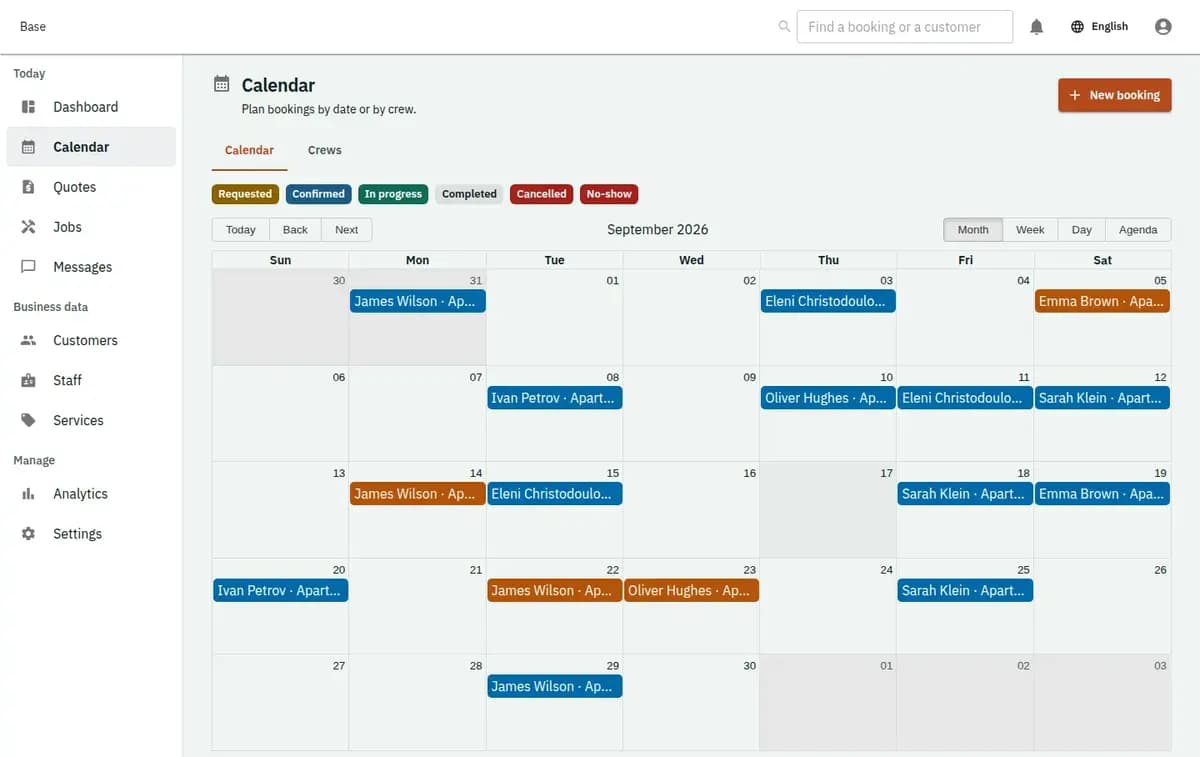
Base cleaning dispatch calendar showing sites accepted quotes crews visits and completion evidence
A real console. The records in it are invented.

Cleaning company software for homes, villas and offices

The profile fits a small residential, villa, holiday-property, office or commercial cleaner that qualifies address and scope before committing a team. It supports service sites, versioned quotes, accepted jobs, one or repeated visits, finite visit plans, composite crew assignment, arrival and completion evidence, approved scope changes and return visits.

How a cleaning request becomes scheduled work

Quote, job and visit preserve the commercial decision and the field execution separately.

  1. 1. Qualify the site and scope

    Staff record the customer site, check the service area and describe the approved rooms, area, frequency, extras and access needs. Restricted keys or access codes require appropriate protection and purpose-limited retention.

  2. 2. Version the quote and obtain acceptance

    The estimator prepares labelled labour, area, room, extra, mandatory-fee and discount lines. The customer accepts a specific version. Until acceptance, the request cannot become authorised work, and a revised amount does not overwrite the earlier quote.

  3. 3. Create the job and visit plan

    The accepted quote creates a job. One-off work receives its required visit; recurring work receives a versioned finite plan and generated future visits only through the configured horizon. Each occurrence remains individually reviewable.

  4. 4. Schedule the complete crew

    Dispatch selects staff with the required skills and checks working hours, travel and turnover buffers plus any named vehicle or equipment. All required people and resources are reserved in one action. A collision leaves the visit unscheduled.

  5. 5. Arrive, complete and preserve follow-up

    The assigned crew records arrival, the approved checklist and required completion evidence. A failed required upload cannot mark the visit complete. Approved scope changes or return work create linked records, so history is preserved instead of rewriting the original visit.

Where cleaning work breaks between quote and visit

The workflow keeps the approved site and scope attached to every scheduled visit.

An address is promised before service-area review

A postcode or map pin alone does not approve travel. Staff qualify the site against the business’s service zones and operating decision. An outside-area request remains visible for follow-up but cannot silently become a scheduled job.

The crew sees a different scope from the customer

Room, area, frequency, selected extras, access instructions and mandatory lines belong to a versioned quote. Acceptance fixes the working scope. A later change becomes an approved change order rather than an edited message that the assigned team never sees.

Recurring work creates an endless vague calendar

A repeated agreement produces a finite horizon of actual visits from a versioned plan. Each visit has its own crew, schedule and state. Conflicts are reported instead of being skipped inside an infinite recurrence.

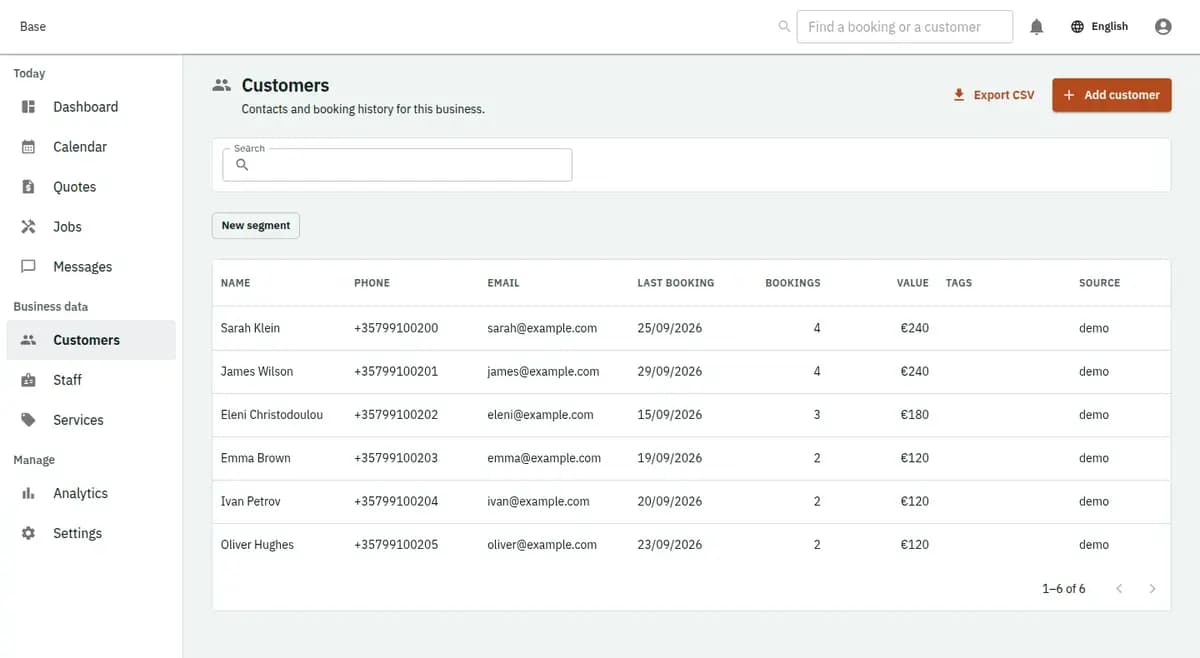
The booking console, with invented records: the customer list

From quote to job to visit with crews

The job owns the accepted scope; each visit owns a real field assignment.

A crew is reserved as one promise

Every required staff member and named vehicle or equipment must be available with working and travel buffers. Reservation happens in one transaction. If one member conflicts, nobody is partly assigned and the visit stays in the dispatch queue.

Recurring schedules remain finite and versioned

A repeated cleaning plan generates only a bounded horizon of visits. Changing frequency or scope creates a new version for future work without rewriting completed occurrences. Staff can see exceptions and unassigned dates explicitly.

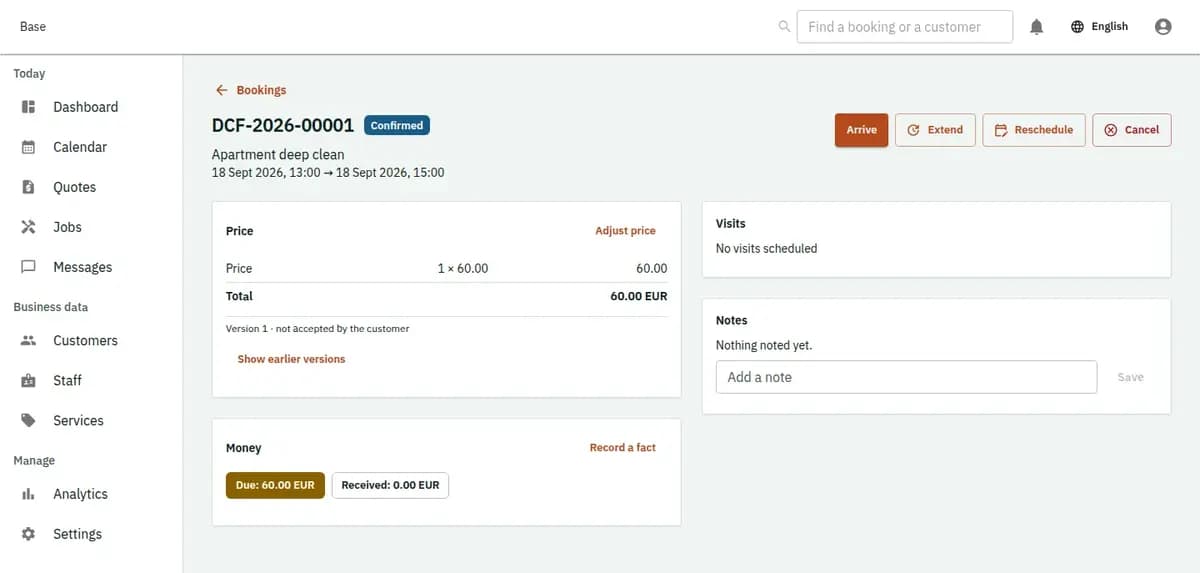
The booking console, with invented records: one booking with its price lines and history

A normal visit and two refusal paths

A normal visit and two refusal paths show how the accepted scope remains protected.

A villa receives a weekly cleaning plan

Staff qualify the address, define the rooms and extras, issue a quote and record acceptance. The job generates a finite set of future visits. Dispatch assigns the complete crew, and each visit records arrival and evidence against the approved scope.

The request lies outside the service area

A customer submits an address beyond the company’s active zone. Base keeps the record as a request and refuses automatic job or visit creation. An authorised person may decline it or make a separate reviewed business decision.

One required team member is unavailable

The quote is accepted, but a required cleaner is already assigned during the travel buffer. Composite reservation fails and the visit remains unscheduled. Dispatch can choose a fully eligible team or another time without leaving a partial crew promise.

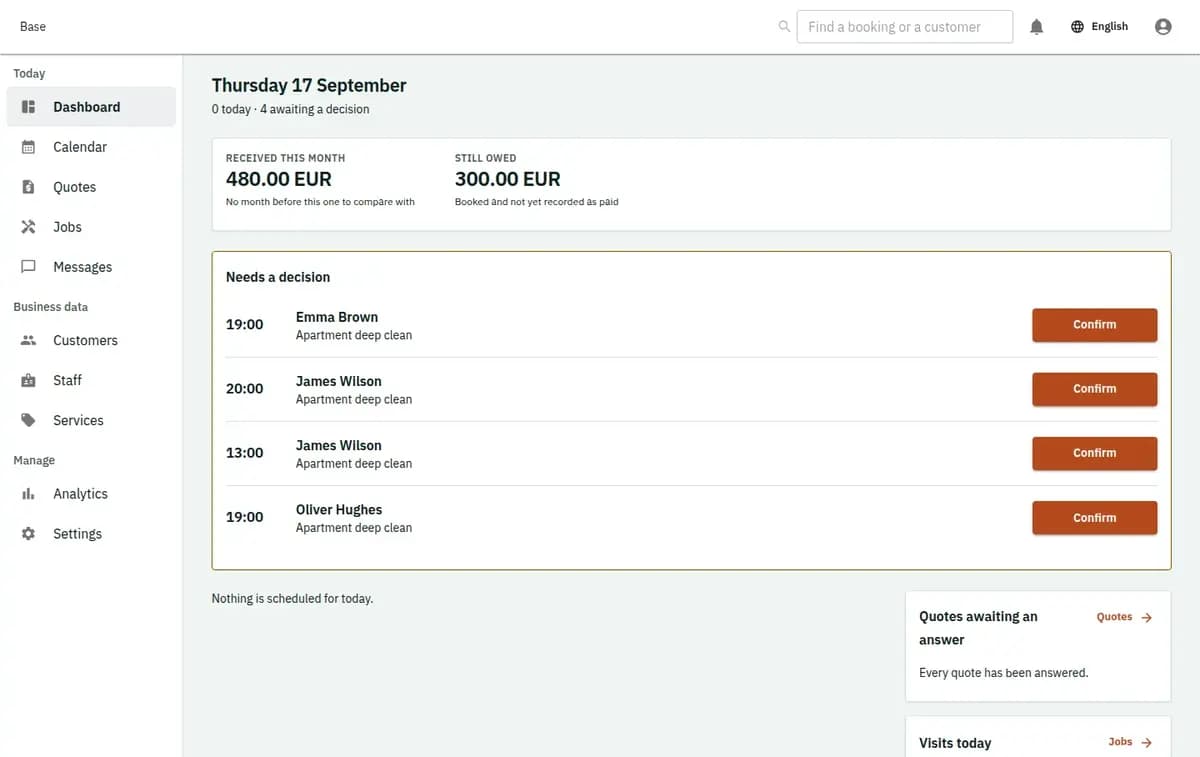
The booking console, with invented records: the day’s requests and money

Completion evidence with privacy boundaries

Field records support customer communication while keeping access data and staff decisions appropriately controlled.

Quote and visit history remains attributable

Every quote version, acceptance, crew assignment, arrival, completion, change order and return visit keeps its actor and time. A later scope change does not alter what the original crew was asked to do or what evidence they supplied.

Site access data needs strict handling

Addresses are collected for service delivery. Keys and access codes must be restricted, protected and deleted under purpose-based retention. Crew views should expose only their assigned visits and the operational minimum, not every customer record.

What to prepare in cleaning scheduling software

Define active service zones, cleaning services, scope templates, durations, price lines and reviewed access, cancellation, privacy and completion policies. Add staff skills, working hours, teams, vehicles or equipment only where they constrain delivery, plus realistic travel and turnover buffers. Configure quote approval, dispatch and crew permissions. Set a finite recurring generation horizon and required evidence rules, then validate imported sites, accepted quotes and future visits for missing scope or collisions.

Limits of this cleaning business software

The profile coordinates quoted field work without implying a marketplace or automatic dispatch intelligence.

Business systems outside the cleaning profile

Base is not a cleaning marketplace, payroll engine, route optimiser or chemical inventory. A site is the customer’s location, not a schedulable resource. The system does not accept out-of-area work automatically, and customer payment takes place outside Base.

No marketplace, payroll or route optimisation

Base does not generate leads, rank providers, pay crews, optimise routes or manage chemical inventory. Dispatch remains a staff decision based on released service zones, skills, schedules and buffers.

No customer payment processing

Immutable quote lines and external received, refund or deposit facts can be retained, but customer funds move outside Base. The product does not run checkout, payroll, bank reconciliation or settlement.

Unqualified or unscheduled work does not proceed

An out-of-area request stays a request, an unaccepted quote cannot create authorised work, and a crew conflict leaves the visit unscheduled. Required evidence failure also prevents completion. Each refusal preserves the last valid state.

Cleaning business questions

What does Base cost for a small cleaning company?

Base cleaning company software has a Free plan at €0 covering 2 staff accounts and 5 bookable items. Standard is €19 and Pro €39 a month per business, with no commission on jobs. As cleaning scheduling software it syncs both ways with Google and Microsoft calendars and sends notifications by email or Telegram, while customers pay you directly outside Base.

Can Base reject an out-of-area request?

It keeps the enquiry visible but does not automatically create a job or visit outside the active service zone. Authorised staff decide whether to decline or review it separately.

Does a quote need customer acceptance?

Yes. A job is created from a specific accepted quote version. Revised scope or price requires a visible new version or change order rather than a silent edit.

Can the system schedule a multi-person crew?

Yes. All required eligible staff and named resources are reserved together. If any member conflicts, the complete visit remains unscheduled without a partial assignment.

How are recurring cleanings represented?

A versioned plan generates a finite horizon of real visits. Each visit has its own schedule, crew and state, so exceptions remain visible and completed history is not rewritten.

Does Base process cleaning payments?

No. Customer money and refunds remain outside Base. Accepted quote lines and factual external money events may be retained for operations.

Next step

Open a workspace and set up one booking flow

Registration takes an email address. The operating model, services and resources are configured afterwards, in the console.