Booking deposits, extras and payment records kept on the booking

A price is a promise made at a moment. Change the list in April and the booking taken in March must still say what the customer was told, or every conversation becomes an argument about which version was true. The same goes for the extras that were promised and the deposit that was taken: they are part of what was agreed, and they belong on the booking rather than in somebody’s recollection of it.

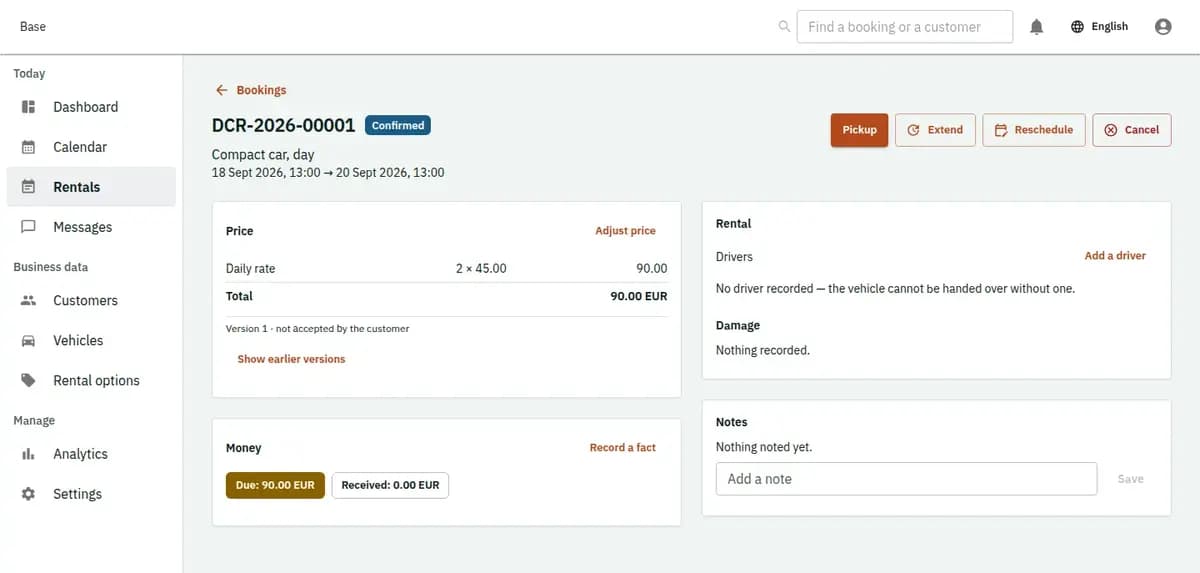
The booking console, with invented records — Pricing, extras and deposits
A real console. The records in it are invented.

A price quoted from memory and a price on the invoice are two different numbers, and the difference is discovered at the counter.

What is included

  • The whole price before confirmation, line by line
  • Extras chosen by the customer, priced in the same total
  • Deposits held as a requirement, never counted as revenue
  • Tiers, seasons and paid options as lines in the same snapshot
  • The snapshot is kept: what was agreed stays what was agreed
  • Consistent quotes
  • Optional extras
  • Explicit deposit handling

Prices, extras and deposits on every booking

The commercial shape of a booking: what it costs by duration or period, what can be added to it, and what you take up front. It fits hourly, daily and weekly rates, per-night pricing, per-person prices for sessions and departures, seasonal differences, and the extras a business actually carries — helmets, seats, cots, equipment, transfers.

What it is not

It is not a payment system, a card processor, an invoicing tool or an accounting package. Base does not charge, does not refund, does not hold funds and does not calculate tax for you. The customer pays the business the way they always have; what is here is the record of what was agreed.

Where money quietly gets confused

Three ordinary situations that turn into disputes because the figure moved after the fact.

The price list changed after the booking

Rates go up in June, and a booking taken in March is suddenly quoted differently at the counter. Whatever the outcome, the business looks careless. The agreed figure has to be frozen on the booking when it is confirmed, no matter what the catalogue does later.

Extras are promised and then not there

Two helmets, a child seat, a cot: these are countable things, not checkboxes. When they are not treated as stock, they are promised to three bookings at once and the third customer is disappointed on the busiest morning of the season.

Nobody knows whether a deposit was taken

A deposit taken in cash on Saturday, remembered on Monday, disputed on Friday. Recording that it happened — the amount, the time, the person — costs seconds and settles the whole conversation, even though the money itself never touched the platform.

Setting rates, extras and the booking deposit

Four steps, and the fourth is the one that keeps you honest.

1. Price the periods you actually sell

An hour, a day, three days, a week, a night, a place on a departure. Include the seasons where price genuinely differs rather than inventing tiers you will never explain to a customer.

2. Enter extras as things you can run out of

Each extra is counted, by size where size matters, held for the period of the booking and released when it comes back. That is what makes “yes, we have a child seat” a fact rather than a hope.

3. Say what you take up front

Deposit, prepayment or nothing: whichever it is, write the rule where the customer accepts it and where your staff can read it at the counter without asking somebody.

4. Freeze what was agreed on the booking

When the booking is confirmed, its price lines, extras and rules are what was agreed at that moment. Later changes to the catalogue do not rewrite history, which is the difference between a record and a rumour.

Rental deposit tracking as a recorded event

Three guarantees, and all three of them are about the past staying still.

The agreed figure does not move

The price on a confirmed booking is the one the customer was told. A new season or a corrected rate applies to new bookings, and the old one keeps what it promised.

Extras cannot be oversold

Countable stock is held for the same period as the booking, so a busy Saturday runs out of helmets in the calendar rather than at the counter, with a refusal that names what was missing.

The deposit is a recorded event

Taken, when, by whom, and returned if it was. No money passes through Base, and the record is what makes the conversation about it short.

A season change and the last small helmet

A summer price list, and a Saturday that ran out of helmets.

A booking made before the season changed

A customer booked in March at the winter rate and arrives in July. The booking shows what was agreed and the desk honours it without a search through emails. Whether you also want to explain the new rate is a choice, not a scramble.

The last small helmet

Three bookings want small helmets on the same morning and there are two. The third is refused at the point of booking, with the reason, and the customer is offered another time or another item — instead of arriving to find out.

Payments and invoices stay outside the calendar

Money has its own systems and its own obligations, and mixing them into a booking record helps nobody.

No payment handling

Base does not take cards, does not hold funds, does not refund and does not settle. What it holds is what was agreed and what your staff recorded as having happened.

No invoicing or tax

Invoices, receipts, VAT and whatever your accountant requires belong to the systems built for them. The booking is an input to that work, not a replacement for it.

Writing rates for the periods you sell

Write your rates for the periods you genuinely sell, and be honest about seasons rather than inventing them. Count your extras — the actual number of helmets in the actual sizes — because the value here comes from the number being right. Decide your deposit rule and your cancellation rule and write both in the words you would say to a customer. Decide who is allowed to change a price on a confirmed booking, because that is the permission that matters most. Then take five recent bookings and check that the figures on them are what the customers were actually told.

Not a payment processor or accounting tool

It records the commercial agreement. Collecting on it is your business.
Not a payment processor

No cards, no wallets, no gateways, no refunds. If somebody tells you otherwise, they are describing a different product.

Not dynamic pricing

Nothing raises your prices because demand looks strong or discounts them because the week is quiet. Prices change when you change them.

Not accounting

Ledgers, invoices, tax returns and reconciliation stay where they are. Exported bookings are the input; the accounting is done by people and tools qualified for it.

Pricing questions

How do I keep track of a deposit I took outside Base?

Record it on the booking. Base does not take or hold money, so a booking deposit is entered as a fact: the amount, when it was taken, who took it and whether it was returned. For rental deposit tracking the same record stays on the hire until the item comes back. You take the money the way you already do, and the booking shows what was agreed if anyone asks later.

What happens to old bookings when I change prices?

They keep what was agreed. A new rate applies to new bookings, so a customer is never quoted one figure and charged another.

Are extras limited by stock?

Yes. They are counted, by size where it matters, and held for the period of the booking, so they cannot be promised to two customers at once.

Does Base take deposits?

No. A deposit is recorded as a fact — amount, time, who took it, and whether it was returned. The money moves through your own process.

Can prices differ by season?

Yes, along with different rates for hours, days, weeks or nights, so the price list matches the way you actually sell.

Can it produce invoices?

No. Bookings can be exported for whatever you use for invoicing and accounting, which is where that work belongs.

Next step

Open a workspace and set up one booking flow

Registration takes an email address. The operating model, services and resources are configured afterwards, in the console.