Rental handover and return that leave both sides with the same record

Every rental business has the same bad afternoon: an item comes back with a mark on it and nobody can say whether it was there before. The fix is not a longer contract, it is a habit — a short, identical check at the moment the thing leaves and again when it comes back, recorded where both the desk and the next shift can see it. Base gives that habit somewhere to live.

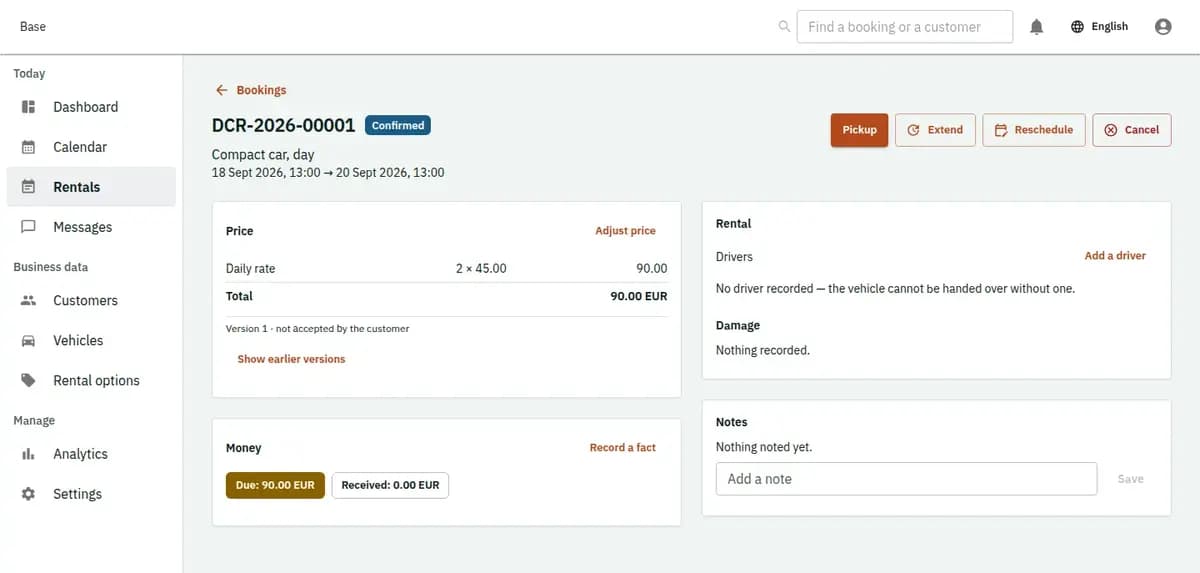
The booking console, with invented records — Rental pickup and return
A real console. The records in it are invented.

The car goes out, the car comes back, and the argument about the scratch happens six days later with nothing written down.

What is included

  • A handover with mileage, fuel and condition
  • Photographs kept with the rental, not in someone's phone
  • Return recorded against the same checklist
  • Damage written down when it is found
  • Extending a live rental without a second booking
  • Clear handover checklist
  • Condition evidence
  • Visible return status

Handover checks for vehicles, bikes and equipment

The two moments where a rental is won or lost: giving the item out and taking it back. It fits vehicles with fuel and mileage, bikes and boards with condition, tools and cameras with cases and cables, and boats with everything at once. It matters most where the same unit goes out several times a day and where the person handing it over is not the person who took the booking.

What it is not

It is not an inspection standard, a damage-assessment method or a legal opinion. It does not decide who is at fault, does not calculate a repair cost, does not charge a card and does not replace your rental agreement. It records what your staff saw, when, and who saw it.

Why the return goes wrong

Three reasons a handover that felt fine becomes a disagreement a week later.

Nobody wrote down what was already wrong

The scratch on the left panel, the missing cable, the tyre that was already low. Without a record from the moment it left, the business is arguing from memory against a customer who is certain, and the business usually pays.

Fuel and mileage are remembered differently

Half a tank means one thing to the person who filled it and another to the person who returned it. Numbers written at both ends turn a dispute into arithmetic, and arithmetic ends conversations quickly.

What left with the item is forgotten

Two helmets, a charger, a child seat, the roof rack. Extras are the things that quietly disappear, because they are the things nobody lists. If they are recorded at handover, their absence at return is a fact rather than a suspicion.

Rental check in check out, step by step

Four steps that take three minutes and save the afternoon they would otherwise cost.

1. Prepare the unit before it goes out

The preparation time between hires is part of the booking, and the check that ends it is what makes the handover honest. An item that is not ready is not handed over just because the calendar says two o’clock.

2. Record what leaves

Condition and any existing damage, fuel or charge, mileage or hours, the extras that go with it, and who checked. Photographs where they help. It is the same short list every time, which is what makes it get done.

3. Take it back with the same fields

The return repeats the check and records what changed. The difference between the two is visible immediately, in front of the customer, rather than being discovered after they have gone.

4. Close the rental with a result

Returned on time, returned late, damage noted, extras missing. The deposit is recorded as a fact — taken, when, by whom, returned or not — and the money itself moves the way your business already moves it.

What the vehicle inspection app records at both ends

Three practical things, none of which require anybody to trust anybody else’s memory.

The same fields at both ends

Because the handover and the return capture the same list, the comparison is trivial and cannot be argued into a different shape.

It lives on the booking, not in a folder

Notes and photographs sit with the rental they belong to, so the next person who opens it — a different shift, a week later — sees exactly what happened without asking.

A late return is visible against the next hire

When an item is overdue, the booking waiting for it shows the conflict while there is still time to call both customers instead of after one of them has arrived.

A mark already there and a missing charger

A mark that was already there, and a missing charger.

The mark that was already there

A customer returns a scooter and the desk sees a scrape on the panel. The handover record shows the same scrape photographed that morning, by name and time. The conversation takes twenty seconds and both people leave satisfied — which is not what happens when the answer is “I think it was there”.

The charger that did not come back

The handover lists a charger and the return does not. It is a recorded fact rather than an accusation, the customer checks the car, and it is in the boot. Without the list, the charger disappears and is bought again in March.

What a car rental damage report really proves

A handover record is useful precisely because it is modest about what it proves.

It shows what somebody saw, not who is liable

Photographs and notes with a name and a time are evidence of an observation. Fault, liability, repair costs and insurance are decided outside Base, by people and processes that are qualified to decide them.

Only what the hire needs

Condition, fuel, mileage, extras and short operational notes. Not a document scan you did not need, not a photograph of a customer, not more identity information than your own rules require you to see.

A short check list staff will actually finish

Write the check as a short list your staff will actually complete on a busy Saturday — five fields that always get filled beat fifteen that never do. Decide which items need photographs and which do not. Set the preparation time per unit so the check has room to happen. Agree what counts as a note worth writing: existing damage and missing extras, not opinions about the customer. Write your deposit rule and your late-return rule in the words you will say out loud. Then run one weekend with the check before you make it the standard, and cut whatever nobody used.

No charges, deposits or damage assessment

It captures the moment. Everything that follows from the moment is your decision.
No charges and no deposits held

Base does not take, hold or refund money. The deposit is recorded as an event so the record is complete; the transaction happens in your own process.

No damage assessment

Nothing measures a scratch, prices a repair or decides whether wear is fair. Those are trade judgements, and a booking system pretending otherwise would be worse than useless.

It cannot record what nobody checked

A handover completed in a hurry with empty fields is an empty record. The habit is the feature; the platform only makes the habit cheap.

Handover questions

What should a car rental damage report include?

Base records rental check in check out with the same short list at both ends: condition and existing damage, fuel or charge, mileage, the extras that left with the car, who checked and when, plus photographs where they help. Side by side, the two records are the car rental damage report you point at later. Deciding fault, cost and insurance stays with you.

What is recorded at handover?

Condition and existing damage, fuel or charge, mileage or hours, the extras that leave with the item, who checked and when, plus photographs where they help.

Are the return fields the same?

Yes, deliberately. The same short list at both ends makes the comparison obvious and stops a disagreement turning into two versions of a memory.

Does Base decide who pays for damage?

No. It records what was seen and when. Fault, cost and insurance are decided by you, using that record as evidence rather than as a verdict.

Are deposits handled here?

They are recorded as facts — taken, when, by whom, and returned if they were. No money moves through Base.

What happens if an item comes back late?

The next booking on that unit shows the conflict while there is still time to contact both customers, instead of the problem arriving with the next one at the counter.

Next step

Open a workspace and set up one booking flow

Registration takes an email address. The operating model, services and resources are configured afterwards, in the console.