
Rental management

Beach rental software for sunbeds and watercraft

  • Counted sets, not named sunbeds
  • The count is the reservation
  • All of it or none of it

No card asked for · nothing taken from a booking · your data exports

Operating model
Rental management
What is booked
Item → From / To → Return
Getting started
Beach umbrella booking: what to prepare before the season

Nobody asks for sunbed number 47. They ask for two beds and an umbrella in the front row, from now until four. A beach stand sells a count against a number it is licensed to put on the sand, and most of that count is sold to people already standing in front of the attendant. Base keeps the pre-booked and the walk-up trade in one running total per zone and hour, so the last two beds in the front row are sold once — and the kayak that has not come back yet is not counted as available.

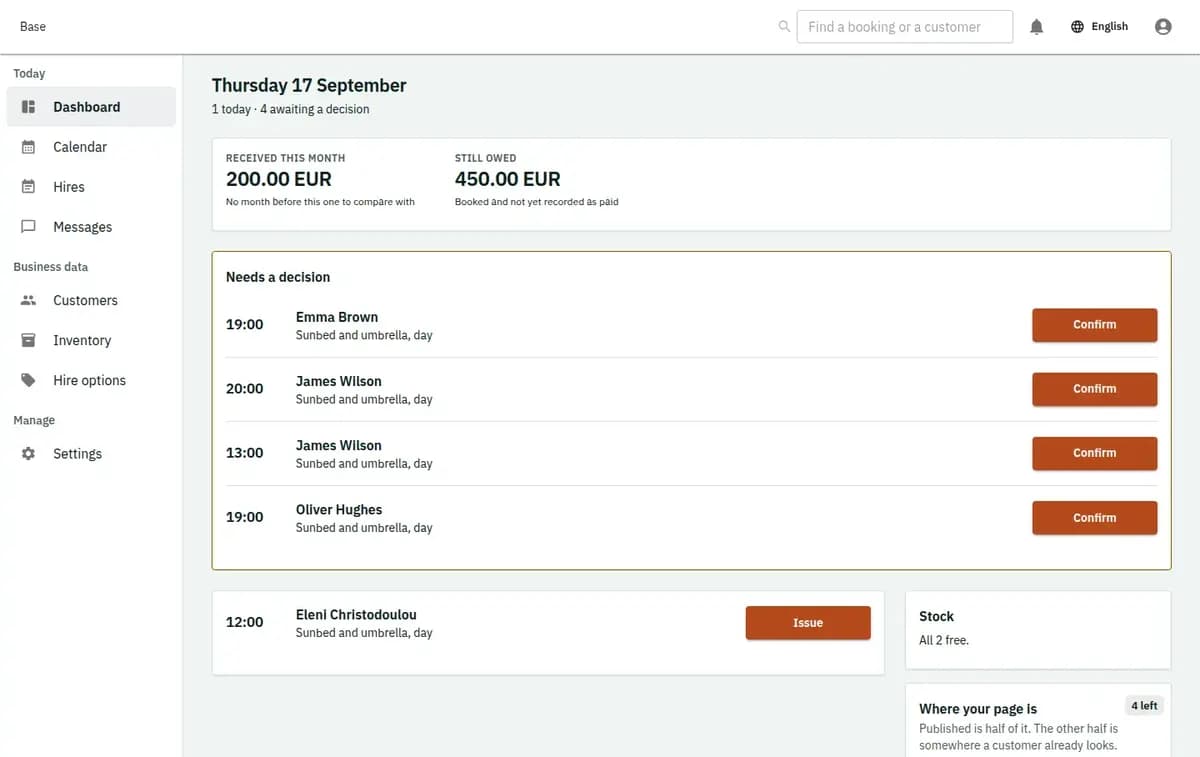
Base view showing sunbed and umbrella counts by beach zone with hourly kayak hires
A real console. The records in it are invented.

Who this beach rental software fits

It fits a licensed beach stand or waterside hire point: sunbeds and umbrellas by the half-day or day, kayaks, paddleboards and pedalos by the hour, sometimes lockers and towels. It is useful when the number of beds on the sand is fixed by a licence rather than by ambition, when the front row and the back row are different products at different prices, when the same attendant is serving a queue and answering the phone, and when equipment goes out for an hour and has to be back before the stand closes.

How a sunbed booking system runs a beach day

The stand works in counts and periods, and the record keeps up with a pace that does not allow typing much.

  1. 1. Enter what the licence actually allows

    Set the real number of sets in each zone — front row, second row, shaded area — and the hourly stock of kayaks, paddleboards, pedalos and anything else that leaves the stand. The number to enter is the number permitted on the sand, not the number in the storeroom. Prices are set per zone and per period, with the half-day and full-day boundaries the stand actually uses.

  2. 2. Publish the periods that are sold

    Beach trade is bought in a few shapes: morning, afternoon, full day, and hours for equipment. Configure those rather than a free-form calendar, so a customer picks something the stand can actually deliver and the attendant is not converting requests into shapes in their head.

  3. 3. Take the booking or serve the queue

    An online request holds nothing until it is confirmed against the count for that zone and period. At the stand, an attendant records a walk-up in a couple of taps and the same count moves. Both paths meet the same limit, which is the only way the number on the screen can be trusted at midday.

  4. 4. Issue and keep the hour

    Equipment going out records the quantity, the time and the return due. Sunbeds are issued as a set for the period. Where a stand takes a deposit or an identity check for a kayak, that is recorded as a fact of what staff did, without holding any document in Base.

  5. 5. Take it back, or record what did not come back

    Return puts the quantity back into the count for the rest of the day and records the time. A missing paddle, a torn seat, an unreturned board or a late return is recorded against the hire with the person who saw it. Refunds and deposit outcomes are entered afterwards as facts; Base does not price a loss and does not decide who owes for it.

What goes wrong on a busy stretch of sand

A beach stand fails in ways a calendar was never designed to show, because what is being sold is a number that changes every few minutes.

The walk-up and the booking share one number

Twenty sets on the sand are twenty, whether they were reserved last night or claimed at eleven this morning. Base holds one count per zone and period, and an attendant selling to the queue draws it down in the same place a website booking does. That is the whole point: the failure this stand knows is two families sent to the same two beds, one holding a phone and one holding a receipt.
The front row is not the same product

A bed by the water and a bed behind the walkway carry different prices and sell out at different times. Zones are separate counts, so «we still have beds» stops being a true sentence that leads to an unhappy customer. When the front row is gone at ten, the stand can say so and sell the second row honestly instead of discovering the mismatch at the sunbed itself.

An hourly hire has to come back

A kayak out at half past three on a stand that closes at six is a different thing from a sunbed for the day. Hourly equipment is counted back in on return, and a piece that has not returned is not available to the next customer just because its hour has ended. The overdue hire is visible while somebody can still walk to the water’s edge and look.

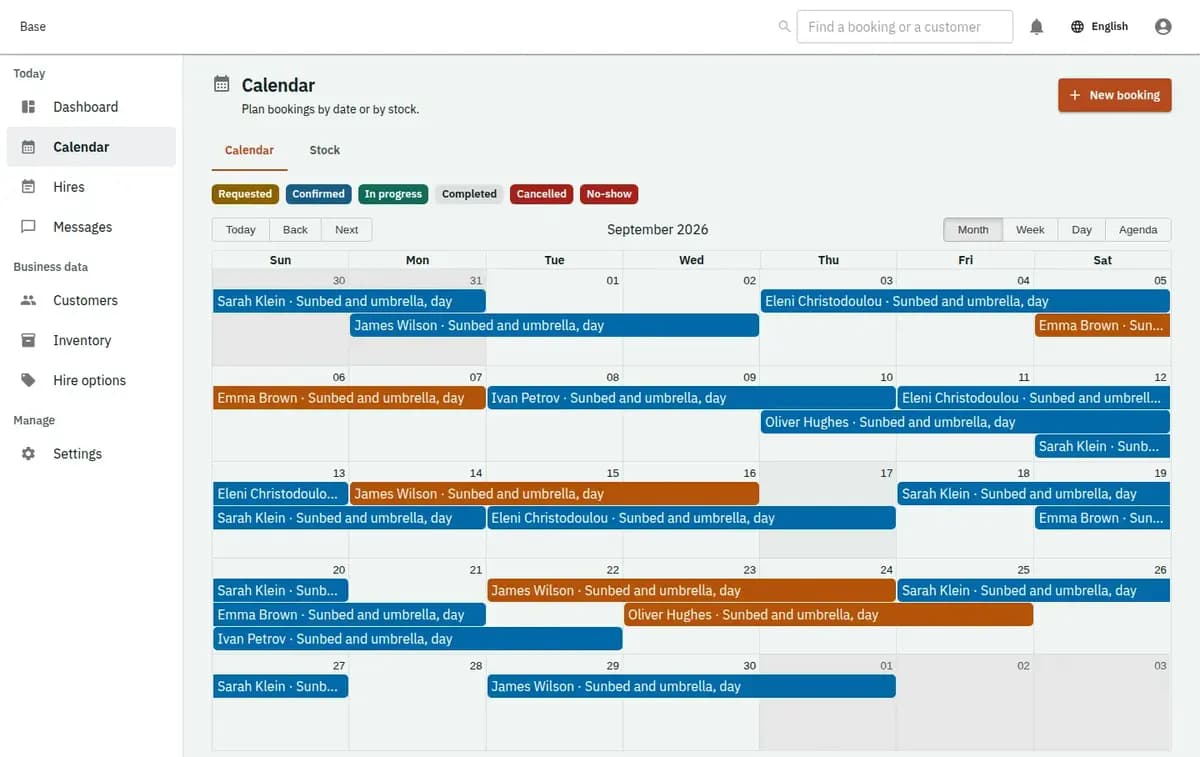
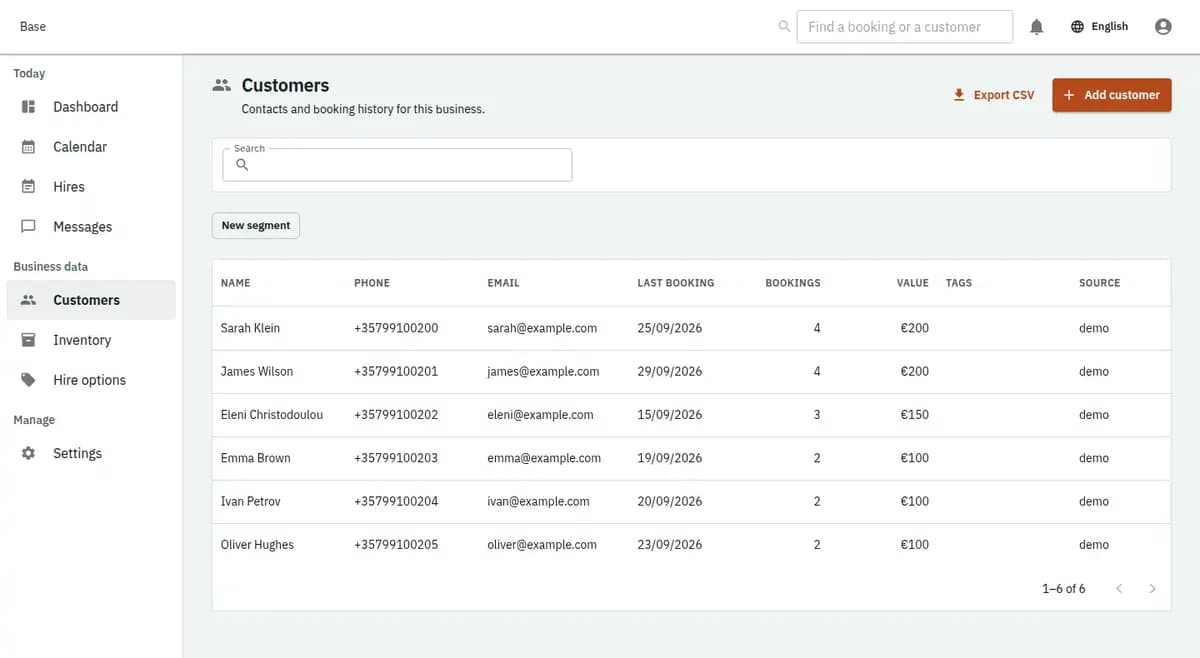
The booking console, with invented records: the customer list

Counted sets, not named sunbeds

This profile deliberately does not name individual objects. What it protects is a count, and that changes what can be promised.

The count is the reservation

A booking for three sets takes three from the zone’s number for the requested period and returns them when it ends or is cancelled. Two confirmations that would together exceed the remaining number cannot both succeed: one takes what is there and the other is refused, with nothing partially reserved. The stand is never told it has beds it has already given away.

All of it or none of it

A party asking for four sets is not quietly served with three. If four cannot be covered for the whole period, the confirmation fails and the attendant offers a different zone, a shorter period or a later start — a decision made in front of the customer rather than discovered when they walk down to find one bed short. The same rule holds for a family taking three kayaks.

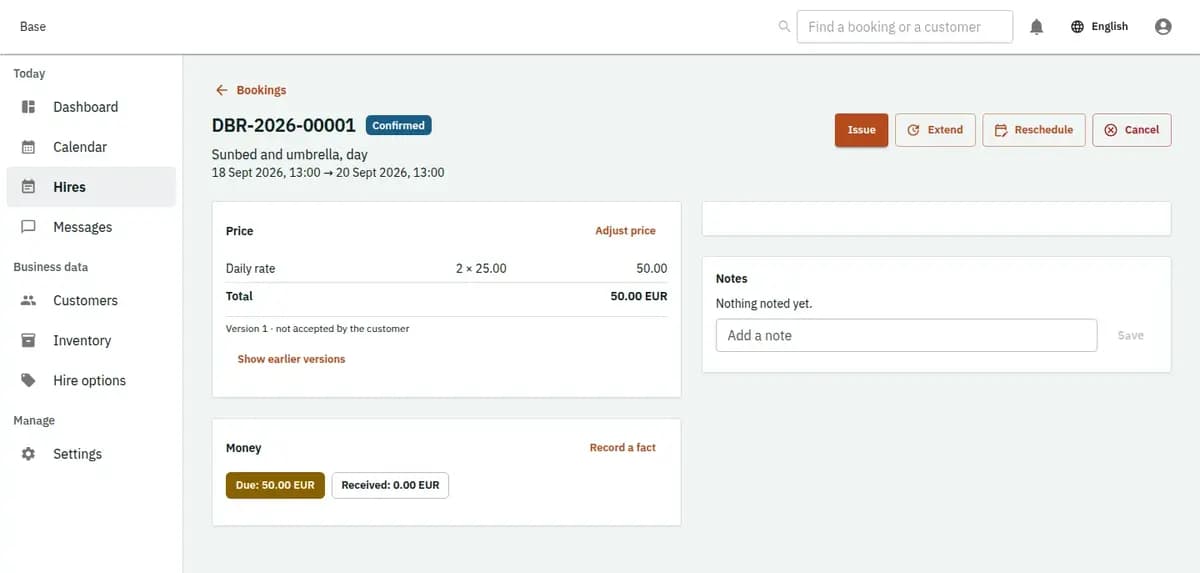
The booking console, with invented records: one booking with its price lines and history

Three moments on a busy August afternoon

The three moments that decide whether the day was calm or spent apologising.

Two beds and an umbrella, front row, now until four

The attendant takes it at the stand in a few taps. The front-row count drops by one set for that period, and the website stops offering it in the same instant. The customer walks to the water, and nobody else is sent to the same place.

The last set goes twice

A booking arrives from a phone while the attendant is confirming the same set for a couple at the stand. One succeeds, the other is refused immediately with the count that is actually left. The attendant offers the second row at its own price while the customers are still there, which is a conversation, not a complaint.

The wind comes up and the umbrellas come down

The stand decides to close the umbrellas and stop the kayaks. That decision is recorded by the person who made it, with a reason, and the affected hires are released so the count is honest for the rest of the day. Base does not read a forecast, does not close anything by itself and does not refund anyone — it makes the decision visible to everyone working the stand at once.

The booking console, with invented records: the day’s requests and money

A record that fits the pace of the work

An attendant with a queue will not fill in a form. What is kept is the little that is worth keeping.

Only what the stand actually needs

A sunbed hire needs a period, a zone, a quantity and a price. A kayak hire needs a name and a contact number so somebody can be called if the board is not back. That is the whole record. Base does not ask for identity documents, does not hold a scan, and does not build a customer profile out of a day at the beach.

Losses are observations with a time on them

An unreturned board, a missing paddle or a damaged seat is written against the hire by the person who saw it, when they saw it. Base does not value the item, does not calculate a charge and does not take money from a deposit. The stand applies its own rule and records the outcome, which is what makes the note useful if the customer comes back the next morning.

Beach umbrella booking: what to prepare before the season

Count the sets your licence permits in each zone and enter that number, not the number in storage. Decide the zones customers actually recognise and price them separately. Set the periods you sell — morning, afternoon, day, and the hourly blocks for equipment — and the time by which hourly equipment must be back. Count kayaks, paddleboards and pedalos as they are today, with anything broken left out. Decide who may release a hire without payment, who records a loss, and what the stand does when the wind gets up. Then let the attendants use it for a week before the beach fills: the count only stays true if the walk-up trade is entered too.

What this profile is not

A beach concession touches several regimes, and only one of them is here.

When a different product is needed

Base is not a beach ticketing or admission system, does not roster lifeguards, does not draw a seating plan of individually numbered beds, does not run a beach bar or kitchen, and does not decide when conditions are unsafe. It is not a marketplace and does not take the customer’s money — the stand does that with its own method and records the fact afterwards.

No numbered seating plan

This is a pooled count, not a map of individually identified beds. If the stand genuinely allocates numbered positions and needs to show a customer their exact place, that is a different model and this profile does not pretend to provide it.

No safety or weather authority

Base does not know the wind speed, does not decide when to bring the umbrellas down, does not roster or replace a lifeguard and does not judge whether a customer should take a kayak out. Those decisions belong to the stand and to whoever holds the licence for the beach; the system records what was decided and by whom.

A refusal is a valid result

A count that is already spent, a period outside the operating window, a zone that is closed or equipment that has not come back stops confirmation. The previous state is untouched, the remaining number is shown plainly, and the attendant offers what is genuinely there.

Beach rental questions

Can guests reserve front-row sunbeds online before they arrive?

Yes. Guests send a request from your booking page in English, Greek or Russian, and it counts against the same zone and hour total as walk-up sales, so the sunbed booking system sells the last front-row beds only once. Kayaks and paddleboards go out by the hour from the same record, so Base also serves as paddle board rental software for the stand.

Do walk-up customers have to be entered?

Yes, if the count is to mean anything. The point of the profile is that the beds sold at the stand and the beds booked online come out of the same number. Entering a walk-up takes a couple of taps; skipping it is what puts two families on the same set.

Can the front row and the back row be priced differently?

Yes. Each zone is its own count with its own prices and periods, so «we still have beds» stays a true statement about a specific zone rather than a promise the stand cannot keep.

What happens if a party wants four sets and three are free?

The confirmation is refused rather than quietly serving three. The attendant sees the number that is actually left and can offer another zone, a later start or a shorter period while the customer is still in front of them.

How are hourly kayaks handled?

As counted stock with a return time. A piece that is overdue stays out of the available count until somebody records it back, so the next customer is not sold a board that is still on the water.

Does Base decide when to close for wind?

No. The stand decides. Base records that decision with the person, the time and the reason, releases the affected hires and shows the same answer to everyone working that day.

Is a deposit taken through Base?

No. The stand takes and returns a deposit its own way. The hire can hold the fact — taken, returned, withheld — with the person and the time, and no card or document details.

Next step

Open a workspace and set up one booking flow

Registration takes an email address. The operating model, services and resources are configured afterwards, in the console.