
Rental management

Scooter rental software for scooters, quads and ATVs hired by plate

  • One plate, one period, one helmet count
  • The machine is named, not counted
  • The kit is counted, not named

No card asked for · nothing taken from a booking · your data exports

Operating model
Rental management
What is booked
Item → From / To → Return
Getting started
What motorbike rental software needs before bookings open

A scooter counter does not rent «a 125». It rents plate MHA 421, which is back at half past four, needs ten minutes of fuel and a wipe before it goes out again, and can only go to a rider whose licence covers it. Base builds availability from those machines rather than from a class name, checks the helmets and kit that leave with each one, and keeps the fuel, mileage and damage seen at issue next to what is seen at return.

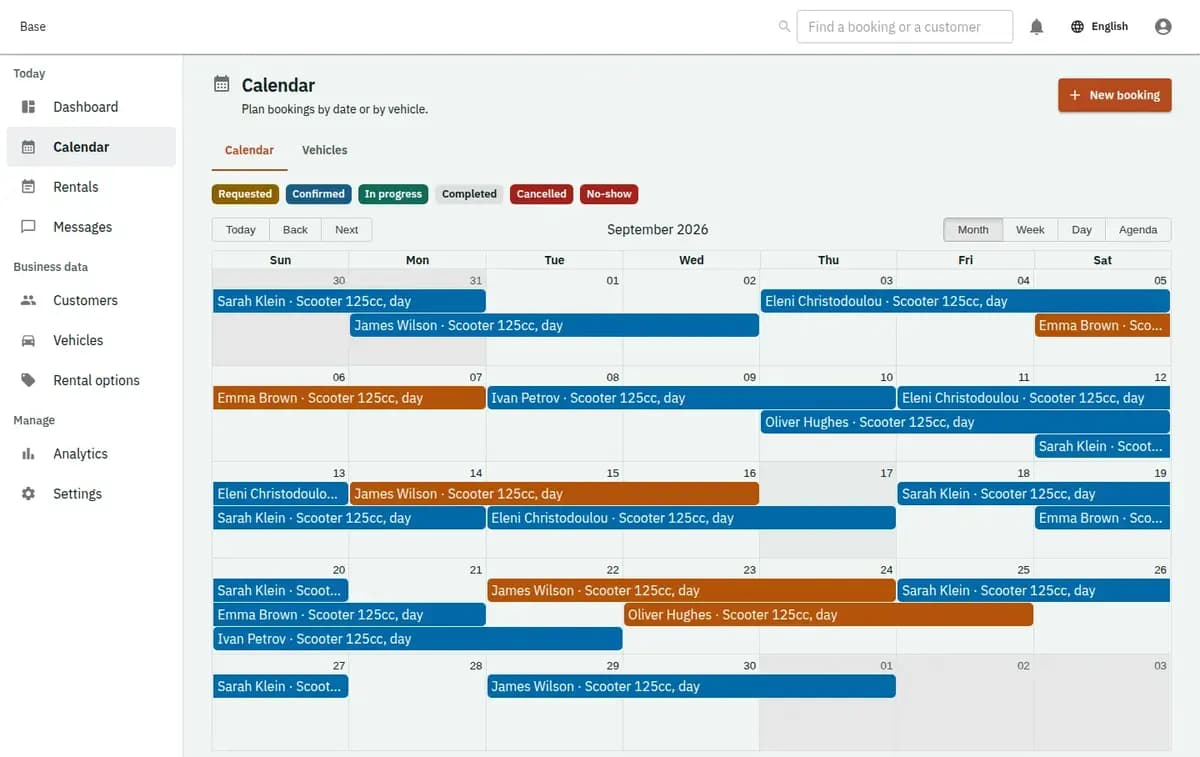
Base calendar showing scooter and quad hires by plate with helmet issue and turnaround gaps
A real console. The records in it are invented.

Who this scooter rental software fits

It fits a hire point with a countable yard: mopeds, 125s, road quads and trail quads that go out by the hour, the day or the week, often two or three times a day each. It is useful when staff must know which machine is genuinely back and prepared, when a hire depends on what the rider is licensed for, when helmets and kit are a second thing that has to leave with the bike, and when the walk-around at issue is the only reason a damage conversation at return can be calm. Requests from the desk, the phone, a hotel concierge and the website all enter the same queue.

How a machine goes out and comes back

The hire is one record from the first message to the deposit outcome, and every operational fact lands on it rather than in a notebook by the till.

  1. 1. Put the real yard into the system

    Each machine is registered by its plate with engine size, the licence category it requires, the turnaround it needs and its own service blocks. Helmets and kit are entered as counted stock by size. Rates are set by hour, day and week with the deposit the hire point actually asks for. A machine off the road for a new rear tyre is blocked as itself, not deleted from the fleet and forgotten.

  2. 2. Take the request with the rider count

    A booking says how many machines, for how many riders, from when to when — a family asking for two 125s and a moped is one request, not three conversations. Staff can enter a walk-up or a hotel call with the same fields. Nothing is reserved yet: an enquiry about Saturday does not take Saturday away from the customer standing at the counter.

  3. 3. Confirm named machines and their kit together

    Staff assign the actual plates. One guarded step checks each machine against the requested period plus its turnaround, its service blocks, the licence category recorded for the rider it goes to, and the helmet sizes still free. If one machine of four cannot be covered, nothing is confirmed by halves — staff see which one failed and swap it or offer another time.

  4. 4. Issue at the counter

    At handover staff record the rider they checked and the category and expiry they read, the helmets and kit issued, fuel level, odometer and the condition seen on the walk-around, with photographs where the hire point takes them. The deposit taken outside Base is noted as a fact. From that moment the machine is out, and the yard view says so.

  5. 5. Close it honestly

    Return records the time, fuel, odometer, kit handed back and any new damage against the condition recorded at issue, then releases the machine after its turnaround. A late return, a no-show or a cancellation each closes the record with its own reason. The deposit result is entered as what the hire point did; Base does not price a scratch or decide who caused it.

What actually goes wrong on a scooter yard

None of these are calendar problems. They are the three places where a hire point promises something the yard cannot deliver.

The engine size decides who may take it

A moped, a 125 and a road quad are not one pool with three labels. Each machine records what a rider must hold for it, and each hire records the licence category and expiry staff actually read at the desk. When the recorded category does not cover the machine, confirmation stops and staff pick a different one or decline. Base checks what has been entered against what the machine requires; whether a particular foreign licence is valid on Cyprus roads stays the hire point’s decision, not a promise made by the platform.
The helmet is inventory too

A bike without a helmet in the rider’s size does not leave. Helmets, jackets, gloves and top boxes are counted stock, and a booking for three riders takes three helmets out of that count for the same period. The count comes back when the kit does. A missing helmet at return is recorded against the hire, in the same place as a scratched fairing, rather than discovered a week later when the sizes stop adding up.

The gap between two hires is the real constraint

The same machine going out at nine and again at two is normal, and the fifteen minutes between them are not free time — they are refuelling, a wipe-down, a tyre glance and the walk-around for the next rider. That turnaround is configured per machine and subtracted from availability, so the calendar cannot sell a bike that is technically «back» but not yet ready. A late return pushes into the next hire visibly, while there is still time to phone the next customer.

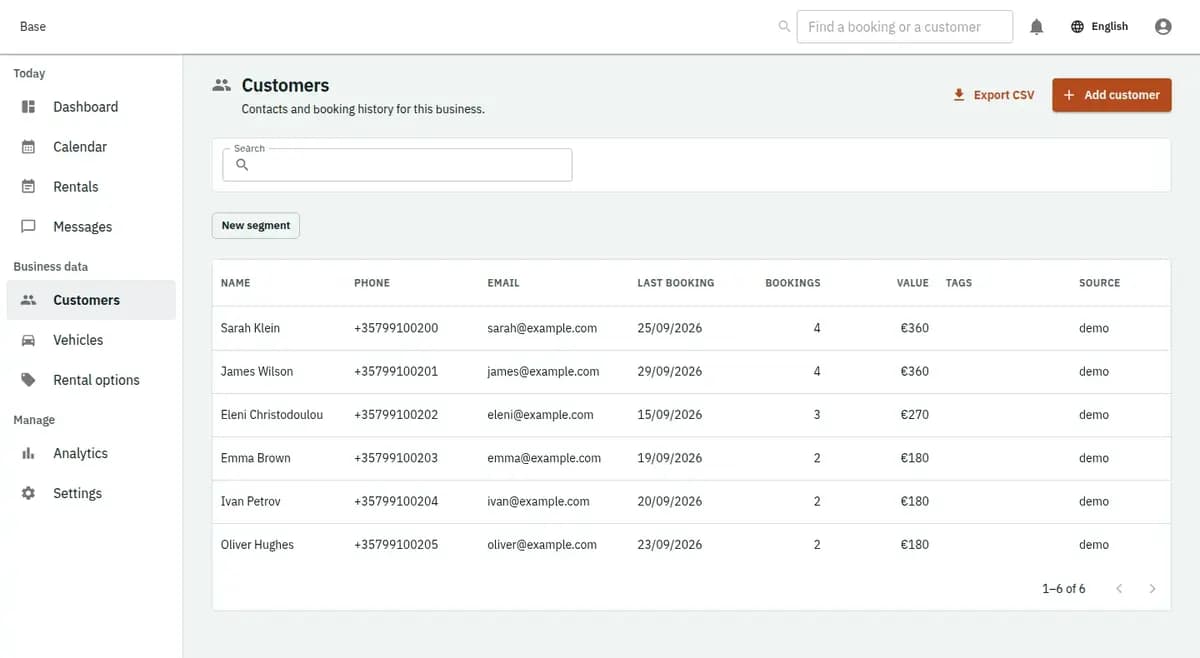
The booking console, with invented records: the customer list

One plate, one period, one helmet count

Two different allocation rules run in the same confirmation, because a hire needs both a machine nobody else has and kit that has not run out.

The machine is named, not counted

Availability is per plate: confirmed hires, service blocks and the configured turnaround are all subtracted from that one machine. Two staff members confirming the last 125 at the same second do not both succeed — the first valid confirmation holds it and the second is refused outright, with nothing half-written. Saying «we have four quads» is not the same as saying this quad is free from ten to two, and only the second one can be promised.

The kit is counted, not named

Helmets and safety kit are a quantity by size for the hire period. A booking that needs a small and two mediums checks those counts alongside the machines and fails as one action if either side is short. That keeps the common refusal — the bikes are free but there is no small helmet until three — visible before the customer is told yes.

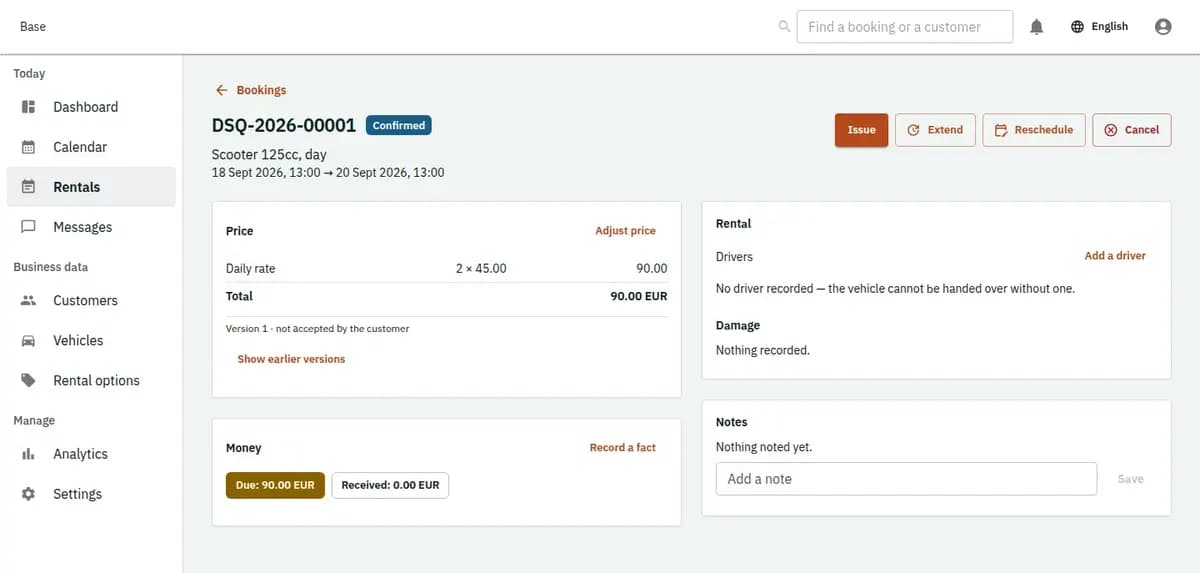
The booking console, with invented records: one booking with its price lines and history

Everyday situations for a quad bike rental booking system

The ordinary day, the collision and the awkward moment at the desk all follow the same rules.

A family takes three machines for the day

Two adults with full licences and a teenager who may only ride a 50. Staff assign two 125s and a moped in one confirmation, with three helmets in the sizes requested. The refusal case is the useful one: if the only free moped is already promised for the afternoon, the whole booking stops rather than sending the family off one machine short.

Two counters reach for the last quad

A hotel phones while a walk-up is at the desk. Both staff members confirm within seconds of each other. One hire is created; the other action is refused with a clear reason and the request stays in the queue, so the second customer can be offered the trail quad instead of discovering at nine tomorrow that two families were promised the same machine.

The licence at the desk is not the one on the booking

The rider arrives with a category that does not cover the 125 that was reserved. Staff record what they actually read, and the issue step stops. The booking does not silently continue as though the check had passed: staff move the rider to a machine the recorded category covers, or decline the hire with a reason that is still on the record when the customer calls back.

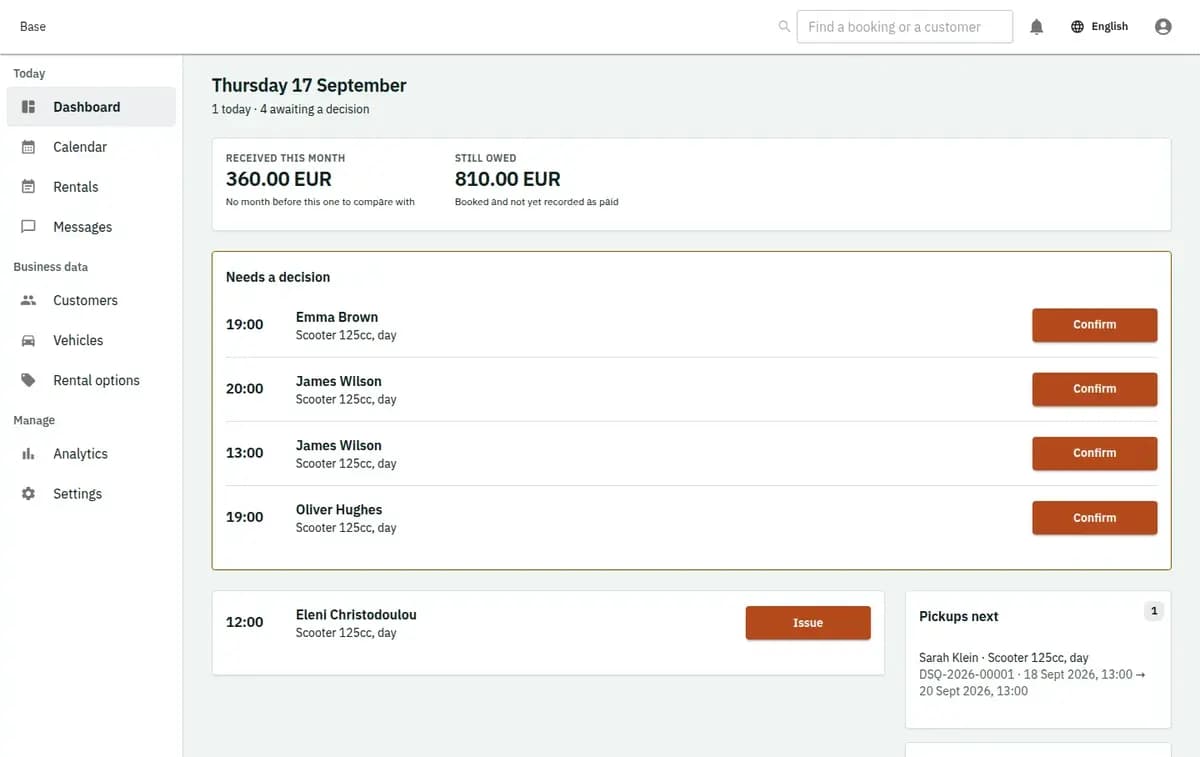
The booking console, with invented records: the day’s requests and money

What the hire keeps, and what it deliberately does not

The record exists so two staff members on different shifts describe the same day the same way.

A check is recorded as a check

The hire holds the rider’s contact details, the licence category and expiry staff read, and the operational facts of issue and return. It is not a document vault: whether a scan or a photocopy is kept, for how long and on what legal basis is the hire point’s decision under its own privacy notice, and Base neither requires it nor pretends to validate a document it has never seen.

Damage is an observation, not a verdict

Condition notes and photographs at issue and at return are what staff saw, with the person and the time attached. Base does not compare them, does not decide fault, does not price a repair and does not take money from a deposit. A correction adds to the record rather than replacing what was written first, which is what makes it useful when a customer disputes a charge weeks later.

What motorbike rental software needs before bookings open

List every machine with its plate, engine size, required licence category and turnaround; add the service blocks already in the diary. Count helmets and kit by size honestly — the number on the shelf, not the number bought. Set hourly, daily and weekly rates with the deposit and the fuel rule you actually apply, and write the cancellation and late-return policy you are willing to hold to. Decide who may confirm a hire, who may issue and who may close a damage note. Import future bookings before you go live and let the conflicting rows fail: a row that will not import is usually a double booking you were about to discover in August.

Where this ATV rental software stops

A hire point uses more than one system, and the honest thing is to say which parts are not here.

When a different product is needed

Base does not track, geofence or remotely immobilise a machine, does not read a telematics box, does not handle traffic fines or police correspondence, and does not decide who is legally allowed to ride what. It is not a workshop system for servicing, not a parts store and not a consumer marketplace. The customer pays the hire point outside Base; staff record only money facts that actually happened.

No tracking, no remote unlock

Base does not know where a machine is. There is no GPS, no geofence, no immobiliser, no telematics feed and no alert when a quad leaves the trail. If the hire point uses a tracker, it stays a separate tool; the booking record can hold what staff wrote down about the trip, and nothing more.

No fines, no legal judgement

Traffic penalties, police correspondence, insurance claims and the question of which licence is valid on Cyprus roads are handled by the business. Base records the category staff read and refuses a hire when the machine requires something that was not recorded — that is a configuration check, not legal advice, and it does not make the hire point compliant.

A refusal is a working answer

An overlapping hire, a machine still inside its turnaround, a service block, a missing helmet size or a licence category that does not cover the machine will stop confirmation or issue. The previous valid state stays exactly as it was, staff get the reason in words, and the customer is told no honestly instead of being sold a bike that is not there.

Scooter rental questions

Can tourists book a quad online in their own language?

Yes. The booking page is available in English, Greek and Russian, and a request from it joins the same queue as desk, phone and hotel concierge requests. Staff then confirm a specific machine. The same setup works as a quad bike rental booking system and as motorbike rental software for a yard that also rents mopeds and 125s.

Can one booking hold several machines for different riders?

Yes. A family or a group is one hire with several assigned plates, each with the licence category recorded for the rider taking it and the helmets issued with it. It confirms as one action: if a single machine cannot be covered, the whole booking stops rather than going out incomplete.

Does Base decide whether a licence allows this machine?

No. Each machine records what it requires and each hire records what staff read at the desk, and confirmation stops when those do not match. Whether a particular licence — foreign, provisional or recently issued — is valid to ride in Cyprus is the hire point’s judgement, and it stays that way.

How are helmets handled?

As counted stock by size, checked in the same step as the machines. If the bikes are free but the sizes are not, confirmation fails as one action instead of leaving staff to discover the gap at handover.

What stops the same bike going out twice?

Availability belongs to the plate, and every confirmed hire and service block is subtracted from it along with the turnaround minutes configured for that machine. Concurrent confirmations are resolved as one winner and one refusal, with no partial reservation left behind.

Can a hire be extended by an hour at the beach?

Staff can extend the hire, and the extension is rechecked against the next booking for that machine and its turnaround. If the machine is promised at two, the extension is refused and the original hire is left untouched, so nobody is told yes twice.

Does Base take the deposit?

No. The deposit is taken and released by the hire point with its own method. The record holds what happened as a fact — taken, returned, partly withheld — with the person and the time, and no card details.

Next step

Open a workspace and set up one booking flow

Registration takes an email address. The operating model, services and resources are configured afterwards, in the console.