Booking models

Class booking system for timetables, capacity and instructors

The class model fits anything where several people join the same session at the same time and the limit is how many can fit. That limit does not belong to the class; it belongs to Tuesday at seven, which has twelve mats and one instructor who might be away next week. A timetable is a set of real sessions, each with its own places, its own instructor and its own history — which is why a cancelled Tuesday has to change one evening rather than a rule.

  1. Build a timetable

  2. Assign instructor and space

  3. Set capacity and recurrence

  4. Track participants and changes

Class scheduling platform for recurring sessions, instructors, rooms and limited capacity.

What it solves

  • Recurring classes
  • Capacity-limited sessions
  • Instructor and room coordination
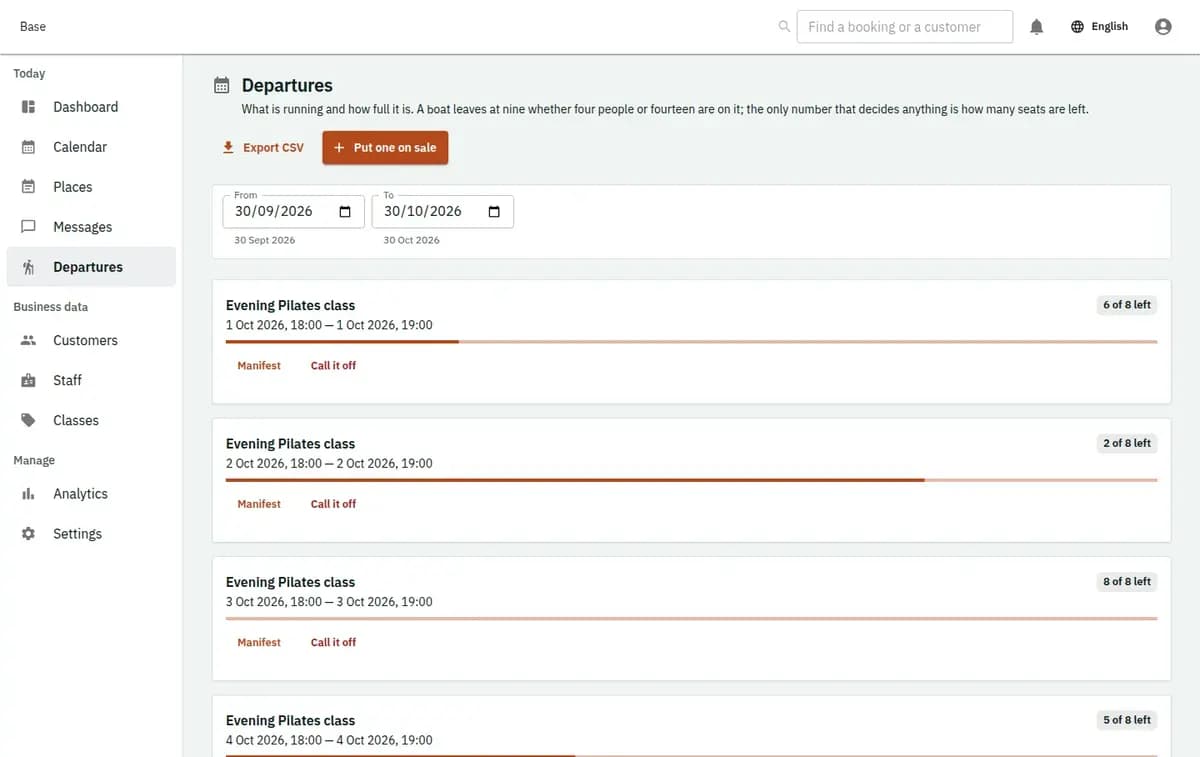
The booking console, with invented records — Class booking
A real console. The records in it are invented.

When a class booking system is the right fit

Use it for group fitness, yoga and pilates, dance and martial arts, swimming lessons, workshops, cooking or pottery evenings, kids’ groups and any course that runs as a series of sessions. It suits a single instructor with one room and a studio with four rooms and a dozen teachers, and it holds up when the same class runs several times a week, when capacity differs by room, and when people book weeks ahead for a specific evening.

When another model fits better

One customer with one practitioner for a private hour is the appointment model. Hiring the room itself, with nobody teaching, is resource booking. Something taken away and returned is rental, and nights are accommodation. If you find yourself creating a class with capacity one, you wanted an appointment.

What a timetable does that an appointment book cannot

Four things, and each of them is the difference between a full room and an argument at the door.

Capacity belongs to the session, not the class

Yoga does not have twelve places. Tuesday at seven in the small studio has twelve, Thursday at nine in the hall has twenty-five, and the Saturday workshop has eight because of the equipment. Places are counted on each occurrence, so a busy evening fills and closes while the rest of the week stays open.

A repeating timetable still has exceptions

The schedule repeats, but one Tuesday falls on a holiday, one is moved an hour later and one is cancelled because the instructor is ill. Each of those changes exactly one session and leaves the pattern intact. A timetable that can only be edited as a rule forces you to choose between lying about one week and rebuilding the term.

People come for a person as much as for a class

A substitute instructor is sometimes fine and sometimes the reason half the room does not come. Sessions name their instructor, and replacing one is a deliberate act with a record, not a silent swap discovered at the door — which also means the people booked can be told before they arrive.

A cancellation is only useful if somebody hears about it

A place freed two hours before the session is worth nothing sitting in a database. A waiting list is what turns that into a full room, and it needs to be ordered, visible and acted on quickly, because the value of the empty mat falls to zero when the session starts.

Class scheduling software for recurring sessions

Four steps: describe what repeats, generate what actually happens, then work the sessions.

1. Describe the classes and where they run

Each class has a length, a level, an instructor who normally teaches it and the room it uses. Rooms carry their own capacity, so a class that moves to the hall for a month can take more people without anybody rewriting the class itself.

2. Generate the sessions, not just the pattern

The weekly pattern produces dated sessions with places, and from that moment each session has its own life: it can be moved, cancelled, given a different instructor or capped lower because half the equipment is being repaired. The pattern stays the plan; the sessions are the truth.

3. Publish and take bookings against places

Customers book a specific session, and the count of remaining places falls as they do. Staff book the same way for people who phone or turn up, so the room never has two versions of how full it is.

4. Run the session and record who came

A register for the instructor, arrivals marked, no-shows recorded, late cancellations noted with the time they arrived. That record is what makes a decision about a class that is not working an argument about attendance rather than about impressions.

Three rules for a busy timetable

Three rules that keep a timetable honest when it gets busy.

A full session is full

Places are held per session and cannot be oversold, whether the booking comes from the website or from the desk. The thirteenth person is refused with the next session offered rather than added to a room with twelve mats.

The room and the instructor are checked with the session

Two classes cannot occupy one room, and one instructor cannot teach two rooms at seven. Both are verified when a session is scheduled, so a clash is a scheduling decision made in advance rather than a surprise on the evening.

One cancelled evening is one cancelled evening

Cancelling or moving a session touches that session only. Everyone booked on it can be notified, the rest of the term is untouched, and nobody has to rebuild a pattern to fix one week.

A full Tuesday and an instructor away

A full Tuesday with a drop-out, and an instructor away for a week.

Twelve mats, thirteen people

Tuesday at seven fills by Sunday. The thirteenth request is refused and offered Thursday, and the person is added to the waiting list. On Tuesday afternoon somebody cancels, the first person on the list is contacted and the room is full again — which only happens because both the list and the free place are in the same system.

An instructor away for a week

Four sessions need cover. Each one gets its substitute named on the session, and the people booked can be told in advance rather than finding out at the door. The class itself is unchanged, so when the instructor returns nothing has to be put back.

What the class register holds and leaves out

A class list is a working document about an evening, not a file about the people on it.

Attendance, not assessment

The session records who booked, who came and who did not. Injuries, medical conditions, progress and anything a participant told the instructor in confidence belong wherever your studio already keeps them, under its own rules — not accumulated on a booking because the class is physical.

Passes are a count, not money

Where you sell a block of sessions, Base can count what has been used. It does not hold funds, does not refund an unused pass, does not bill a membership monthly and does not decide what an expired pass is worth. That is your commercial decision, applied by you.

Preparing class booking software for a new term

List the classes with their real lengths and the rooms they use, and give each room the capacity it genuinely has rather than the one you would like. Enter the instructors with the days they teach and the weeks they are away, and decide who may substitute for whom. Decide how far ahead sessions are published — a term, a month, six weeks — and how late somebody may cancel without cost. Decide whether you keep a waiting list and who works it. Then publish one week, watch what the desk has to correct, and publish the rest.

Bookings that are not measured in places

The session is the unit here. Anything measured in something other than places has its own model.

Not private sessions or room hire

A one-to-one hour is an appointment, and hiring the studio with nobody teaching is a resource booking. Running either as a class of one hides the constraint that actually matters.

Not memberships or billing

Monthly membership, door access, direct debits and pricing tiers are a different product. Base counts sessions and attendance; what somebody pays and when stays with the systems you already use for money.

A refusal is a valid result

A full session, a room already in use, an instructor teaching elsewhere or a request after the cut-off stops the booking. The previous state stands, the reason is plain, and the next session with places is offered instead.

Class booking questions

Can the front desk book people into a class as well as customers booking online?

Yes. In this class booking software, customers book a specific dated session online and staff book the same session for people who phone or turn up, so the remaining places fall in one count. Because the class scheduling software holds places per session, a full Tuesday is full whichever way the request arrives, and the next person is offered another session or a place on the waiting list.

Can capacity differ between sessions of the same class?

Yes. Places belong to each dated session and follow the room it runs in, so the same class can take twelve in the studio and twenty-five in the hall.

Can one session be cancelled without touching the timetable?

Yes. Sessions are generated from the pattern but live on their own, so a holiday, an illness or a one-off move changes that evening and nothing else.

Is there a waiting list?

Yes, ordered per session, so a place freed a few hours before can be offered to the next person while it is still worth something.

Can a substitute instructor be recorded?

Yes, on the session itself, which is what allows the people booked to be told before they arrive rather than at the door.

Does Base handle memberships and passes?

It counts sessions used from a block. It does not bill a membership, take payment or decide what an expired pass is worth — those stay with your own commercial process.

Next step

Open a workspace and set up one booking flow

Registration takes an email address. The operating model, services and resources are configured afterwards, in the console.