Class booking

Tour booking software for departures and check-in

  • Bounded seat capacity with named resources
  • The final seat has one owner
  • Capacity edits preserve confirmed promises

No card asked for · nothing taken from a booking · your data exports

Operating model
Class booking
What is booked
Class → Capacity → Schedule
Getting started
What to prepare in activity booking software

Base helps small tour and activity operators publish finite departures and protect the number of seats actually released. A reservation joins party size and category to a departure, pickup choice and any required named guide, vehicle or vessel. Confirmation allocates seats and increments confirmed occupancy atomically, so a final-seat race has one winner. The resulting manifest then supports reminders, check-in, completion, no-show or an audited operator cancellation.

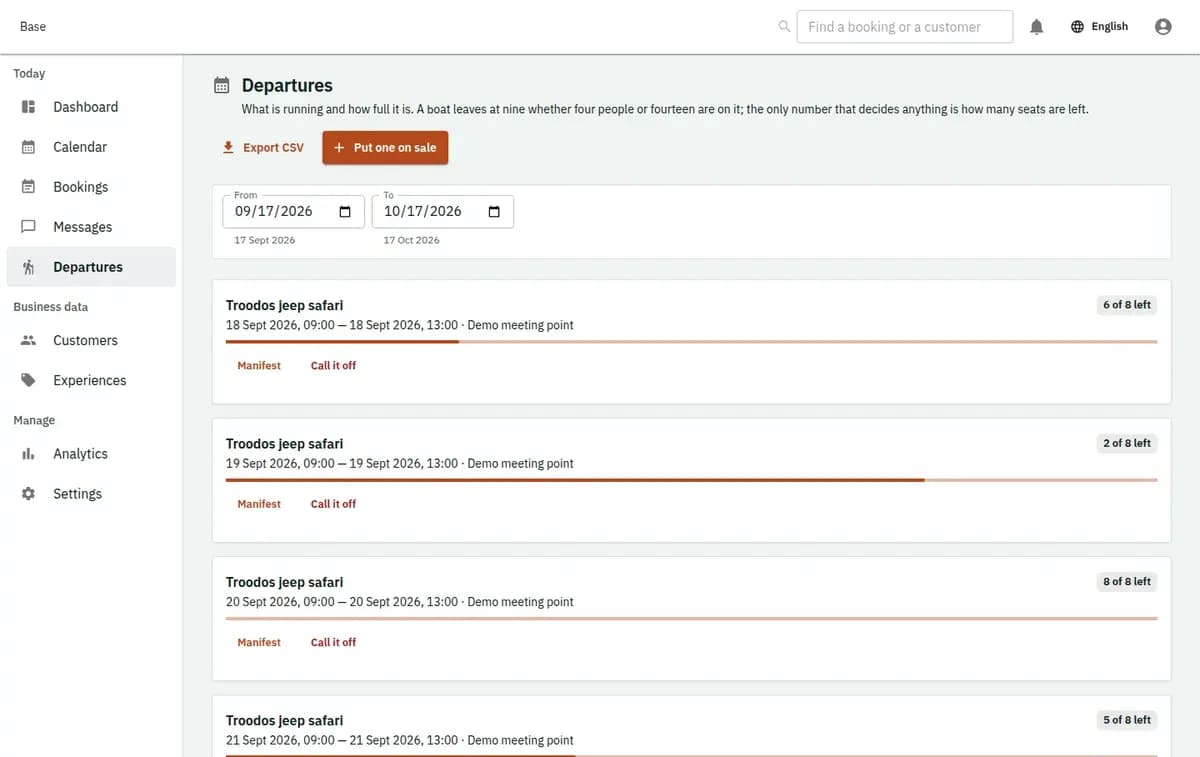
Base tour departure showing seat capacity pickup points guide and participant manifest
A real console. The records in it are invented.

Booking system for tour operators and activity businesses

The profile fits an owner-led excursion, experience or activity business that publishes scheduled departures with bounded places. It supports participant categories, pickup points, assigned guides and optional named vehicle or vessel resources. Staff can manage requests, confirmations, a departure manifest, check-in, no-show and operator cancellation in one record.

How tour operator software manages each departure

The experience describes the offer; each released departure owns capacity, resources and its manifest.

  1. 1. Define the experience

    Create the tour or activity with duration, participant categories, pickup choices, price lines, sales window and reviewed policies. Add guides and any named vehicle, vessel or equipment that genuinely limits a departure.

  2. 2. Release finite departures

    Operations create dated departures with immutable released capacity, time and required named resources. A later audited capacity change cannot fall below confirmed participants. The schedule is finite rather than an endless recurrence with hidden exceptions.

  3. 3. Confirm the party atomically

    The booking captures party size, supported categories and pickup point. Confirmation checks the sales window, party limits, remaining capacity and named resources in one transaction. One valid request wins the final-seat race; the other remains unconfirmed.

  4. 4. Prepare and check in the manifest

    Assigned staff use the participant manifest and minimum contact information needed for the departure. Check-in records who arrived against the existing reservation. Duplicate actions do not create extra participants or consume another seat.

  5. 5. Complete, no-show or cancel

    Staff complete the departure and its operational records, mark an absent participant through the booking flow, or record an operator cancellation and reason. Notifications do not change state. Any refund is handled externally and may be noted as a fact.

Problems caused by loose departures

A departure must protect its final seat and every named resource promised to the party.

Capacity is copied between channels

Calls, messages and website requests may compete for the same remaining places. Base confirms participant counts against one departure ledger. Requests do not lower availability until a valid confirmation consumes capacity, and confirmed seats cannot be silently erased.

Pickup and party details detach from the booking

Adult, child or other approved categories and the chosen pickup point stay with the reservation and manifest. Staff can prepare the departure without rebuilding who is coming, where they join and which booking owns each participant.

A guide or vehicle conflict is found too late

A released departure can require a named guide and optional vehicle, vessel or equipment. Those resources are checked with seat allocation. If a required assignment conflicts, confirmation fails rather than selling capacity for a departure that cannot operate as released.

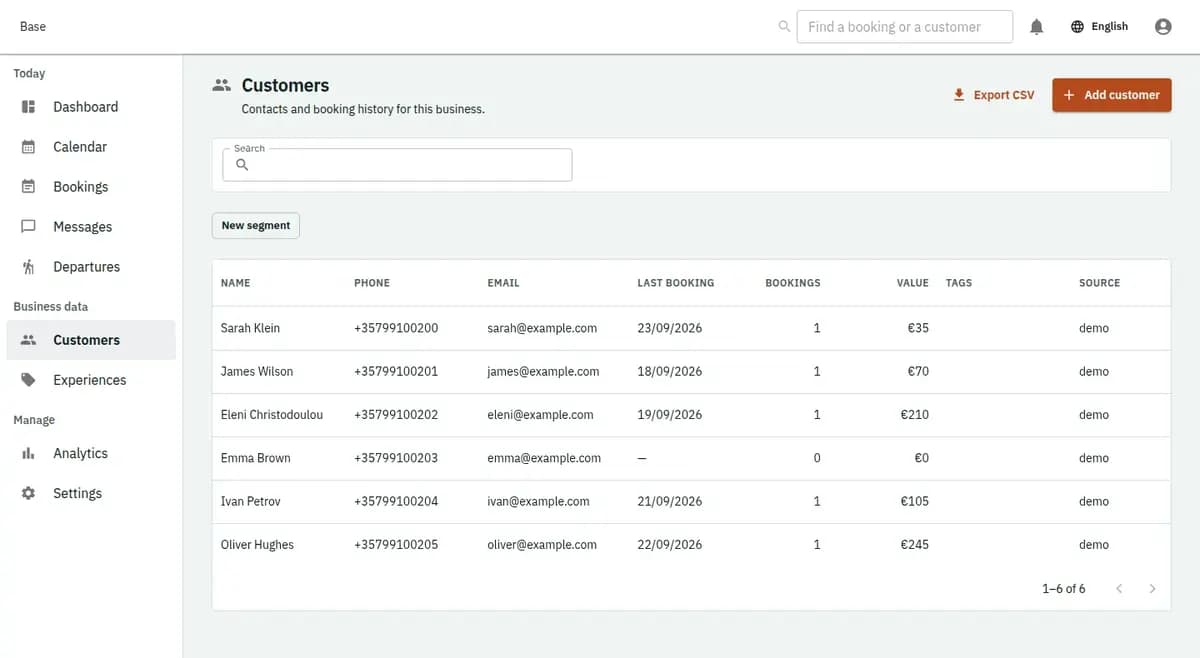
The booking console, with invented records: the customer list

Bounded seat capacity with named resources

Availability is a released departure, not a generic free slot in a calendar.

The final seat has one owner

Confirmation increments participant count atomically and creates the reservation in the same action. Concurrent parties cannot drive capacity below zero. A refused request does not receive a confirmation, alter the ledger or create an unsupported waitlist.

Capacity edits preserve confirmed promises

Operations may audit a legitimate capacity change, but the new value cannot fall below already confirmed seats. Required guides or vehicles remain named assignments; a collision is surfaced instead of being hidden behind numeric availability.

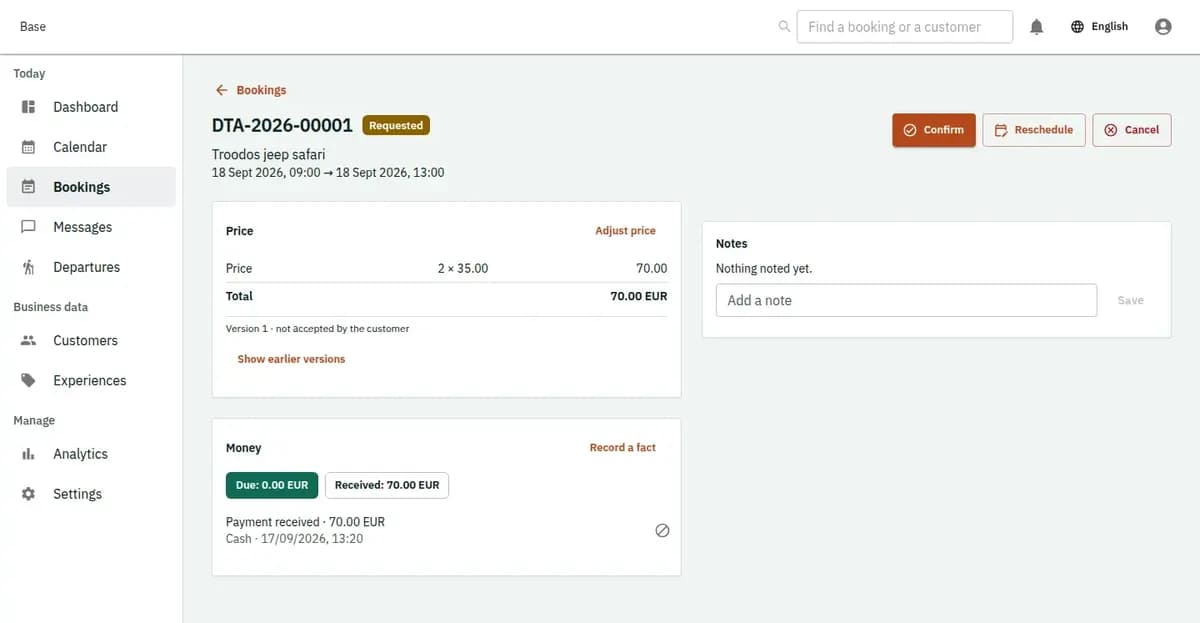
The booking console, with invented records: one booking with its price lines and history

Excursions, final-seat refusals and operator cancellations

A normal excursion, a final-seat refusal and an operator cancellation follow the same departure model.

A family books an afternoon excursion

The family chooses adult and child categories plus a released pickup point. Base checks party limits, available seats, guide and vehicle, then confirms the reservation. Their participants appear once on the departure manifest and are checked in on arrival.

Two parties request the final seat

The departure has one place left when two confirmations arrive. The first valid transaction consumes it. The second is refused without negative capacity or a misleading message, so staff can offer another departure rather than honouring an impossible promise.

Weather causes an operator cancellation

Authorised staff decide the departure cannot operate and record the cancellation with a reason. A retry does not duplicate the transition, and a notification outage does not restore capacity incorrectly. Any customer refund remains outside Base.

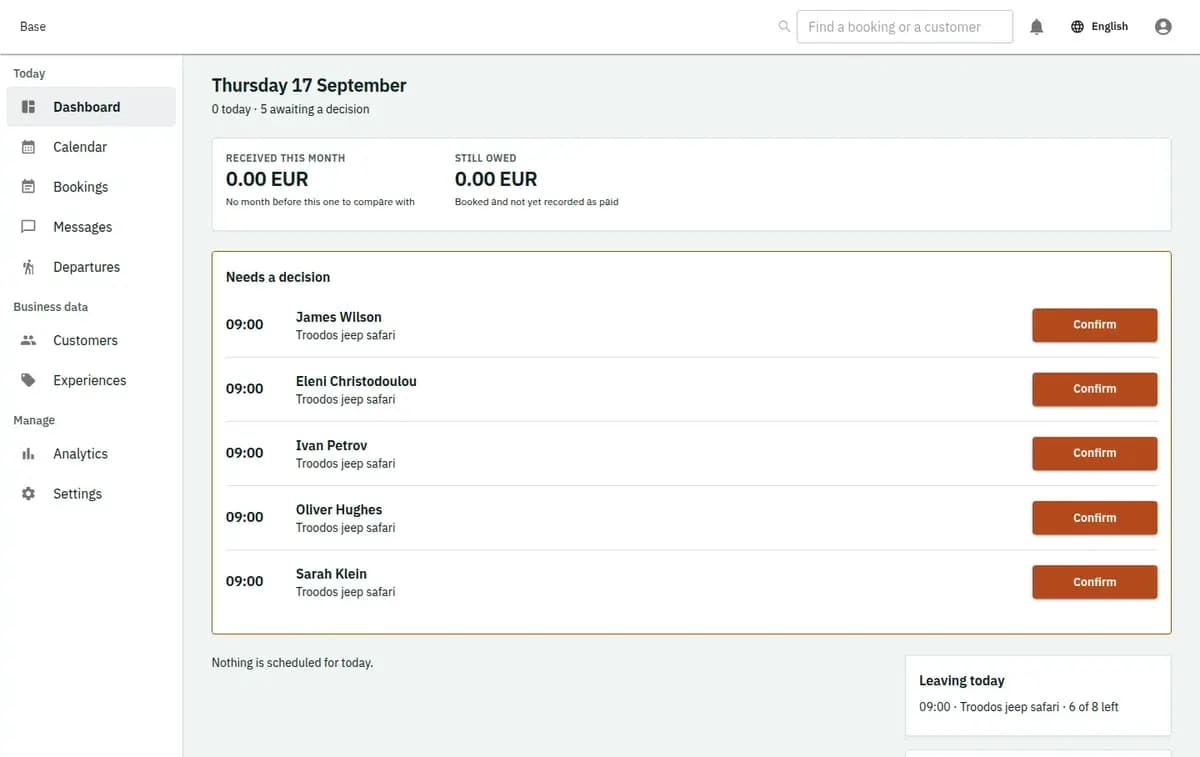
The booking console, with invented records: the day’s requests and money

Auditable departure facts without marketplace claims

The record explains capacity and operational decisions while keeping finance and professional judgment outside the scheduler.

Manifests contain the operational minimum

Participant category, pickup and necessary contact details belong to the departure record under permissions. Passport or health information is absent by default. Operators remain responsible for approved notices, policies and lawful retention.

Cancellations and capacity changes have history

Released capacity, named assignments, confirmations, check-ins and operator cancellations stay attributable. The history supports staff coordination but does not promise demand, rankings, customer outcomes or automatic weather accuracy.

What to prepare in activity booking software

Create real experiences with duration, categories, pickup points, sales windows, price context and reviewed cancellation, weather, privacy and waiver documents. Add guides and any required vehicles or vessels with schedules. Release finite departures with explicit capacity and assignments. Configure manifest permissions and reminder timing, then validate imported future bookings against capacity and resources rather than accepting overbooked rows.

Where this tour booking software stops

The profile manages departures and participants without becoming an OTA or finance platform.

Commerce and workforce systems outside the profile

Base is not an OTA marketplace, channel-settlement service, dynamic-yield engine or guide-payroll system. It does not promise marketplace demand or automatically decide weather cancellations. End-customer payment and refunds happen outside Base; the system records only approved external facts.

No OTA marketplace or channel settlement

Base does not distribute inventory to a consumer marketplace, settle reseller commissions or promise channel reconciliation. Agent source can be retained for attribution without creating a payable commission ledger.

No dynamic yield, payroll or checkout

Price categories and selected extras may be snapshotted, but dynamic yield, guide payroll and payment processing are outside the profile. Customer funds and refunds remain external operational facts.

Full capacity or a resource conflict means refusal

A full departure, closed sales window, invalid party limit or unavailable required guide or vehicle stops confirmation. The failed action does not consume a partial seat, move the customer silently or lower capacity below confirmed bookings.

Tour booking questions

Is Base a marketplace that sends us customers?

No. Base is a booking system for tour operators who bring their own customers: you publish departures on your own booking page in English, Greek or Russian. There is no commission on bookings; you pay a flat plan per business, from Free at €0 to Standard at €19 or Pro at €39 a month. As activity booking software, it does not promise marketplace demand.

Can Base protect the last seat?

Yes. Party size is allocated atomically against a released departure. If two confirmations race for one remaining seat, one succeeds and the other is refused without overselling.

Can each booking include a pickup point?

Yes. A supported pickup choice stays with the reservation and participant manifest so operations and the assigned guide can prepare the departure.

What happens if the guide or vehicle is unavailable?

When a named resource is required, confirmation checks it with capacity. A conflict stops the complete action rather than leaving a seat reservation for an unstaffed departure.

Does Base decide weather cancellations?

No. Authorised staff make and record the operator cancellation with a reason. The platform preserves the transition and can support notifications.

Does the system process tour payments?

No. Accepted price lines can stay with the booking, while payments, deposits and refunds happen outside Base and may only be recorded as external facts.

Next step

Open a workspace and set up one booking flow

Registration takes an email address. The operating model, services and resources are configured afterwards, in the console.