
Class booking

Course booking software for schools and finite lesson series

  • Finite sessions, protected seats and lesson balance
  • Each departure owns its place count
  • Series and entitlement stay bounded

No card asked for · nothing taken from a booking · your data exports

Operating model
Class booking
What is booked
Class → Capacity → Schedule
Getting started
What to prepare in music school software

Base helps a small language, music, coding, art or tutoring school sell places in released class sessions without confusing a course with one calendar event. A term becomes a finite series of real sessions. Every session has a teacher, optional classroom, seat capacity and participant list. A package balance records lesson entitlement consumed and reversed; it is not customer money or tuition collection.

Base school class calendar with finite term sessions teachers classrooms capacity attendance and lesson balances
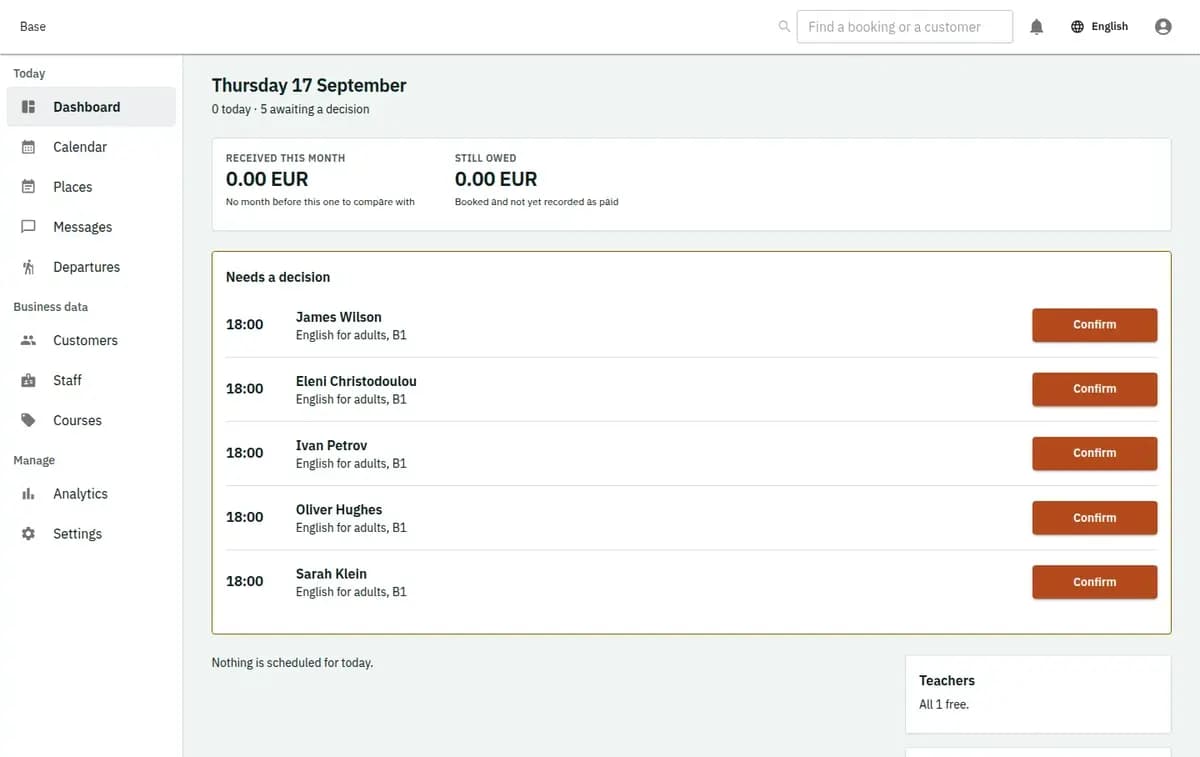
A real console. The records in it are invented.

Language school software for small private schools

This profile fits a private language, music, coding, art or tutoring school that releases bounded group sessions, assigns a teacher and classroom, sells a finite number of places and records attendance. It also supports a block of lesson entitlements consumed one class at a time when the school uses that released package behaviour.

How course scheduling software builds a finite series

The school releases concrete sessions, then books places and records what happened in each one.

  1. 1. Define the course and resources

    The owner creates the course, level, duration, capacity rules, per-place price lines and reviewed policies. Teachers receive relevant skills and working times. A classroom is a named resource when its use can collide. Base does not create curriculum, learning materials or academic requirements.

  2. 2. Generate a bounded term series

    Staff choose a start, recurrence and explicit end or number of sessions. Base previews the finite occurrences against teacher and room constraints. The result is a known list of sessions rather than an endless repeating block whose future conflicts remain invisible.

  3. 3. Release sessions with exact capacity

    Each session is released with its teacher, classroom and maximum places. A booking request names the student or booking contact and the number of places needed. Confirmation atomically protects the remaining capacity and required named resources; a party cannot be partially accepted.

  4. 4. Check in and consume entitlement

    The teacher or authorised counter sees the participant list for that session and records attendance, completion or no-show. If a released lesson package applies, one unit is consumed against that booking without representing money. Duplicate commands cannot spend the same unit twice.

  5. 5. Cancel or change one occurrence

    An authorised cancellation releases the place and reverses entitlement according to the recorded policy in the same operation. A teacher, room or time change checks the replacement constraints first. Series exceptions remain visible and completed sessions are never rewritten by a future term edit.

Class operations that need more than a repeated event

A course, its finite series and each bookable session have different responsibilities.

The course is confused with a session

The course describes the offering, expected duration, level and term. A released session owns a real start time, capacity, assigned teacher and classroom. Keeping the distinction means a cancellation, teacher change or attendance result affects the correct occurrence instead of rewriting the whole course.
The final place is promised twice

Seat capacity belongs to the released session and is updated inside the booking transaction. Two families trying to take the final place cannot both succeed. The winning confirmation consumes the seat; the other request receives a refusal and leaves the participant list and balance unchanged.

A lesson block is treated as payment

A package balance is a finite entitlement to attend lessons, not cash, card processing or an accounting balance. Consumption links one unit to the relevant booking. A cancellation can reverse that unit under the recorded policy without deleting the original consumption history.

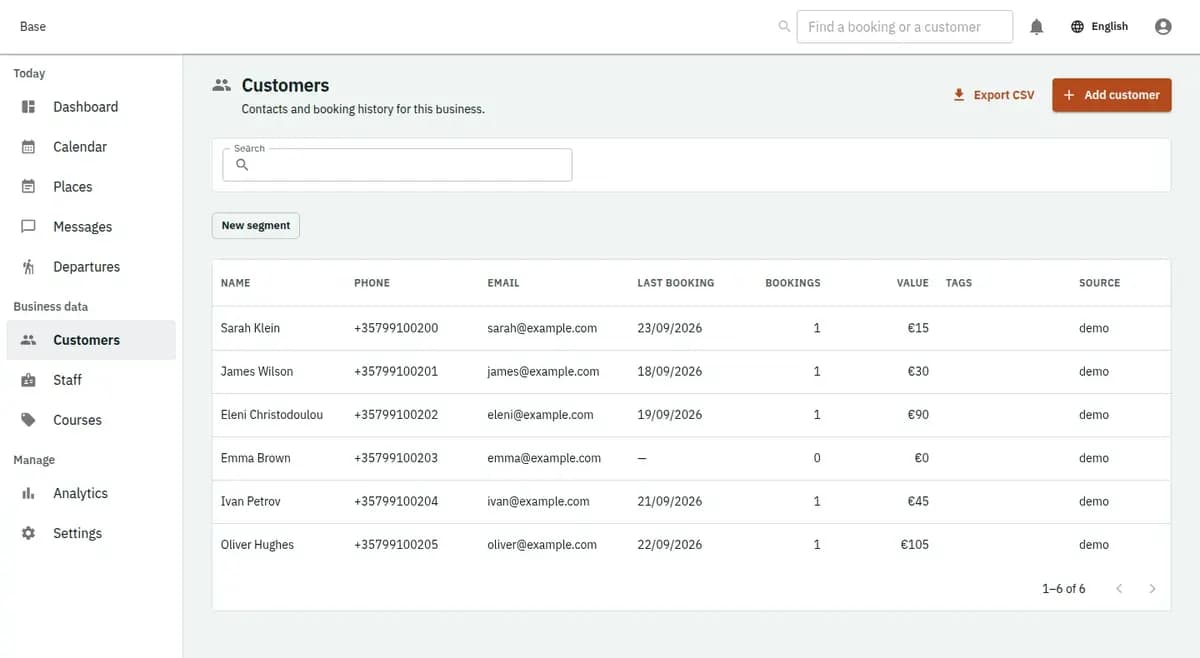
The booking console, with invented records: the customer list

Finite sessions, protected seats and lesson balance

The allocation model combines capacity with the teacher and classroom required for a real class.

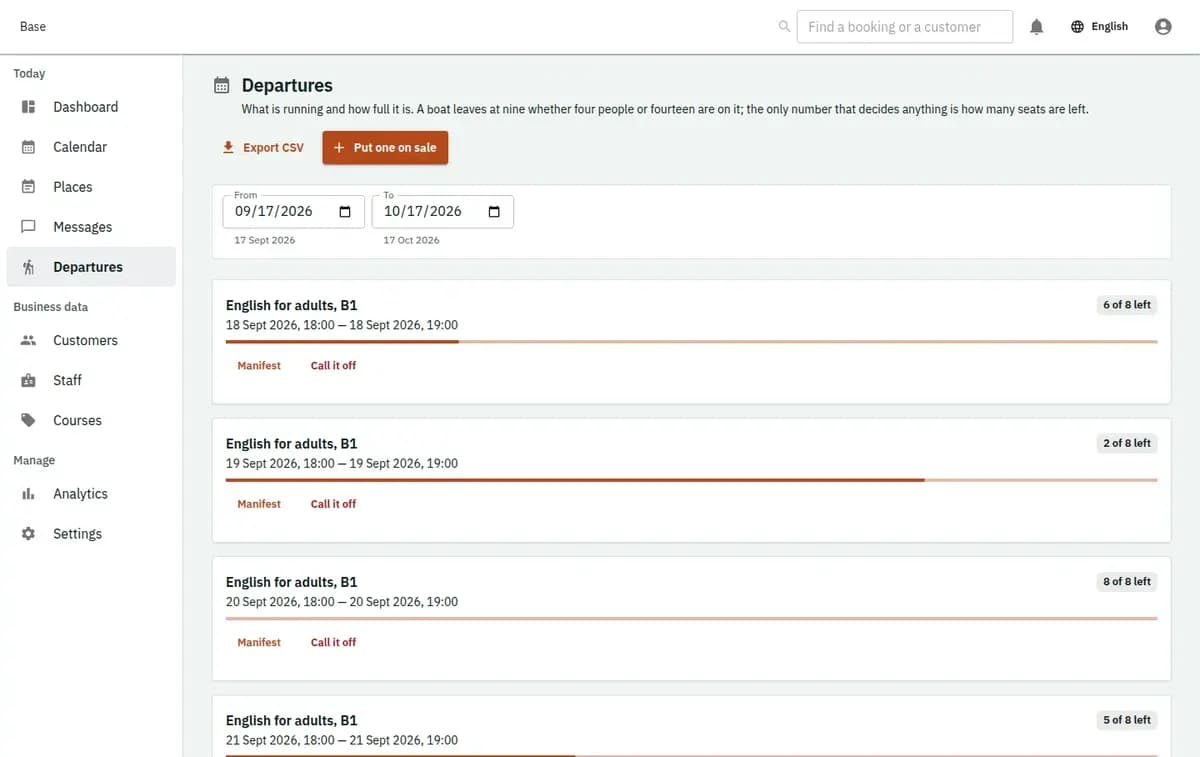
Each departure owns its place count

Confirmed places cannot exceed the released session capacity, even under concurrent demand. Capacity cannot be reduced below places already sold. Cancellation returns an eligible place atomically, and the participant list reflects the same booking state rather than a separate manual counter.

Series and entitlement stay bounded

A term generates only an explicit finite set of sessions and reports conflicts instead of silently skipping them. A lesson package has a non-negative unit balance, with each consumption and policy-based reversal linked to a class booking. Neither mechanism creates money or an infinite schedule.

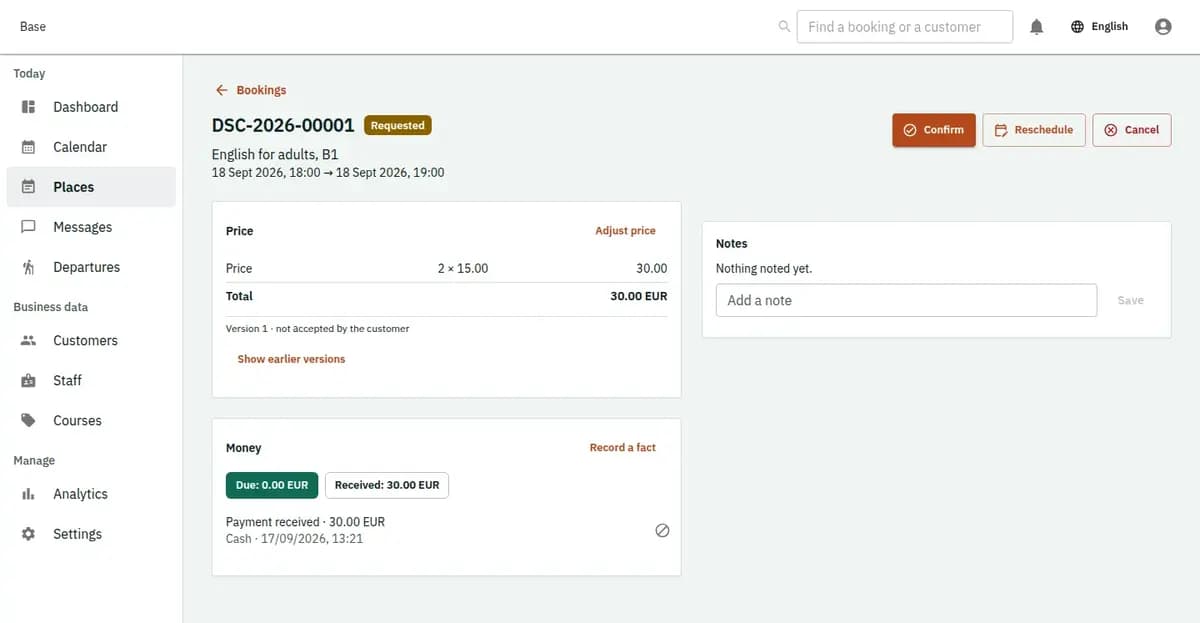
The booking console, with invented records: one booking with its price lines and history

Terms, final-seat races and series conflicts

A normal term, a final-seat race and a series conflict make the allocation rules visible.

A language school releases a term

The coordinator creates a twelve-session course series with one teacher, one classroom and ten places per session. Families book against released sessions, and the teacher opens the current participant list for attendance. Eligible package units are consumed per attended booking and remain traceable.

Two students request the final place

Only one seat remains when two confirmations arrive together. The database-protected capacity update allows one booking to succeed. The other is refused as a whole, without an eleventh participant, a negative package balance or a misleading confirmation.

The classroom is unavailable mid-term

The series preview finds that one future session collides with another class in the required room. Base reports the occurrence and does not silently publish a partial term. Staff choose another room, teacher or time, or release an explicitly reviewed exception.

The booking console, with invented records: the day’s requests and money

Attendance evidence with an academic boundary

Operational class records remain useful without becoming claims about learning or institutional authority.

Bookings and balance movements remain attributable

Session release, capacity changes, bookings, attendance, cancellation and entitlement consumption retain their actor and time. A reversal points to the earlier consumption and applicable policy. Staff can explain the operational history without editing away a no-show or cancelled occurrence.

The school owns educational and regulatory records

Base stores only the customer, participant and class details needed for booking and attendance. Grades, coursework, assessments, certificates, curriculum and state reports stay outside this profile. The school decides lawful minor-data handling, staff suitability and any official registers.

What to prepare in music school software

Create courses with level, duration, term and per-session capacity; add teachers, verified scheduling skills, shifts and classrooms; and define explicit finite-series rules. Configure price lines, request confirmation, reviewed cancellation and privacy policies, attendance roles and package unit behaviour where released. Import customers, teachers, courses and future sessions only after previewing missing resources, over-capacity rows, collisions and incomplete balance evidence.

Where this course booking software stops

The profile coordinates places and sessions, not teaching, institutional administration or finance.

When an institutional system is needed

Base is not an LMS, institutional timetable, student-information system, grade book, curriculum manager or state-reporting tool. It does not issue certificates, manage academic progress or process tuition payments. Regulatory standing, teaching content and marks remain entirely with the school.

No LMS or academic record

Base does not host coursework, plan curriculum, grade students, measure progress or issue certificates. Course level is a booking attribute. It does not replace a school information system or make educational judgments.

No infinite series or overselling

Every term has a finite horizon and every released session has a hard capacity. A conflicting teacher or room is reported, and a full class refuses another place. Staff cannot lower capacity beneath confirmed bookings or spend a package below zero.

No tuition payment processing or state reporting

Customer payments happen outside Base. A package balance represents lesson units only, not funds or accounting. The platform does not submit authority attendance, regulatory standing or other state reports for the school.

School booking questions

Can teachers keep their lessons in their own Google or Microsoft calendar?

Yes. Base syncs both ways with Google and Microsoft calendars, so a teacher sees assigned sessions next to their private commitments. Whether you use it as language school software or music school software, each session of a term keeps its teacher, classroom and seat limit, and booking notifications go by email or Telegram rather than SMS.

What is the difference between a course and a session?

The course defines the offering and term. Each released session has its own date, teacher, classroom, capacity, participant list and attendance outcome.

Can two people book the final place?

No. Capacity is protected inside the confirmation transaction, so one request can take the final place and the other is refused without partial changes.

How does a finite term series work?

Staff choose a bounded number or end date, preview every occurrence and resolve reported teacher or room conflicts. Base does not create an endless repeating booking.

Is a lesson package a payment balance?

No. It is an entitlement measured in lesson units. Customer money stays outside Base, while consumption and reversal are linked to class bookings.

Does Base manage grades or curriculum?

No. Academic content, assessment, certificates and regulatory reporting remain with the school. This profile manages released sessions, places and attendance.

Next step

Open a workspace and set up one booking flow

Registration takes an email address. The operating model, services and resources are configured afterwards, in the console.