Class booking

Dance studio software for classes, terms and levels

  • Levels, ages and places per class
  • The last place goes once
  • Sisters book together or not at all

No card asked for · nothing taken from a booking · your data exports

Operating model
Class booking
What is booked
Class → Capacity → Schedule
Getting started
Classes, teachers and studios to publish first

A dance school runs two businesses from the same rooms. In the afternoon it teaches children in groups by age and grade, enrolled for a term and booked by a parent. In the evening it teaches adults who come when work allows, buy a pack of classes and drop in to salsa or contemporary on the nights they can. Base holds both on one timetable: each class has its level, its age band, its teacher, its studio and a number of places, and every booking says who dances and who is responsible for the booking.

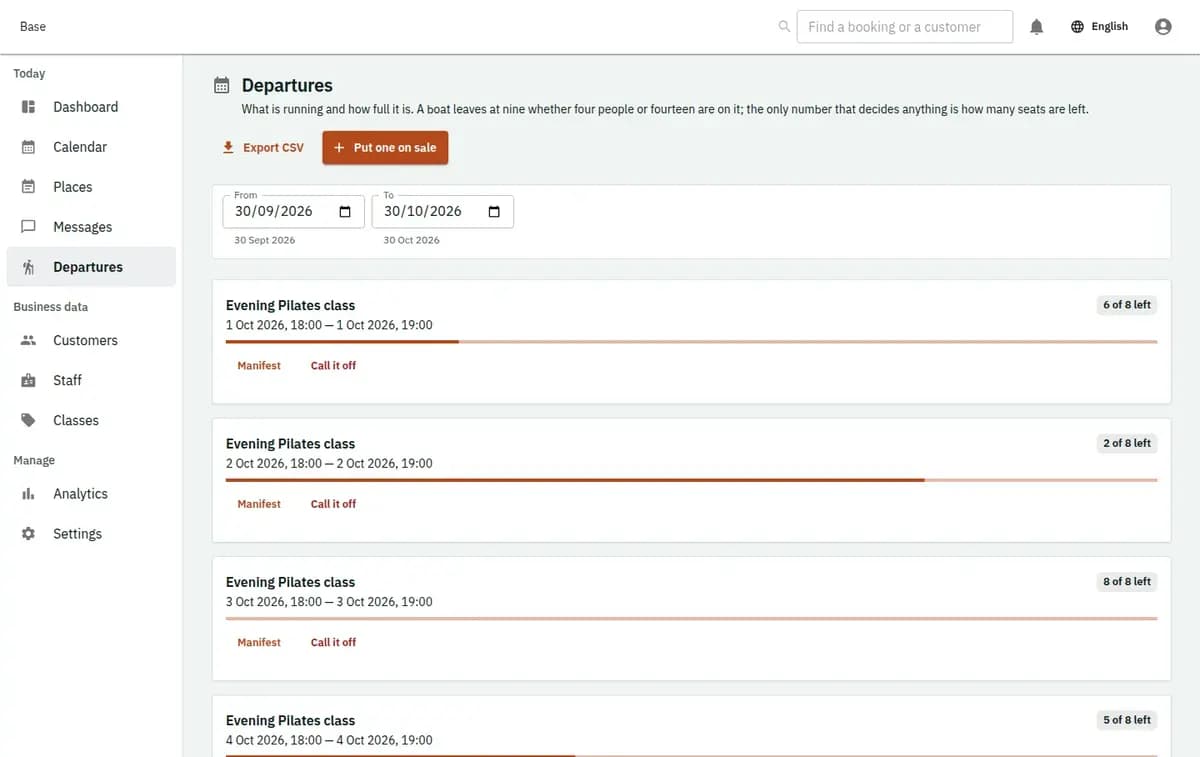
Base timetable for a dance studio showing weekly classes by level and age, teacher, studio room, remaining places and the class register
A real console. The records in it are invented.

Who this dance school software fits

It fits a ballet, contemporary, jazz, hip hop, Latin or ballroom school in Cyprus with one or several studios and a handful of teachers. It suits a timetable of weekly classes grouped by level and age, enrolment by term for the children’s groups, drop-ins and class passes for adults, private lessons for couples or exam preparation, and a waiting list for the classes that fill first. It works for a school that wants parents and adult students to book online from a phone instead of on WhatsApp, and for a teacher who wants to see tonight’s register without phoning the office.

Dance class booking system for drop-ins and terms

Publish the timetable, take places, work the register. Everything else is detail around those three steps.

  1. 1. Build the timetable you can teach

    Create each class with its style, level, age band, length, teacher, studio and places. Set the places from the studio and the teacher’s judgement, not from how many names you would like. A term is a run of weekly sessions with an end date; a drop-in is a single session; a private lesson is booked with a teacher like an appointment.

  2. 2. Open term enrolment

    Parents book the children’s groups for the whole term from your booking page in English, Greek or Russian, giving the child’s name and age. Staff enter bookings taken at the desk or by phone with the same fields. Nothing holds a place until confirmation, which matters on the evening enrolment opens and every parent in the school opens the same page.

  3. 3. Sell drop-ins and class passes

    Adults book a single evening or use a class pass, a pack of visits counted down one class at a time. When a class is full, the next person joins the waiting list for that session, and a cancellation frees the place for the first name on it. Notifications go by email or Telegram.

  4. 4. Take the register in the studio

    The teacher opens tonight’s class on a phone and sees who is expected, with the parent’s contact beside each child. Arrivals are marked as they come in; a dancer who does not come is a no-show on the record rather than a blank. A teacher who links a Google or Microsoft calendar sees the classes there too, synced both ways.

  5. 5. Close the term

    At the end of term, attendance per dancer shows who has been coming and who has missed half of it, which is the conversation before the next term rather than after the show. Term fees, deposits and refunds are paid outside Base and recorded as facts. The register and bookings export to a spreadsheet when you need them elsewhere.

Who belongs in which class tonight

Few of the problems are about time slots. They are about who belongs in which class and who is expected in the studio tonight.

Level and age decide the class, not the time

Grade 2 ballet for seven-to-nines and beginner ballet for adults may share Tuesday at six in different rooms. A parent who books the wrong one has a child in a class she cannot follow and a teacher who has to sort it out in the doorway. Each class carries its level and age band, the dancer’s age is part of the booking, and a booking outside the band is refused when it is made rather than discovered on the studio floor.


The children enrol by term, the adults drop in

The Saturday junior groups fill in September and stay the same until Christmas. The Thursday salsa class changes every week. A school that handles both from one paper list ends up guessing who is coming. A term booking takes a place in every session of the term at once, a drop-in takes one place in one evening, and both count against the same number.

The studio is the limit, and so is the teacher

A small studio holds twelve dancers safely, and the large one twenty. A teacher can be in one room at a time, and two classes booked into the same studio at the same hour is a problem nobody notices until the music starts. Classes are tied to a teacher and a studio, and a clash is reported before the term is published.

The parent is the contact, the child is the dancer

The child dances; the parent books, cancels and needs a message when a class moves. Both sit on the same booking, so the register shows the child’s name and age with the parent’s contact next to it. Sisters in different grades stay in different classes without the school matching them by surname.

Levels, ages and places per class

The allocation is a count of places against one dated class, with the teacher and studio that class needs.

The last place goes once

A booking takes places from the class and returns them on cancellation. Two parents confirming the last place in Grade 3 at the same moment do not both succeed: one takes it and the other is told immediately and can join the waiting list.

Sisters book together or not at all

Two children in the same group are one confirmation. If one place is left, the booking is refused rather than half-served, so a parent is never left with a place for one of two daughters and an awkward choice.

Age bands are checked at booking

Each class carries a minimum and maximum age. The child’s age goes in with the booking, so a six-year-old cannot be enrolled in the nine-to-twelves by mistake, and the refusal names the reason in plain words.

Teachers and studio rooms

A teacher is one person in one place at a time, and a studio is one class at a time. Classes are checked against both, so a substitute covering Wednesday is checked against her own timetable before the change is saved.

Passes count visits, not money

A class pass is a number of visits, each one used against a specific booking and given back if the class is cancelled. It is not a balance of money and does not renew itself. What a pass costs and how long it lasts is your decision.

One term, one evening and a cancelled Saturday

Four moments that make the difference between a calm studio and a scramble at the door.

Two sisters enrol for the autumn term

The parent books the older girl into Grade 4 on Mondays and the younger into pre-primary on Saturdays. Each booking takes a place in every session of its term in one action, so the school knows in September what it has promised in December, and both registers carry the same parent contact.

Thursday salsa is full by Wednesday

The fourteenth request is refused and joins the waiting list. On Thursday afternoon a couple cancels, two places free up, and the first people on the list are contacted while there is still time to come. An adult using a class pass has one visit counted against the booking.

The teacher is ill on Saturday morning

Staff move the class to a substitute or cancel it with a reason. Every affected booking appears in one list with the parent’s contact, passes are given back, and the change goes out by email or Telegram. Base does not phone anyone; it makes sure nobody is missed while somebody does.

A seven-year-old is booked into the teen group

The refusal happens at booking, with the age band as the reason, so the school can offer the junior class instead. The alternative is a child in the wrong room, a parent who has driven across Limassol, and a teacher deciding on the spot.

Parents, enrolment and children's details

Children’s details are the part of a dance school that needs the most care, and the honest answer is a short list of what Base holds and what it refuses to hold.

Only what the register needs

Base keeps the child’s name and age for the class and the parent’s contact for the booking. That is enough to place a dancer in the right group and reach the adult responsible when something changes.

No medical, consent or collection records

Base does not hold injuries, allergies or medical notes, photo consent, collection permissions or photographs of pupils. Those records carry duties and access rules that belong in the school’s own process, and putting them in a booking calendar would make them easier to reach and harder to govern.

Attendance is an operational note

Marking who arrived helps the teacher run the class and helps the school talk to a parent about the term. It is not a statutory register and not evidence of supervision. Whatever the school must keep by law, it keeps where it already keeps it.

Parents see their own bookings

A parent opens a link from the confirmation and sees the child’s bookings in the customer portal, with no account and no password to remember. They can see the term, cancel a session within your rules and book the next one.

Classes, teachers and studios to publish first

Write down the classes you actually run, with day, time, style, level, age band, teacher and studio. Set places from the studio size and the teacher’s judgement. Decide what a term is — how many weeks, whether a missed class can be made up — and set it up as one term rather than twelve unrelated bookings. Decide which adult classes take drop-ins and class passes, how many visits a pass holds, and whether each class keeps a waiting list. Choose a plan: Free at €0 for up to 2 staff accounts, Standard at €19 a month or Pro at €39 a month, one subscription per school and no commission on bookings. Then add the booking widget to your own website, load the dancers you already have and publish one week before the rest of the term.

What this dance studio software will not do

A dance school has needs a booking calendar has no business pretending to meet.

When a dance school needs something else

Base does not take card payments, bill monthly memberships automatically, sell tickets for the end-of-year show or manage costumes and exam entries. It does not keep medical notes, consent forms, collection permissions or photographs of pupils. It is not a marketplace and does not send students to you from a directory of other schools.

No card payments or automatic billing

Base does not take card payments and does not charge a monthly membership on its own. Term fees, deposits and pass sales are paid the way you already take them and recorded in Base as facts.

No shows, costumes or exam entries

Tickets for the end-of-year show, costume orders and entries for dance exams are outside Base. Level is a booking attribute; Base does not grade dancers, track syllabus progress or issue certificates.

It does not enforce a ratio or a rule

You set the places and the age band. Base counts bookings against them and refuses the one that would exceed them. It does not know what supervision your classes require, does not check a teacher’s qualifications and does not make a school compliant.

No SMS and no door control

Notifications go by email and Telegram, not SMS. Base does not open doors or run a turnstile; the register is marked by a person in the studio.

Dance studio software questions

Can parents book a term online in their own language?

Yes. Parents book from your booking page in English, Greek or Russian, naming the child who dances while they stay the contact on the booking. As a dance class booking system, Base sells a term as a place in every session and an evening as a single drop-in, and notifications go by email or Telegram rather than SMS.

Can adults use a class pass for drop-ins?

Yes. A class pass is a pack of visits; each booking uses one and a cancelled class gives it back. Base counts the visits — the price and expiry of the pass are yours, and payment happens outside Base.

How are levels and ages handled?

Each class carries its level and age band, and the child’s age is part of the booking. A booking outside the band is refused when it is made, so the mismatch is a message on a weekday rather than a conversation at the studio door.

What happens when a class is full?

The next person joins the waiting list for that session. When somebody cancels, the place is free again and the first person on the list is contacted while there is still time to come.

Can teachers see their classes in their own calendar?

Yes. Base syncs both ways with Google and Microsoft calendars, so a teacher sees her classes next to her private commitments, and opens the register for tonight’s class from her phone.

Does Base keep medical or consent information about children?

No, deliberately. It keeps the child’s name and age and the parent’s contact. Medical notes, photo consent and collection permissions belong in the school’s own process, where the access rules they require actually live.

Is this dance school software free to start?

Every school starts on the Free plan at €0, with Standard at €19 a month and Pro at €39 a month when you need more staff or features. There is no commission on bookings, and Base does not process payments.

Next step

Open a workspace and set up one booking flow

Registration takes an email address. The operating model, services and resources are configured afterwards, in the console.