Staff and resource scheduling for the whole job, not only the hour

Most bookings need more than time. They need somebody who can actually do that work, often a room or a vehicle, sometimes a second person, and always the hours those people really work rather than the hours on the door. Scheduling means holding all of that together at the moment of confirmation, because the day is where a missing piece is discovered, and by then it costs a phone call and an apology.

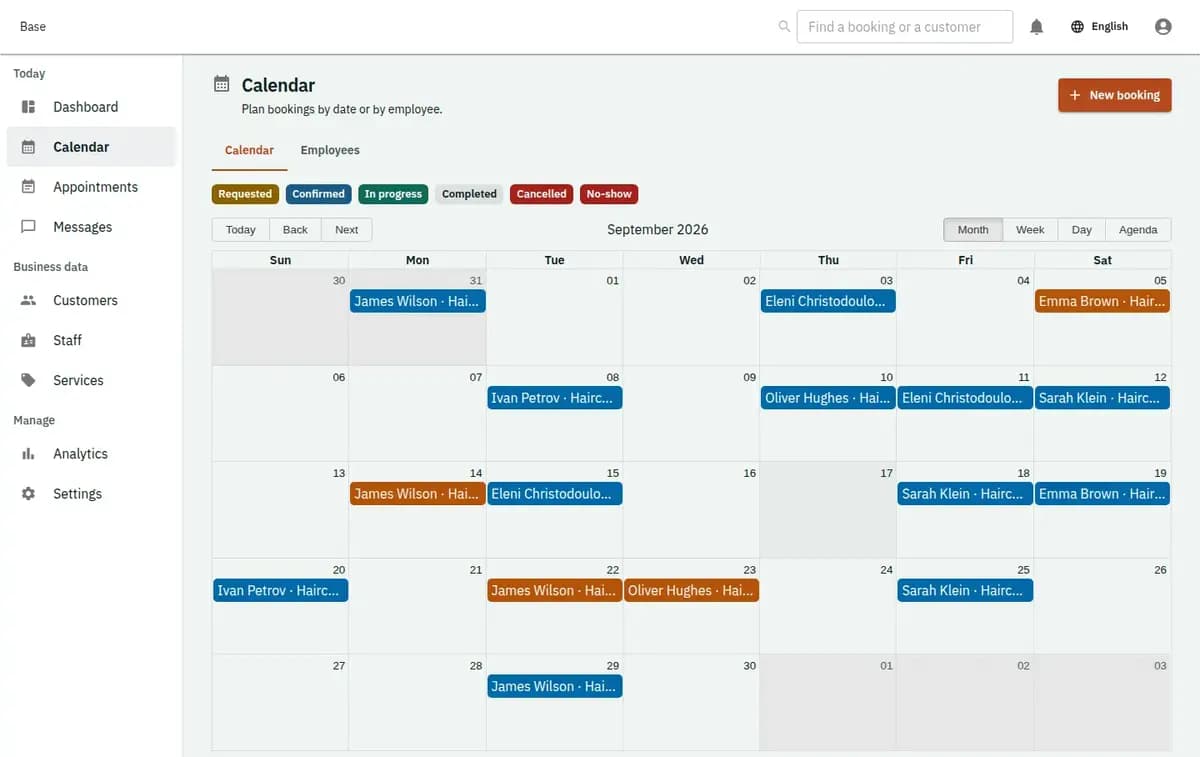
The booking console, with invented records — Staff and resource scheduling
A real console. The records in it are invented.

A booking is not only a time — it is a person, a room and a machine, all of which can be busy. Booking the time and discovering the rest afterwards is how a day falls apart.

What is included

  • Each booking holds the people and things it needs
  • Automatic pick of whoever is free, or a named choice
  • A booking that needs two things at once takes both or neither
  • Qualifications with an expiry date, so a lapsed one is not assigned
  • Per-location schedules for a business with more than one
  • Visible responsibility
  • Location-aware schedules
  • Practical workload planning

Resource scheduling software for people, rooms and vans

The people who deliver the work and everything they need to deliver it: consulting rooms, treatment rooms, chairs and tables, courts and halls, vans and cars, machines, and the countable equipment that leaves with a job. It fits a single person who is also the only resource, and a team of a dozen across two locations where four things have to line up before anybody can say yes.

What it is not

It is not a rota planner and does not decide who should work which shift, it does not calculate overtime or holiday entitlement, and it is not a human-resources system. It knows when somebody is available and what they can do — not what they are paid or how their week should be arranged.

Where the day quietly goes wrong

Three failures that look like scheduling problems and are really missing information.

Not everybody can do everything

One person does colour, one is qualified for the gas work, one has the licence for the van. A schedule that treats staff as interchangeable will send the wrong person, and the customer finds out at the door. Skills belong on the person and are checked when the work is assigned.

The room, the van and the kit are separate constraints

Two people free and one treatment room is one appointment. Three engineers and two vans is two jobs. When only people are scheduled, the second constraint is remembered by somebody, and remembering fails on the busy days rather than the quiet ones.

Real hours are not opening hours

Somebody starts at ten on Tuesdays, somebody leaves early on Fridays, somebody is on holiday for two weeks in August and somebody has a standing commitment every second Thursday. A schedule built on the shop’s hours promises time that specific people do not have.

Setting up people, skills and requirements

Four steps, and the last one is the one that keeps it true after the first month.

1. Enter people with hours and skills

Real working hours by day, days off, holidays and the services each person actually performs. If somebody only does two of your six services, saying so here removes a whole class of mistakes later.

2. Enter what limits you, and only that

Rooms, vehicles, equipment and countable stock that genuinely stop two jobs happening at once. Everything else stays out of the schedule, because a list of resources nobody checks makes the view harder to read without making it truer.

3. Say what each kind of work requires

This service needs a qualified person and a room; that one needs two people and a van; another needs nothing but the person. The requirement lives on the work, so every booking of that kind is checked the same way regardless of who takes it.

4. Keep the exceptions in the same place

Training mornings, maintenance, a vehicle off the road, a week of holiday. Exceptions belong beside the schedule rather than in a message, and the moment they live elsewhere the whole thing starts lying again.

Employee scheduling for bookings by skill and resource

Three checks that run together, because a booking with three of the four things it needs is not a booking.

The right person, not just a free one

Assignment respects who can do the work. Somebody without that skill is not offered, and a booking cannot be quietly moved to them later.

Every resource the work requires

Room, vehicle, equipment and countable extras are verified with the person for the whole period plus buffers. A missing piece produces a refusal that names it rather than a confirmation that fails on the day.

Jobs that need two people hold two people

Where the work genuinely takes a pair, both are held. Neither can be given away to something else, which is the difference between a schedule and a wish.

A missing skill and a missing van

A skill that was missing, and a van that was not.

The only person qualified is away

A customer asks for the service only one member of staff performs, on a week she is on holiday. The calendar does not offer it and the desk says so immediately, rather than booking it and calling back on Thursday to unpick it.

Three engineers, two vans

The third job of the morning has a person free and no vehicle. It is refused with the van named, moved to the afternoon when one returns, and nobody spends nine o’clock discovering it in the yard.

Availability and skills, not personnel files

A schedule is a record about employees as much as about work, and that deserves a decision rather than a default.

Availability and skills, not personnel files

Working hours, days off, the services somebody performs and the assignments they hold. Not performance notes, not medical reasons for absence, not anything an employment record should carry. A day off does not need a reason to be in the calendar.

Roles decide what each person sees

A member of staff usually needs their own day and the details of their own jobs; not everybody needs every customer’s contact details or the whole business’s numbers. What each role can see is set when the team is set up.

Preparing staff scheduling software with honest hours

Write down who genuinely does what — the honest version, including the service somebody technically can do but never should. Enter real working hours, including the person who starts late on one day a week, and put the known holidays in before the season. List only the resources that really constrain you; a room you have three of is not a constraint. Say what each type of work requires, and be strict about two-person jobs, because those are the ones that quietly fail. Then check a normal week against the schedule and look for the places where you would still have to ask somebody.

No rotas, payroll or HR

It answers who and what is available. Deciding how people should work is management, not the platform’s job.

Not rotas or shift planning

Base does not build a shift pattern, does not balance workloads across a team and does not decide who works Saturday. It takes the hours you tell it and protects them.

Not payroll or HR

Hours worked, overtime, absence policy and pay live in the systems you already use for employment. The schedule ends at what was booked and who it was assigned to.

It cannot check what it does not know

A skill nobody recorded, a van nobody entered and an unwritten rule about who covers which area cannot be enforced. The schedule is as honest as what was put into it.

Scheduling questions

How many staff and resources can I add on the Free plan?

The Free plan (€0) covers 2 staff accounts and 5 bookable items, enough to try resource scheduling software against a real week. Standard (€19/mo) and Pro (€39/mo) are priced per business. Whatever the plan, employee scheduling for bookings works the same way: each person’s real hours, services and holidays, plus the rooms and vehicles a job needs, are checked together at confirmation.

Can services be limited to certain staff?

Yes. Each person carries the services they actually perform, and work is only offered against people who can do it.

Can a booking need a room and a vehicle at once?

Yes. All the resources a job requires are checked together with the person and the buffers, and a refusal names the piece that was missing.

Are two-person jobs supported?

Yes. Where the work needs a pair, both people are held for the whole period, and neither can be assigned elsewhere at the same time.

How are holidays and irregular hours handled?

As real working hours and exceptions on each person, so a late start on Tuesdays or two weeks in August removes exactly the right availability.

Does it plan shifts?

No. It protects the hours you set and does not decide who should work when. Rotas, overtime and pay stay in the tools you already use.

Next step

Open a workspace and set up one booking flow

Registration takes an email address. The operating model, services and resources are configured afterwards, in the console.