Class booking

Yoga studio software and Pilates studio software for small classes

  • Pilates studio software that treats reformers as places
  • Every reformer is one place
  • Capacity per dated class

No card asked for · nothing taken from a booking · your data exports

Operating model
Class booking
What is booked
Class → Capacity → Schedule
Getting started
Mats, reformers and class types to count first

As yoga studio software, Base gives a small yoga or Pilates studio one timetable for mat classes, reformer sessions, weekend workshops and drop-ins. Every dated class carries its own teacher, room and number of places. On a reformer class that number is simply the machines you have working, so nobody is ever promised a reformer that does not exist. Clients book online in English, Greek or Russian, class passes count visits, a waiting list refills late cancellations, and a substitute teacher is named on the class before anyone walks in.

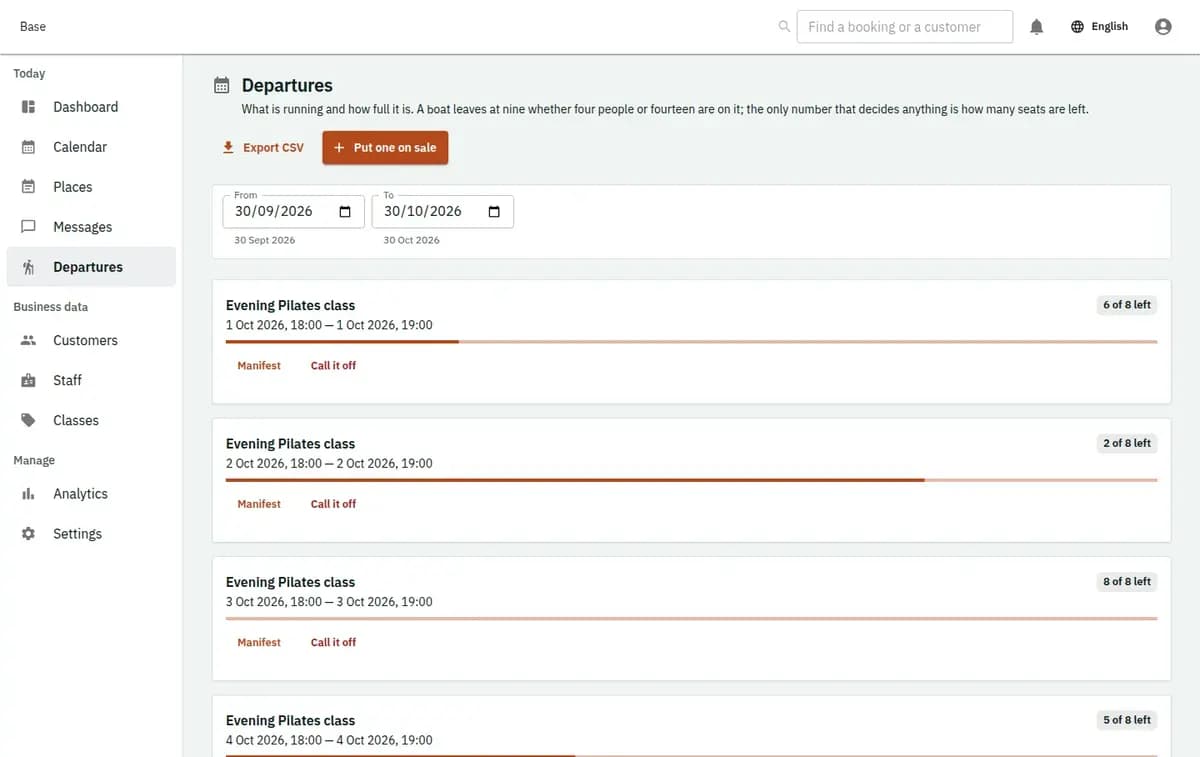
Base studio timetable with mat yoga and reformer Pilates classes, remaining places, teachers and a waiting list
A real console. The records in it are invented.

Who this yoga studio software fits

It suits an independent yoga studio, a reformer Pilates studio, or a mixed space that runs both: one or two rooms, a handful of teachers, small groups and clients who book a particular evening rather than turn up on the off chance. It works for a teacher renting a room three nights a week as well as for a studio with a mat room, a reformer room and a weekly rota of a dozen classes. If your week is a mix of regular classes, beginners’ courses, occasional workshops and private sessions, all of it sits in one place.

Yoga class booking system for drop-ins and courses

A week in the studio, from setting up the rooms to marking who came.

  1. 1. Set up rooms, reformers and class types

    Give the mat room the number of mats it really holds and the Pilates room its number of reformers. Then add the class types — hatha, vinyasa, yin, mat Pilates, reformer beginners, reformer intermediate — with length, level and the room each one normally uses.

  2. 2. Publish the weekly timetable

    The weekly pattern turns into dated classes, each with its own places and teacher. A bank holiday, a later start or a one-off cancellation changes that one date and leaves the rest of the term as it was.

  3. 3. Take drop-ins, courses and workshops

    A drop-in client books a single class. A six-week beginners’ course is published as six dated sessions that people book in sequence, with a register for each. A workshop is a one-off session with its own length, price and capacity, sitting on the same timetable.

  4. 4. Book online or at the desk

    Clients book from your Base page or the booking widget on your own site, in English, Greek or Russian, and manage their bookings from a link without creating an account. Reception books phone and walk-in clients into the same places, so there is only one count of who is coming.

  5. 5. Run the register

    The teacher sees the list for the class, marks arrivals and no-shows, and a visit is taken from the client’s class pass. Attendance stays with the dated class, ready to export to a spreadsheet when you review which slots are working.

Where a shared calendar stops working

Most studios start with a shared calendar and a messaging app. These are the points where that stops working.

Reformers are a hard limit

A mat class can squeeze in one more person; a reformer class cannot. When a Pilates room has eight machines and one is waiting for a new spring, that evening has seven places, full stop. A diary has no idea how many reformers are in working order, so the double booking is found at the door.

One timetable, very different classes

A Tuesday vinyasa class in the big room takes twenty mats, the reformer session after it takes eight, and Saturday’s inversion workshop takes twelve for three hours. Treating them all as one kind of event means either overselling the small room or turning people away from the large one.

Teachers change, clients notice

Plenty of clients come for a particular teacher. When she is ill and someone else covers, the people booked deserve to know before they cross town. A swap that lives only in a group chat reaches the staff and never the clients.

Packs of classes counted by hand

Ten-class cards punched on paper or ticked off in a spreadsheet drift out of step with what was actually attended. Nobody is sure whether a client has two classes left or none, and the conversation happens at reception with a queue behind them.

Late cancellations leave empty mats

A place freed at four in the afternoon for a seven o’clock class is worth something only if the next person hears about it quickly. Without a waiting list it simply stays empty.

Pilates studio software that treats reformers as places

What Base holds for you on every class, whether it is on a mat or a machine.

Every reformer is one place

In this pilates studio software, the capacity of a reformer class equals the machines in the room. When the last reformer is taken, the class is full for the website and the desk alike, and the next person is offered another time or the waiting list.

Capacity per dated class

If two reformers are out for repair next week, lower the places on those dates only. The class type stays the same, and the change cannot drop below the people already booked.

A waiting list that refills the room

When a class is full, clients can join its waiting list. A cancellation frees a place and the people waiting can be told by email or Telegram while there is still time to come.

Class passes counted by visit

Sell a pack of classes and Base keeps count of what has been used and what remains, so a client and reception see the same number. The money for the pack is paid to you directly; Base only records that it was paid.

Calendars and notifications

Teachers see the classes they teach in their own Google or Microsoft calendar through two-way sync. Booking confirmations, changes and reminders go out by email or Telegram.

Teachers, rooms and substitutions

Three ordinary weeks in a studio that runs yoga and Pilates side by side.

A teacher away for a week

The Tuesday and Thursday reformer classes need cover. The studio names the substitute on each of those dated classes, the clients booked are notified, and when the regular teacher returns nothing has to be undone.

The eighth reformer on a Monday evening

Seven reformers are booked and two clients try for the last one within the same minute. One gets it; the other sees the class as full and joins the waiting list. On Monday afternoon someone cancels and the place goes to the person waiting.

A Saturday workshop in the mat room

A three-hour backbends workshop is published with twelve places and its own price, separate from the regular classes. It appears on the same timetable, takes bookings in all three languages and has its own register on the day.

One room, two teachers

A yin teacher rents the mat room on Wednesday evenings. Her classes sit on the studio timetable with her name, and the room cannot be given to a second class at the same hour.

Class passes, attendance and what stays out

What the studio keeps in Base, and what it deliberately leaves out.

A register, not a health file

A class list holds who booked, who came and who did not. Injuries, pregnancies and anything a client mentions to the teacher belong in whatever your studio already uses for that, under its own rules — not on a booking.

Passes are a count of visits

Base counts the classes used from a pack. It does not hold the money, refund an unused class or decide what an expired pass is worth; those are the studio’s own decisions.

Changes leave a trace

A substitution, a lowered capacity, a cancelled class or a late cancellation is recorded with the time and the person who made it, so a disagreement at reception can be settled from the record.

Plans without commission

Base takes no commission on bookings. A studio picks the Free plan at €0 with 2 staff accounts, or Standard at €19 and Pro at €39 when it grows.

Mats, reformers and class types to count first

Count the mats your room genuinely takes and the reformers that are in working order. Write down the class types with their length, level and usual room, and the weekly timetable you want to publish. Add the teachers with the days they teach and the weeks they are away, and decide who may cover whom. Decide how late a client may cancel, how your class passes work and whether each class keeps a waiting list. Then publish a single week, watch what reception has to fix, and publish the rest of the term.

What Base does not do for a studio

Said plainly, so nobody discovers it after the term has started.

When it is not the right tool

Base is not a membership billing system: it does not charge a monthly fee automatically, take cards or open the door for a member. It does not stream online classes, keep health questionnaires or track anyone’s practice over time. A large gym chain with turnstiles and direct debits needs a different kind of product.

No automatic membership billing

Base does not charge a monthly membership, run direct debits or take card payments. Clients pay you as they do today, and the payment or deposit can be recorded against the booking.

No door access or streaming

There is no turnstile or door control, and no video streaming for online classes. A livestream link can be shared with clients by email, but the class itself runs elsewhere.

No health or progress tracking

Base does not hold medical questionnaires, injury notes or a record of anyone’s practice. Keep those under your own policies.

No SMS and no teacher payroll

Notifications go by email and Telegram, not SMS. Attendance can be exported to work out what teachers are owed, but Base does not run payroll.

Yoga studio software questions

Can clients choose a specific reformer?

Clients book a place on the class, and each reformer in the room counts as one place. Which machine a client uses is decided in the room, the way most studios already do it.

Can mat classes and reformer classes share one timetable?

Yes. Both appear on the same timetable, each with its own room and capacity, so the mat room can take twenty while the reformer room takes eight at the same hour.

How do drop-ins and class passes work together?

A client can book a single class as a drop-in or use a class pass, and Base takes one visit from the pass when the booking is used. Payment itself is made to the studio directly.

What happens when a teacher is ill?

Name the substitute on the affected dated class. The clients booked can be notified by email or Telegram, and the rest of the timetable is untouched.

Is there a waiting list for full classes?

Yes. Each class keeps its own waiting list, so a place freed by a cancellation can go to the next person before the class starts.

Can clients book from our own website?

Yes. Add the booking widget to your site or link to your Base page. Clients book in English, Greek or Russian and manage their bookings without an account.

Does it take a commission on bookings?

No. The yoga class booking system works on a plan per studio — Free at €0, Standard at €19 or Pro at €39 — with no commission on any class.

Next step

Open a workspace and set up one booking flow

Registration takes an email address. The operating model, services and resources are configured afterwards, in the console.