
Class booking

Kids activity booking system for sessions, camps and courses

  • Places on a session, not per child
  • The last place goes once
  • A family books together or not at all

No card asked for · nothing taken from a booking · your data exports

Operating model
Class booking
What is booked
Class → Capacity → Schedule
Getting started
What to prepare in camp registration software before a term

A children’s session has two people on it: the child who attends and the adult who books, pays and has to be reachable. It has an age band, because a class for five-to-sevens is not a class a nine-year-old sibling can join. And it has a number of places that comes from the staff-to-child ratio rather than from the size of the room. Base publishes sessions with those places, keeps the parent and the child on one record, and gives the leader a register at the door instead of a printed list that is already out of date.

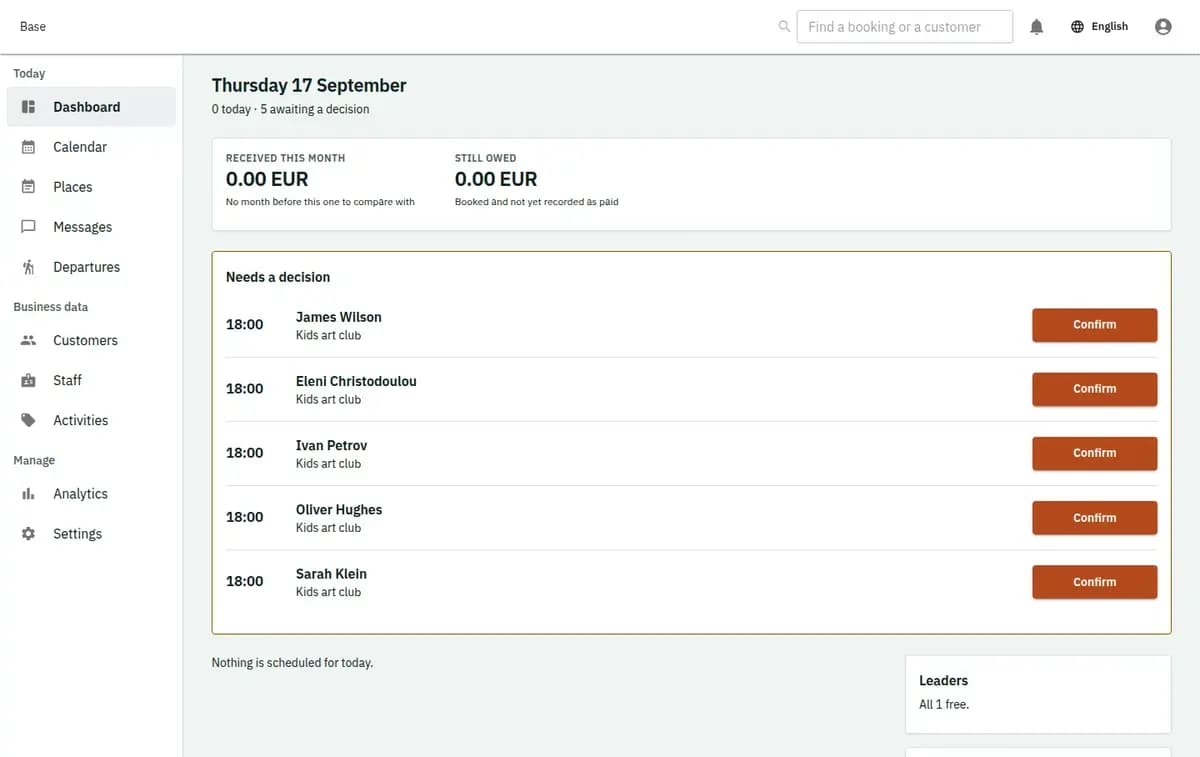
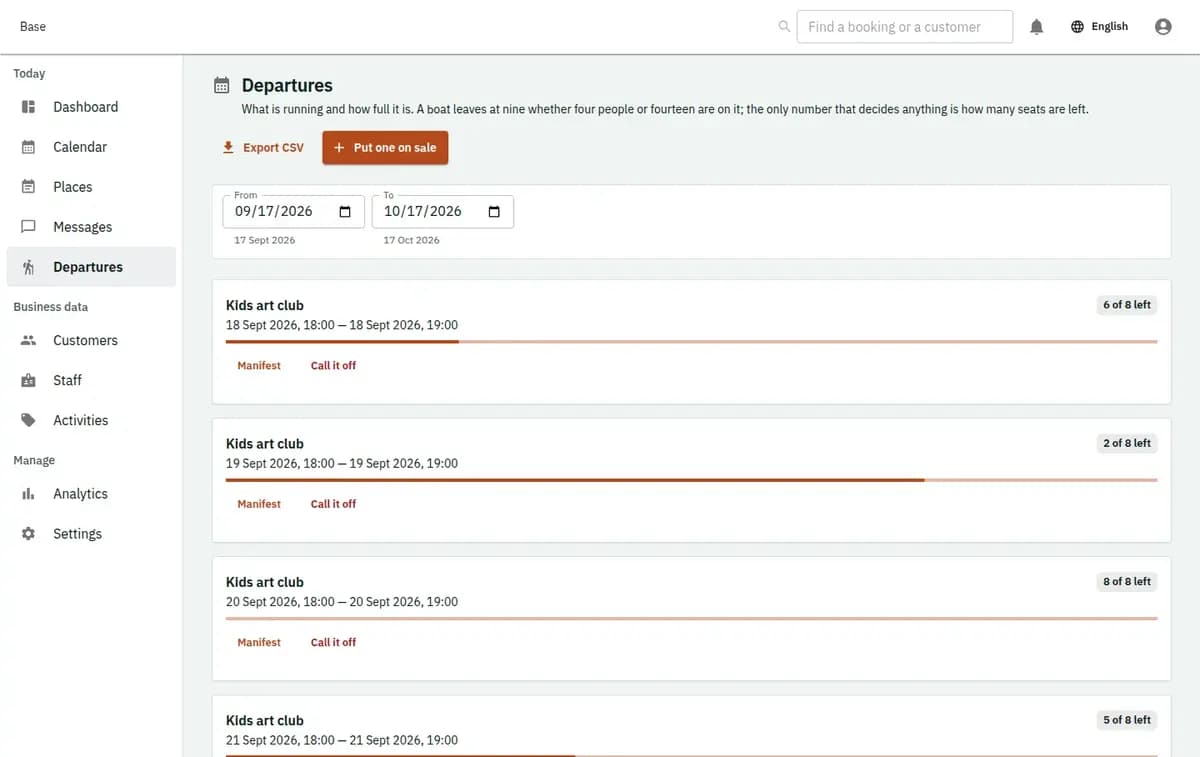
Base session view showing places, age band, assigned leader and the day’s participant register
A real console. The records in it are invented.

Who this kids activity booking system fits

It fits a club, play centre, dance or football school, art studio or holiday camp that sells places in sessions: drop-ins, weekly classes, a course of eight Saturdays, a week of holiday club. It is useful when a session has a fixed capacity that depends on how many staff are on, when children have to be in the right age band, when the person booking is not the person attending, and when someone has to stand at the door and know which twelve children are expected.

Kids club booking software from term to register

Sessions are published, places are taken, the door is worked. Everything else is bookkeeping around those three.

  1. 1. Build the timetable you can actually staff

    Create sessions with their day, time, age band, places and the leader who runs them, plus the room where the room is the limit. A course is a run of sessions with the same children; a drop-in is a single session. Set the places to what your staffing supports rather than what the hall holds — it is easier to add a place than to explain why you took a booking you cannot serve.

  2. 2. Take the booking with the child in it

    A parent asks for a place and gives the child’s name and age. Staff can enter a booking taken at the desk or by phone with the same fields. Nothing holds a place until confirmation, which matters on the Monday a holiday club opens and forty parents look at the same page.

  3. 3. Confirm against places, age and the leader

    Confirmation checks the remaining places for that session, the child’s age against the band, and that the session still has its leader. Two children from one family are confirmed together or not at all, because sending a parent away with one place out of two is not a service. If a place has just gone, the parent is told while another session can still be offered.

  4. 4. Work the door

    The leader opens the session and sees who is expected, with the adult’s contact next to each child. Arrivals are marked as they come in; a child who does not arrive is a no-show on the record rather than a name that stays ambiguous. A late cancellation frees the place for the session that has not started yet.

  5. 5. Close the session and the course

    The session is completed with who attended and who did not. Across a course, the pattern is visible — a child who has missed three of eight is a conversation the club can choose to have. Fees, refunds and credits are handled by the club outside Base and recorded as facts; the profile counts places and attendance, never money.

Who is in the room and who collects

The problems are not about time slots. They are about who may be in the room and who is expected at the door.

Capacity comes from the ratio, not the room

A hall that fits thirty children is not a session for thirty. The number of places is what your staffing allows, and it changes when a leader calls in sick. Places are configured per session, so an activity with one leader offers what one leader can take, and a second leader on the Saturday is what makes sixteen places honest. Base counts places against confirmed bookings; it does not decide what your ratio should be, and it is not a regulator.
The wrong age is the awkward conversation

A parent books the five-to-sevens for a four-year-old and nobody notices until Saturday morning. Sessions carry an age band, the child’s age is part of the booking, and a booking outside the band is refused when it is made rather than at the door. That turns an argument in front of other parents into a message on a Tuesday.

Two people, one booking

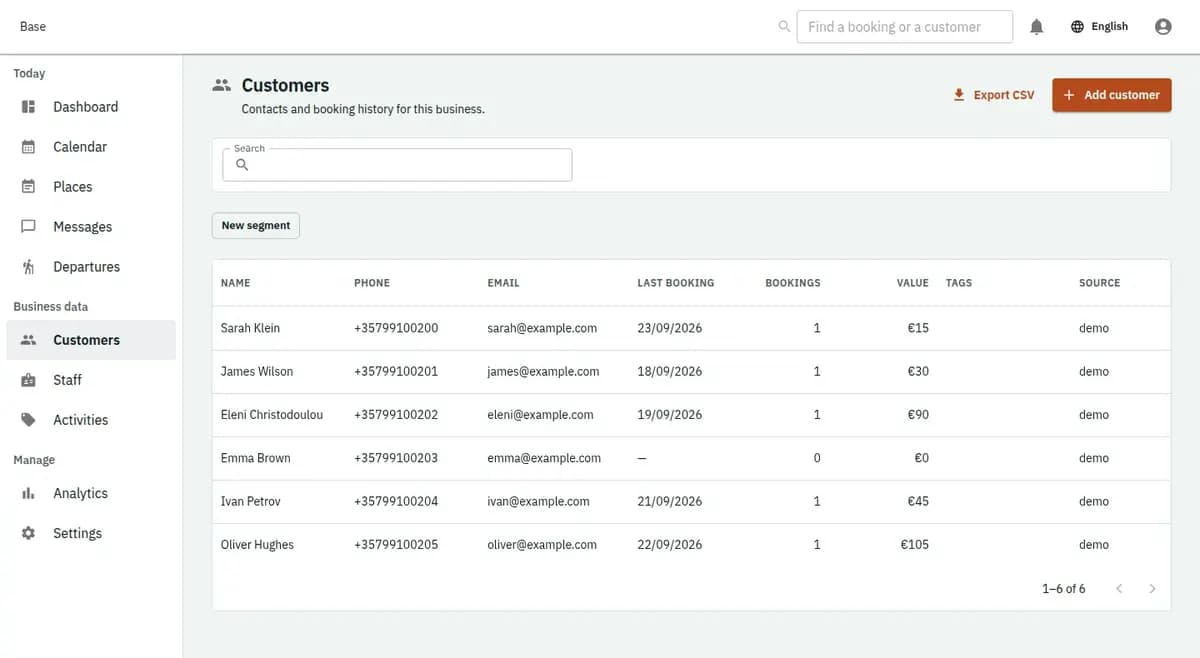
The child attends; the parent pays, cancels and has to be phoned when the class is cancelled. Both sit on the same record: the child’s name and age for the register, the adult’s contact for everything else. A club that keeps children in one list and parents in another spends its Saturdays matching them by surname, which fails exactly when a family has two.

The booking console, with invented records: the customer list

Places on a session, not per child

The allocation is a count against one published session, which is a different rule from booking a person or a thing.

The last place goes once

A booking takes places from the session’s number and returns them on cancellation. Two parents confirming the last place at the same moment do not both succeed: one takes it and the other is refused immediately, with the real number shown. On the Monday morning a holiday club opens, that is the whole difference between a busy hour and forty apologies.

A family books together or not at all

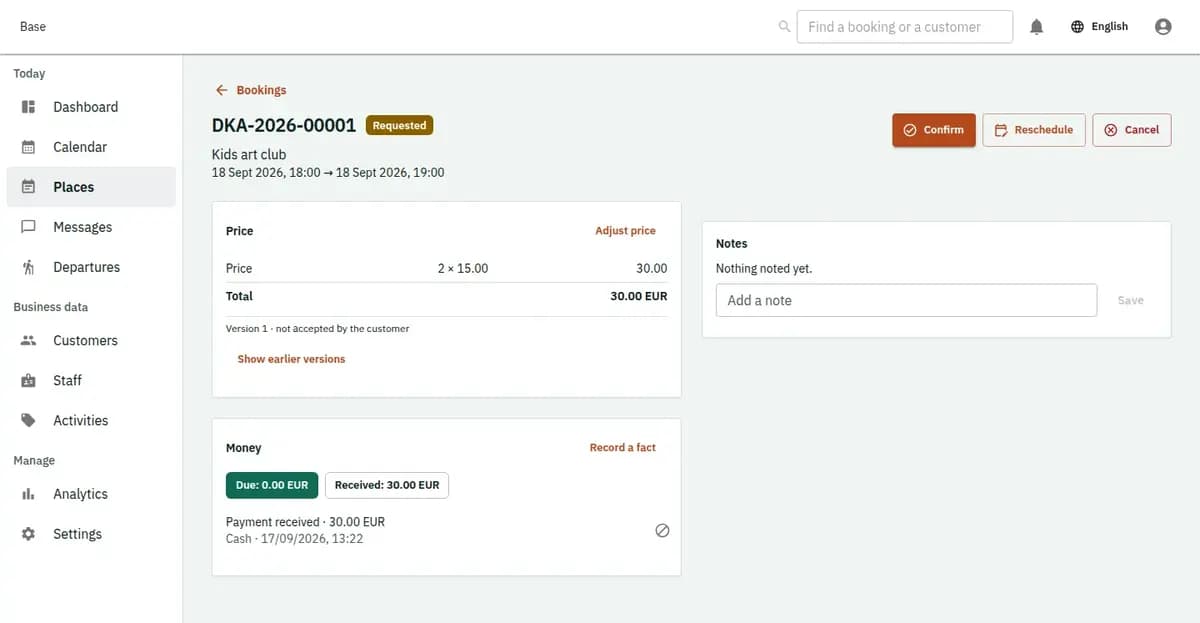
Two siblings needing two places are one confirmation. If only one place is left, the booking is refused rather than half-served, because a parent with one place for two children has a problem the club has just created. Staff can then offer the other session, the second week, or the place they free by moving somebody.

The booking console, with invented records: one booking with its price lines and history

A Saturday session and a holiday week

The three moments that make the difference between a calm door and a scramble.

Two sisters, one term of eight Saturdays

The parent books both children onto the course. Confirmation takes two places from each of the eight sessions in one action, so the club knows in September what it has committed to in November. The leader has the same two names on every register, and the parent’s contact is on both.

The leader is ill on Saturday morning

The session cannot run at the ratio it was published at. Staff cancel or reduce it as an operator decision with a reason, the places are released, and every affected booking is visible in one list with the adult contact next to it. Base does not phone anyone and does not decide whether to run with fewer children — it makes sure nobody is missed while somebody does.

A four-year-old is booked into the five-to-sevens

The refusal happens at booking, with the age band as the reason, so staff can offer the younger session instead. The alternative is the version every club knows: a child at the door on Saturday, a parent who has taken the morning off, and a leader deciding on the spot.

The booking console, with invented records: the day’s requests and money

Sensitive child details kept out on purpose

This is the section that matters most for a children’s activity, and the honest answer is a short list of things the profile refuses to hold.

No safeguarding, medical or collection records

Base keeps the child’s name and age for the register and the adult’s contact for the booking. It does not hold allergy or medical information, consent forms, collection permissions, photographs of children or anything a safeguarding process depends on. That is not an omission to be fixed later: those records carry duties, retention rules and access controls that belong in the club’s own process, and putting them in a booking calendar would make them easier to reach and harder to govern.

Attendance is an operational note, not a statutory register

Marking who arrived helps the leader run the session and helps the club talk to a parent about a course. It is not a legal attendance record, is not evidence of supervision and does not satisfy any obligation a club or school may have. What the club must keep, it keeps where it already keeps it.

What to prepare in camp registration software before a term

Write down the sessions you actually run, with day, time, age band and the leader for each. Set places from your staffing, not from the size of the hall, and be honest about the Saturdays when only one leader is on. Decide what a course is — how many sessions, whether a missed week is made up — and set it up that way rather than as eight unrelated bookings. Decide who at the club may cancel a session and who may mark a register. Then load the children you already have before the term starts: the bookings that fail to import are the ones your paper list has been double-counting.

What the kids activity booking system will not do

A children’s club has obligations a booking calendar has no business pretending to meet.

When a different product is needed

Base does not keep safeguarding records, consent forms, collection permissions, medical or allergy information, or a statutory attendance register. That is deliberate and explained below. It does not arrange transport, run a school timetable, manage a nursery ratio as a regulated obligation, take payment or act as a marketplace.

It is not a safeguarding system

No consent forms, no collection lists, no incident records, no photographs, no medical notes. If a club needs those, it needs a process built for them with its own access rules and retention — not a field added to a booking.

It does not enforce a regulated ratio

You set the number of places. Base counts bookings against that number and refuses the one that would exceed it. It does not know what ratio your activity is required to keep, does not check a staff qualification and does not make a club compliant.

A refusal is a valid result

A full session, a child outside the age band, a cancelled session or a course whose places are gone stops the booking. The previous state is untouched, the reason is in plain words, and staff can offer the other session while the parent is still reading the message.

Kids activity questions

Can parents book a holiday camp week online in their own language?

Yes. Parents book from your booking page in English, Greek or Russian, naming the child who attends while they stay the contact on the record. As camp registration software, Base sells a week of holiday club or a course of Saturdays as places within each session's age band and capacity. The same kids club booking software handles drop-ins, and notifications go by email or Telegram, not SMS.

Can a parent book two children in one go?

Yes, and it confirms as one action. If only one place is left, the whole booking is refused rather than leaving a parent with a place for one of two children.

How are age limits handled?

Each session carries an age band and the child’s age is part of the booking, so a booking outside the band is refused when it is made — not discovered by the leader at the door on Saturday morning.

Can a course of several weeks be booked at once?

Yes. A course takes a place in every one of its sessions in a single confirmation, so the club can see in advance what it has committed to and the leader has the same register every week.

Does Base keep allergy or consent information?

No, deliberately. It keeps the child’s name and age and the adult’s contact. Safeguarding, medical and consent records belong in the club’s own process, where the access rules and retention that they require actually live.

What happens when a leader is ill?

Staff cancel or reduce the session as an explicit decision with a reason. The places are released and every affected booking appears in one list with the adult contact beside it, so nobody is missed while the club phones round.

Is the register a legal attendance record?

No. It is an operational note that helps run the session and talk to parents about a course. Any statutory record a club must keep stays in the system built for that purpose.

Next step

Open a workspace and set up one booking flow

Registration takes an email address. The operating model, services and resources are configured afterwards, in the console.