
Appointment booking

Personal trainer app for standing slots and packages

  • Personal trainer booking software that protects each trainer's hour
  • One trainer hour, however many people are in it
  • Travel time between two addresses

No card asked for · nothing taken from a booking · your data exports

Operating model
Appointment booking
What is booked
Service → Staff → Time
Getting started
Trainers, hours and rooms to enter first

A personal training client does not browse for a slot. They train with Katerina at seven on Tuesday and Thursday, they bought ten sessions in advance, and the arrangement runs for months. Base books that standing pair of hours against the trainer they actually train with, counts what is left of the block in sessions rather than in money, and records what happened when a client cancels at nine the night before.

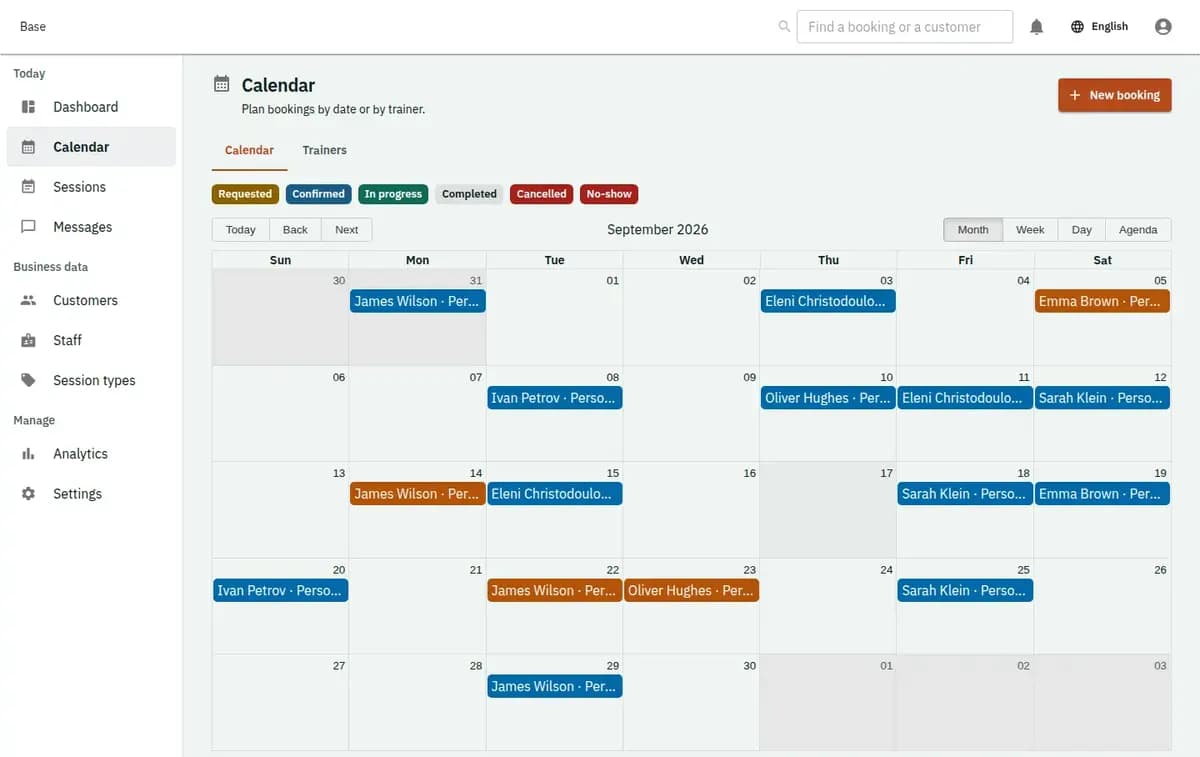
Base calendar showing standing weekly one-to-one sessions by trainer with remaining package sessions
A real console. The records in it are invented.

Who this personal training software fits

It fits an independent trainer, a small studio with three or four trainers, and a gym floor where one-to-one work has to be scheduled around everything else. It is useful when clients come back weekly at the same hour, when sessions are sold in blocks of five or ten, when a couple trains together on a single trainer hour, when the trainer travels between a studio and a client’s building, and when the late-cancellation rule is the difference between a full week and a half-empty one.

PT scheduling software for standing weekly sessions

Set up the people and the hours, then let a standing arrangement produce the weeks.

  1. 1. Enter trainers and the places they work

    Each trainer goes in with their real hours, their days off and the weeks they are away. Rooms or a studio floor are entered where the space genuinely limits how many sessions can run at once — and left out where the trainer is the only constraint. A trainer who does home visits gets travel time between sessions, so the calendar stops promising eight o’clock across town after seven o’clock in the studio.

  2. 2. Describe what you sell in sessions

    A single session, a block of five, a block of ten, a couples session that takes one trainer hour for two people. Durations are the ones you actually run — forty-five or sixty minutes — with whatever gap you need between clients. A price sits beside them, but the block is counted in sessions and that count is what the desk reads.

  3. 3. Make the first session a consultation

    The first booking is where the trainer learns what the client is doing, what they can manage and how often they can realistically come. That conversation decides whether this becomes a standing Tuesday or an occasional booking, and it belongs in the calendar as a session in its own right rather than an unpaid favour nobody wrote down.

  4. 4. Set the standing hours and let the weeks come from them

    Once the pattern is agreed, the weekly hours are created as a series against that trainer. One week can be moved or cancelled without touching the rest, and a holiday can be taken out of the middle. The trainer sees the commitment as an arrangement, not as a wall of identical entries.

  5. 5. Record the outcome, not only the attendance

    Attended, late-cancelled, cancelled in time or no-show: every session ends in one of them. That outcome moves the package count and is what the studio has to hand three months later when a client asks how eight became six.

What one-to-one training does to a calendar

Three things separate this from an appointment book, and all three are about repetition.

The same hour every week is the product

Most one-to-one work is not a single appointment; it is Tuesday and Thursday at seven for the next three months. Entering that as twenty-four separate bookings is how one of them ends up missing. The standing arrangement is created once and the sessions come from it, so a client can move a single week without losing the slot, and the trainer can see what an hour is already committed to before agreeing to anything else.
A package is a count of sessions, not a balance of money

Ten sessions bought in advance is a number that must go down exactly once per session and be visible to whoever is at the desk. Kept in a notebook, the disagreement at session eleven has no answer. Base holds that count against the client and moves it on the recorded outcome of each session, which is exactly why a late cancellation has to be recorded rather than quietly moved.

A cancellation at nine at night is a rule, not a mood

Every studio has a notice period and every studio struggles to apply it the same way twice. The booking keeps when the cancellation arrived and which rule was published at the time, so deciding to spend the session or return it starts from a fact. Base does not take or return money for it; it makes the conversation short.

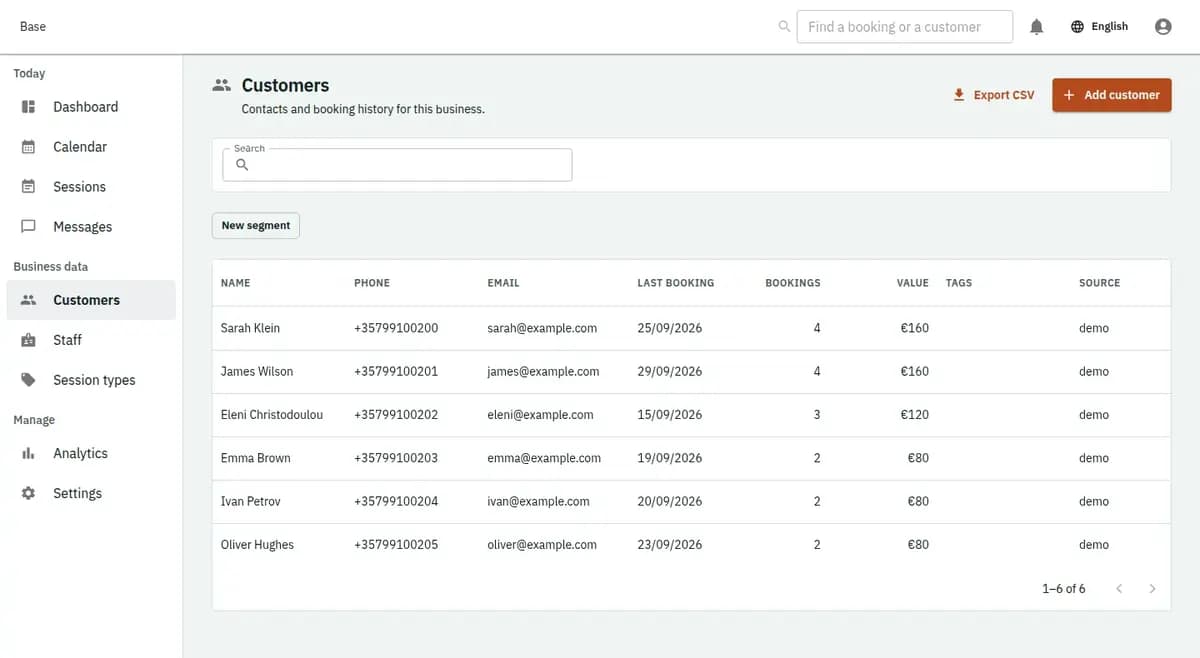
The booking console, with invented records: the customer list

Personal trainer booking software that protects each trainer's hour

The scarce thing is one trainer’s hour, and almost every failure here is a way of selling it twice.

One trainer hour, however many people are in it

A couples session takes the same hour as a single one; it does not double the trainer. Two sessions that would overlap on one trainer are refused, and the person at the desk sees which booking is in the way instead of a blank refusal.

Travel time between two addresses

A trainer who works in a studio and in clients’ buildings needs the gap between them protected. It is configured per trainer and subtracted from availability, so the booking that only works if nobody has to travel is the one that gets refused.

A block that has run out stops being spent

When the last session of a package is used, the next booking is a purchase decision rather than an accident. The remaining count is visible at the moment the booking is made, not discovered at the end of the month.

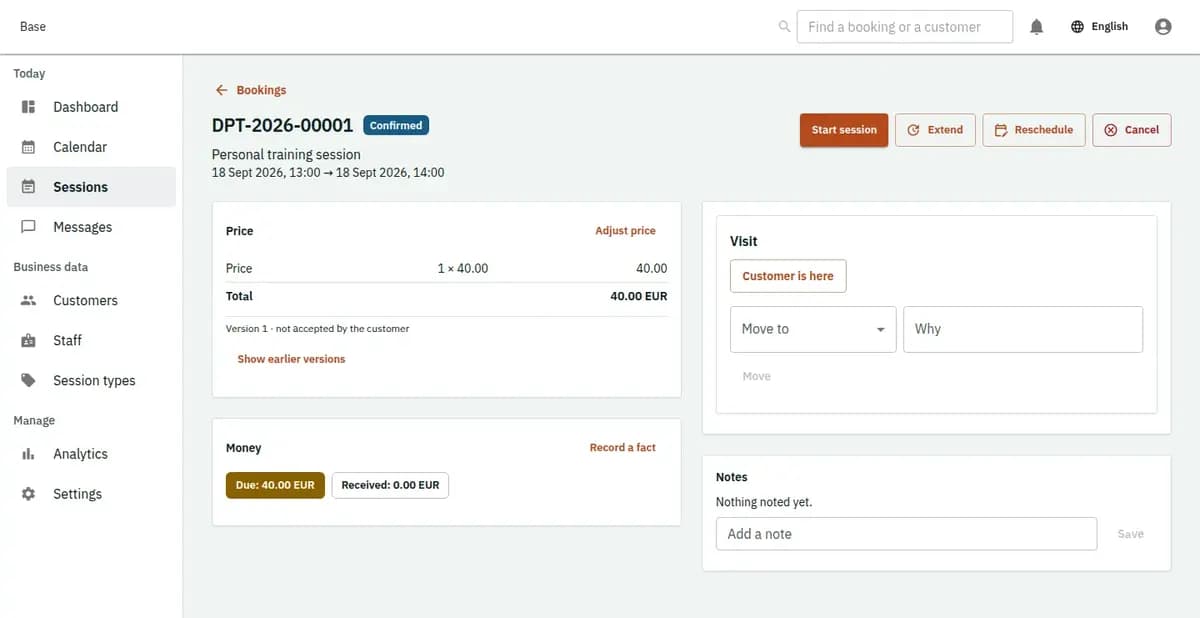
The booking console, with invented records: one booking with its price lines and history

Standing slots, moved sessions and shared hours

The standing pair of hours, the Thursday that moved and the couple sharing one slot.

Ten sessions, twice a week

A client buys ten and takes Tuesday and Thursday at seven. The arrangement runs five weeks; the count falls by one per attended session and the desk can answer how many are left without opening a drawer. When two remain, the trainer raises the next block before the last week rather than after it.

A Thursday moved, the slot kept

A client cannot make one Thursday and asks on Tuesday. That single week moves to Friday; the standing hour stays theirs for the weeks after it. Nothing is rebuilt, and the trainer’s Thursday at seven is free for a one-off session that week.

A couple on one hour

Two people train together with one trainer at six. The booking takes that hour once, records both attendees, and spends one session from the arrangement they agreed. It does not become two bookings competing for the same trainer, which is how a couples slot usually breaks a calendar.

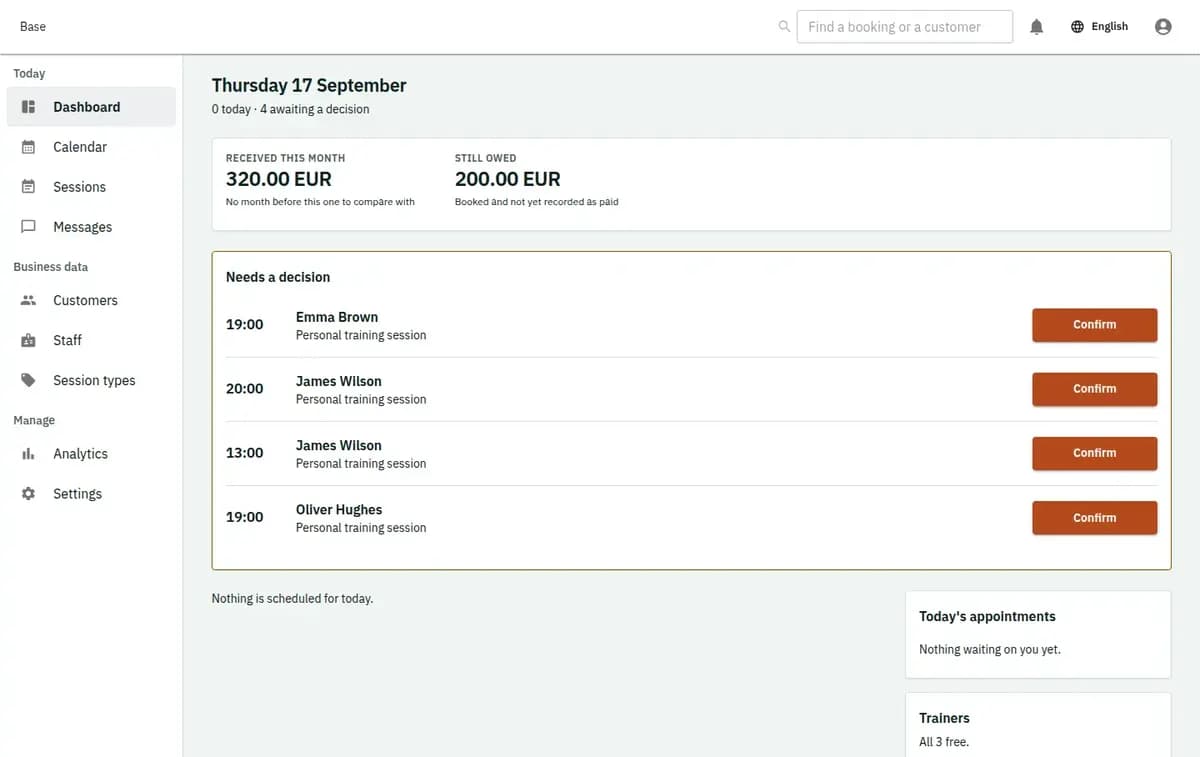
The booking console, with invented records: the day’s requests and money

Health details stay outside the booking

Fitness invites health information, and a booking calendar is the wrong place to accumulate it.

No health data by default

Base holds the contact details, the trainer, the session and its outcome. Injuries, conditions, medication, weight and measurements are not needed to arrange an hour and should not be typed into it merely because the session is about fitness. Where a trainer keeps a client record, it belongs in the tool chosen for that, under the trainer’s own retention rules.

A package balance is not an account

A count of sessions is not money. Base does not hold funds, does not refund an unused block, does not price a session at the moment it is spent and does not decide what an expired block is worth. It says how many sessions were used, when, and how each one ended.

Trainers, hours and rooms to enter first

Enter every trainer with the hours they actually work, their days off and their holidays, and decide whether a room is a real constraint or whether the trainer is the only one. Set travel time for anyone who works at more than one address. Write down your package sizes and your notice period, and decide now what a late cancellation does to a block — that single decision settles most of the arguments you will have. Decide who may book on a trainer’s behalf and who may cancel. Then enter the standing clients you already have before you go live, because the hours that will not fit are the ones you have quietly double-promised.

Where this personal trainer app stops

One-to-one training sits next to several other products, and this is only the hour.

When a different product is needed

Base does not write training programmes, does not store body measurements, weight, photographs or health questionnaires, does not plan nutrition, does not sell a package and does not judge whether somebody is fit to train. It is not a gym membership system, not a timetable for large group classes, and not a marketplace that finds clients for a trainer.

Not a programme or a progress log

Sets, reps, loads, photographs and measurements belong to the trainer’s coaching tool. Base does not design a plan, does not track progress and does not turn a session into a health record.

Not memberships or group classes

Door access, monthly membership billing and a timetable of classes with a capacity are a different product and, for classes, a different profile. Mixing them into one-to-one bookings makes both harder to read.

A refusal is a valid result

A trainer already booked, an hour that does not clear the travel gap, a room in use or a package with nothing left in it stops the booking. The previous state stands, the reason is plain, and the desk offers an hour that works instead of one that does not.

Personal training questions

Can an independent trainer use it without paying?

Yes. The Free plan at €0 includes 2 staff accounts and 5 bookable items, which suits an independent trainer. As personal trainer booking software, Base books standing weekly slots against you and counts the sessions left in a block. Two-way Google or Microsoft calendar sync keeps your personal training software and your own calendar in step; a studio can move to Standard at €19 or Pro at €39 a month.

How are weekly standing slots handled?

The recurring hours are created once as an arrangement against one trainer, and the individual sessions come from it. A single week can be moved or cancelled without disturbing the others.

Does Base track how many sessions are left in a package?

Yes, as a count of sessions. It goes down on the recorded outcome of each session and is visible when the next booking is made, so nobody has to reconstruct it at the end of the month.

What happens with a late cancellation?

The booking records when it arrived and which notice rule applied. Whether the session is spent or returned is the studio’s decision, taken from that record. Base does not charge or refund anything.

Can two people share one session?

Yes. A couples session takes one trainer hour, records both attendees and spends one session from the agreed arrangement rather than becoming two competing bookings.

Can a trainer work at more than one address?

Yes, with travel time configured per trainer. The calendar subtracts it from availability, which is what prevents a session being confirmed on the other side of town straight after another one.

Are health details and training plans stored here?

No. Programmes, measurements, injuries and health questionnaires stay in whatever the trainer uses for coaching. The booking holds contact details, the trainer, the session and how it ended.

Next step

Open a workspace and set up one booking flow

Registration takes an email address. The operating model, services and resources are configured afterwards, in the console.