Appointment booking

Driving school software for instructors, cars and test days

  • Three checks the driving instructor booking system makes
  • The instructor and the car are checked together
  • Pickup travel is subtracted from the day

No card asked for · nothing taken from a booking · your data exports

Operating model
Appointment booking
What is booked
Service → Staff → Time
Getting started
Cars, instructors and categories to enter first

A driving lesson is two scarce things at once: an instructor and a dual-control car of the right kind. An automatic pupil cannot take the manual car, the eleven o’clock is on the other side of town from the nine o’clock, and the test day takes both the instructor and the car for half a morning rather than for an hour. Base checks the person and the vehicle together, protects the drive between two pickup points, and counts what is left of a block of lessons in lessons.

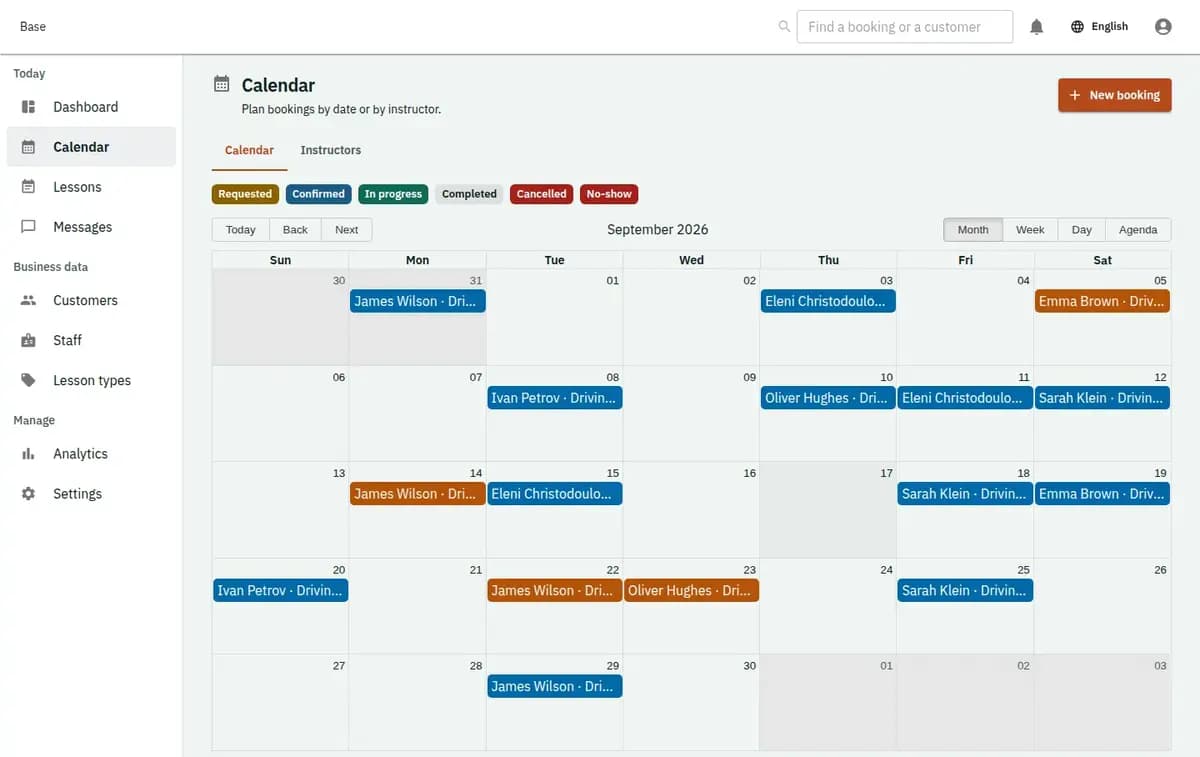
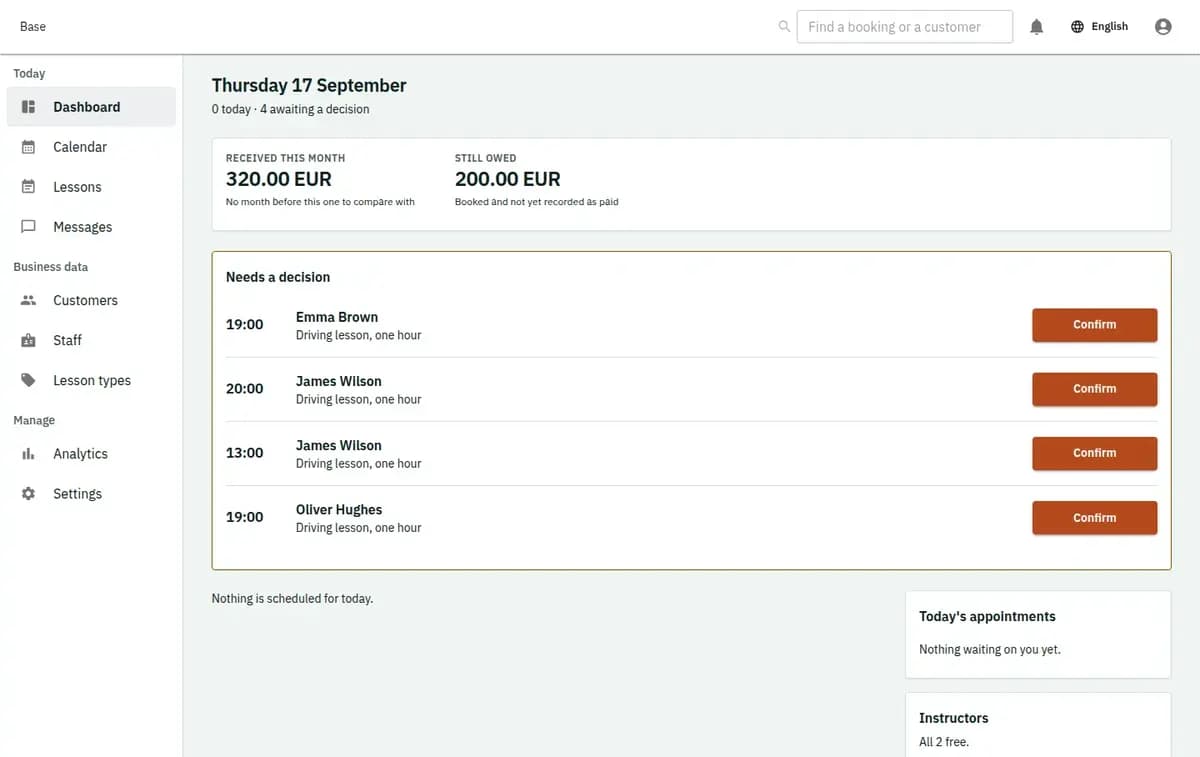
Base calendar showing driving lessons by instructor and car, pickup gaps and a test day block
A real console. The records in it are invented.

Who this driving school software fits

It fits an independent instructor with one car and a school with a yard of them: manual and automatic, a motorcycle or a van for a different category. It is useful when pupils are collected from home, work or a college rather than arriving at an office, when lessons are sold in blocks of five or ten, when the test day has to be taken out of the week for a specific instructor and a specific car, and when a car going in for service must remove exactly the lessons it was carrying and nothing else.

From the first assessment to the test

Enter the yard and the people once, then the weeks build themselves around them.

  1. 1. Enter instructors and cars as separate resources

    Each instructor goes in with their real working hours and the days they are away. Each car is entered with its transmission, the category it is used for and its own maintenance blocks. A car booked in for a service on Thursday takes only the lessons that needed that car out of the week.

  2. 2. Describe lesson types by what they use

    A standard hour, a ninety-minute lesson, a first assessment, a motorway lesson, a test-day block. Each carries its real duration, the kind of car it needs and the travel buffer around it. That description is what stops the day being sold as a row of identical boxes.

  3. 3. Register the pupil with what your staff actually read

    The permit category, the transmission they are learning on, the expiry your staff saw and where they are collected from. Base compares that recorded category against the car a lesson would use and refuses the mismatch; it does not check any document against an authority, and it never claims to have verified anybody.

  4. 4. Build the series and hold the test day early

    Regular lessons go in as a series toward a test date, and the test day is held as a block as soon as it is known. Holding it late is how a school discovers that the only automatic car is already out on the morning of the test.

  5. 5. Record how each lesson ended

    Taken, cancelled in time, cancelled late or a no-show. The outcome moves the count of the block and, together with the recorded time of the cancellation, is what makes the conversation about a spent lesson short.

What a driving school day has to hold

Four things break a calendar that only knows about instructors.

The car is a second booking, not a detail

Two instructors and one automatic car is one automatic lesson at a time. A calendar that books only people confirms both lessons, and somebody discovers the conflict at half past eight in the morning. The vehicle is entered as its own resource with its transmission and the category it is used for, and a lesson holds the instructor and the car together or it is refused.

The gap between two pickups is not free time

A lesson that ends outside a school and a lesson that starts at a supermarket twenty minutes away are not back to back, whatever the calendar says. That travel is configured as a buffer and subtracted from availability, so the day stops selling an hour that begins where the instructor cannot be.

Test day is a block, not a lesson

A practical test takes the instructor and the car for the drive to the centre, the wait and the drive back. Booked as a sixty-minute lesson, it silently double-sells a morning that was never available. Held as a block, it removes exactly the hours it consumes and returns the rest to the week.

A block of lessons is a count that people argue about

Ten lessons paid for in advance is a number that must go down once per lesson and be visible to whoever answers the phone. When a pupil cancels an hour beforehand, whether that lesson is spent is a rule, and the rule needs a record of when the cancellation arrived rather than a memory of it.

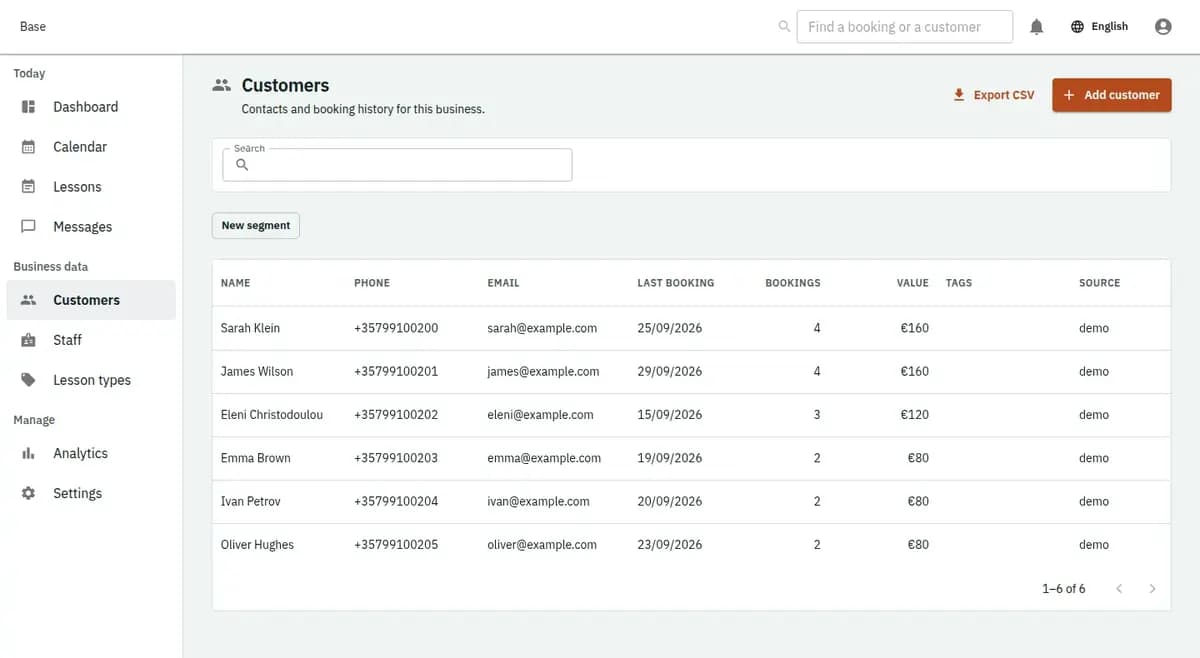
The booking console, with invented records: the customer list

Three checks the driving instructor booking system makes

Three checks, and every one of them is a morning somebody would otherwise lose.

The instructor and the car are checked together

A lesson holds both for its whole length plus its buffers. If either is taken, or the only car of the right transmission is out, nothing is confirmed in half — the refusal names which of the two was missing so the desk can offer the alternative that exists.

Pickup travel is subtracted from the day

The buffer around a lesson is real time. Two lessons at opposite ends of a town cannot be confirmed back to back, which is the difference between a schedule that works on paper and one that works in traffic.

Maintenance removes the right lessons

A car blocked for a service, a tyre or an inspection stops being available for the hours it is out, and only the lessons that needed that specific car are affected. The rest of the yard carries on.

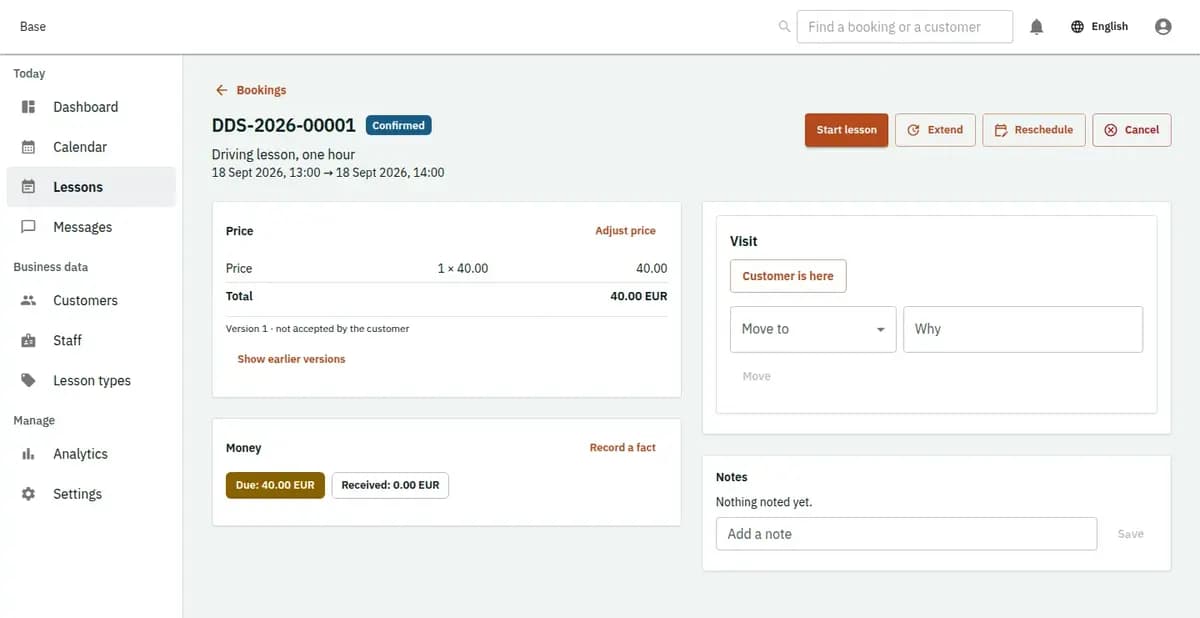
The booking console, with invented records: one booking with its price lines and history

Test preparation, car servicing and late cancellations

A pupil approaching a test, a car in for service and a Saturday cancelled at nine at night.

Ten lessons toward a test

A pupil buys ten and takes two a week on the automatic car. The count falls per lesson taken, the test day is held in the diary six weeks out with that instructor and that car, and when two lessons remain the school raises the next block before the last week rather than after it.

The automatic car goes in for a service

The car is blocked for Thursday morning. The lessons that needed it appear as the ones to move, the manual lessons that day are untouched, and nobody has to reconstruct which pupil was on which car from a paper diary.

A Saturday cancelled at nine at night

The pupil cancels the morning lesson late. The booking records when the cancellation arrived and which notice rule applied, and the school decides from that record whether the lesson comes out of the block. The hour itself is released, so an instructor with a waiting list can still fill it.

The booking console, with invented records: the day’s requests and money

Legal duties the school still owns

A driving school carries legal duties that a calendar cannot take on, and should not appear to.

Documents are recorded, not verified

Base stores the permit category, transmission and expiry that your staff entered, and uses them to refuse a lesson on the wrong car. It does not read a licence, does not contact an authority and is not evidence that anybody checked anything. The check happens in front of your member of staff, and the responsibility stays there.

No syllabus, no progress record

What a pupil can and cannot do yet, the instructor’s notes on their manoeuvres and their readiness for a test belong to the instructor and the school’s own records. The booking holds who, when, which car and how the lesson ended.

Cars, instructors and categories to enter first

Enter every car with its transmission, the category it is used for and the days it is already committed elsewhere. Enter each instructor with the hours they actually teach and the areas they cover. Set the travel buffer honestly — the twenty minutes you keep pretending is ten is the reason your afternoons run late. Decide your lesson lengths and your block sizes, write down your cancellation notice and decide now whether a late cancellation spends a lesson. Decide who may book on an instructor’s behalf and who may cancel. Then put next month’s existing pupils in before you go live: the lessons that will not fit are the ones already double-promised to one car.

Where this driving instructor app stops

A school is teaching, paperwork and a yard of cars; this is the yard and the hours.
When a different product is needed

Base does not teach theory, does not host lessons or mock tests online, does not track a syllabus or grade progress, does not book the official test, does not verify a licence or permit with any authority, does not manage insurance or fines and does not process money. It schedules people, cars and hours; the teaching and the paperwork stay yours.

Not a theory course or learning platform

Highway code, mock tests, progress tracking and course material live wherever you already teach them. Base does not deliver lessons, does not grade anybody and does not know what a pupil has learned.

Not the official test and not an authority

The practical test is booked with the testing body, not here. Base holds the hours you will need for it, and nothing more. It cannot confirm eligibility, cannot verify a licence and cannot speak for any regulator.

A refusal is a valid result

An instructor already teaching, no car of the right transmission free, a car blocked for maintenance or a lesson that leaves no travel time stops the booking. The previous state stands, the reason is plain, and the desk offers an hour that exists.

Driving school questions

What does Base cost for a single instructor or a small school?

An independent instructor with one car can use the Free plan at €0, which includes 2 staff accounts and 5 bookable items. A school with more instructors and cars can move to Standard at €19 or Pro at €39 a month per business. This driving school software takes no commission and no card payments, and as a driving instructor booking system it records lesson payments that pupils make to you directly.

Can the car be booked together with the instructor?

Yes, and it has to be. Each lesson holds a specific instructor and a specific car with the right transmission, and it is refused when either of them is already committed.

How is travel between pickup points handled?

As a buffer around the lesson, configured per lesson type or instructor and subtracted from availability, so two lessons at opposite ends of a town cannot be confirmed back to back.

How is the test day scheduled?

As a block that holds the instructor and the car for the drive, the wait and the return, rather than as a lesson slot. Held as soon as the date is known, it prevents the car being promised elsewhere that morning.

Does Base check a pupil’s licence or permit?

No. It stores the category, transmission and expiry your staff recorded and uses them to refuse a lesson on the wrong car. It does not verify documents with any authority and is not proof that a check took place.

Are lesson packages tracked?

Yes, as a count of lessons that moves on the recorded outcome of each lesson and is visible when the next one is booked.

What happens when a car goes in for repair?

The car is blocked for that period and only the lessons that needed it are affected. Lessons on other cars keep their times.

Next step

Open a workspace and set up one booking flow

Registration takes an email address. The operating model, services and resources are configured afterwards, in the console.