Appointment booking

Barbershop software for chairs, walk-ins and regulars

  • Walk-ins next to online bookings
  • A walk-in is a real booking
  • A named barber, or any barber

No card asked for · nothing taken from a booking · your data exports

Operating model
Appointment booking
What is booked
Service → Staff → Time
Getting started
Services, barbers and chairs to set first

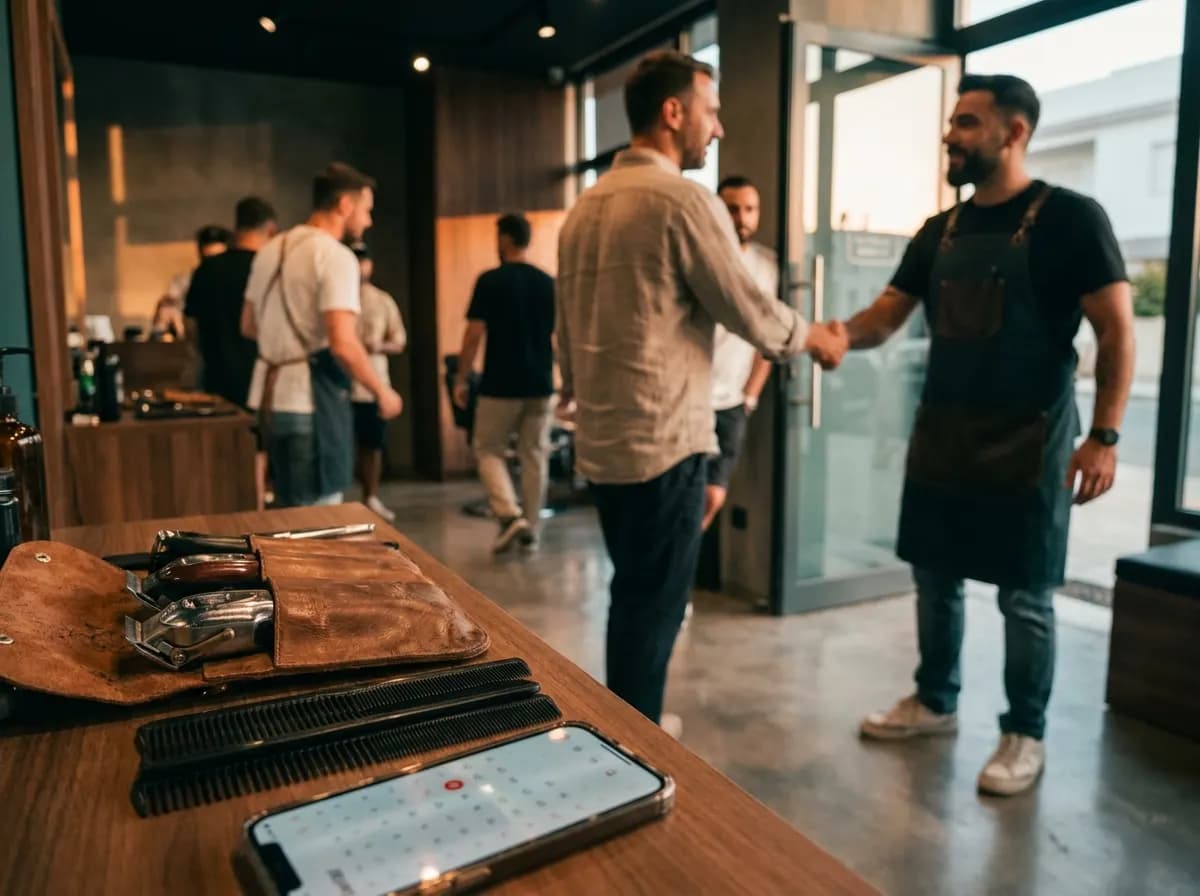
Base is a barber booking app for Cyprus barbershops, where the day is made of short services and the same faces every few weeks. Customers book a cut, a beard trim or a skin fade with the barber they trust, or with whoever is free and does that service. Walk-ins go into the same calendar the moment they sit down, so the next online request already sees that chair as taken. Every visit stays on the customer’s record, which makes it easy to put a regular’s next appointment in before he walks out of the door.

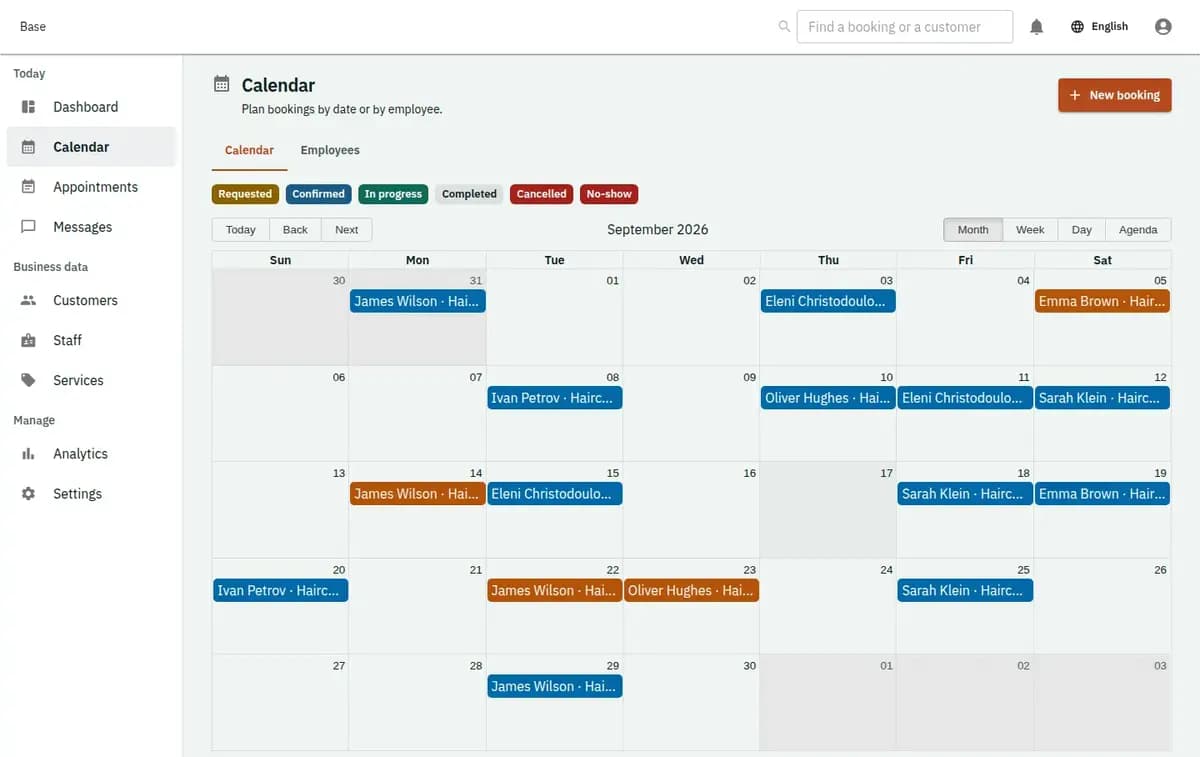
Base barbershop calendar showing barbers, chairs, walk-ins and online bookings for one day
A real console. The records in it are invented.

Who this barbershop software fits

It suits a shop with one barber and one chair as well as a team of five sharing three or four chairs, a barber renting a chair in somebody else’s shop, and a barber who also visits customers but keeps a fixed list of services. What they have in common is short, well-defined work — a cut, a fade, a beard, a hot towel shave, a kids’ cut — a few barbers who each do some or all of it, and a steady base of regulars who expect their usual barber at their usual interval. Online bookings, phone bookings and walk-ins all land in one calendar, and the barbershop software checks the barber, the chair and the cleaning time before anything is confirmed.

Barber shop booking system by barber and chair

Five steps from the price list on the wall to a calendar that holds up on a Saturday.

  1. 1. Enter the services as you really work

    Cut, skin fade, beard trim, cut and beard, hot towel shave, kids’ cut — each with its real duration, its price and the minutes you need afterwards to clean up. If a fade takes your newest barber longer than it takes you, give it the time it actually takes rather than the time printed on the board.

  2. 2. Add barbers, their hours and what each does

    Every barber gets working days, hours, breaks, days off and the services they perform. A barber who does not do hot towel shaves is simply never offered for one. A barber who only works Saturdays appears only on Saturdays, without anybody having to block the rest of the week by hand.

  3. 3. Add chairs only where they limit you

    If every barber has a chair of their own, the barber is the only constraint and the calendar stays simple. If four barbers share three chairs, or two of them share a basin, add those as resources and each booking reserves the barber and the chair together. A booking that would need a chair already in use is refused, and the chair is named.

  4. 4. Publish the booking page and take walk-ins

    Customers book on your Base page or through the booking widget on your own website, in English, Greek or Russian, choosing a named barber or any barber who does that service. At the counter, staff enter a walk-in or a phone booking against the same services and barbers, so the online page never offers a chair that is already busy.

  5. 5. Close the visit and book the next one

    When the cut is finished, the visit is marked as completed, or the booking is marked as a no-show if the customer never arrived. Before a regular leaves, staff can put his next visit in two, three or four weeks ahead with the same barber, while the barber’s calendar is open in front of them.

What goes wrong on a busy Saturday

Most of a barber’s trouble comes from short services colliding with people who did not book.

The walk-in bench and the online calendar disagree

A customer sits down without an appointment, the barber starts, and ten minutes later a booking arrives online for the same barber at the same time. When walk-ins live in someone’s head and bookings live in an app, the clash is only found when two people are waiting for one chair. What helps is one calendar in which a walk-in takes the time as soon as it is entered.

Short services leave no slack

A cut takes thirty minutes, a beard trim fifteen, a fade with beard forty-five. Squeeze them all into the same slot length and the day either runs late from eleven o’clock or leaves gaps nobody can fill. Each service needs its own length, plus the few minutes it takes to sweep up and wipe down the chair and clippers.

Regulars drift away unnoticed

A regular who comes every three weeks is the backbone of a barbershop’s week. When nobody books his next visit at the chair, he messages on a Friday night, finds his barber full and tries the shop down the road. Without a visit history, the owner does not even see that he has stopped coming.

More barbers than chairs, or the reverse

A Saturday-only barber, a chair rented by the day, a basin two barbers share: availability is the barber and the chair together. A diary that only tracks names lets two barbers promise the same chair at eleven, and the problem surfaces with both customers already in the shop.

Walk-ins next to online bookings

Every way a customer arrives becomes the same kind of booking, checked by the same rules.

A walk-in is a real booking

Staff create it against a real service and a real barber. From that moment it blocks the barber’s time and, where chairs are set up, the chair, so the online page stops offering that slot. It also goes into the customer’s history, so a first-time walk-in who becomes a regular has a record from his first cut.

A named barber, or any barber

A customer who asks for a particular barber sees only that barber’s free times, including the week he is away. A customer in a hurry can choose any barber, and Base assigns one who does the service and is free for its whole length and cleaning time. Once confirmed, nobody is quietly moved to someone else.

Two-way calendar sync for each barber

Each barber can connect a Google or Microsoft calendar with two-way sync. A personal appointment in his own calendar blocks that time in the shop, and the shop’s bookings show up on his phone without a second app to check.

A waiting list for a full Saturday

When a barber is fully booked, a customer can join the waiting list instead of giving up. If somebody cancels, the shop can offer the freed time to a person who already asked for it rather than leaving the chair empty for the afternoon.

Regulars, repeat appointments and off-plan days

Four ordinary situations from a barbershop week, including the ones that do not go to plan.

The three-week regular

Andreas has a skin fade with Nikos every three weeks. At the end of each visit the desk books the next one for the same weekday and time while he is still at the counter. He gets a reminder by email or Telegram before the day, and if he needs to move it he does so from the link in his confirmation without calling. His history lists every visit, so a broken rhythm is easy to spot.

A walk-in at half past four

A customer comes in asking for a beard trim. Staff see that Marios is free until his five o’clock, add the walk-in, and that time disappears from the online page straight away. Someone trying to book Marios online for half past four is offered the next free time instead of a slot that is already in the chair.

Four barbers, three chairs

On Saturdays a fourth barber joins the team, but the shop still has three chairs. With chairs entered as resources, every booking reserves a barber and a chair together. When all three chairs are taken at eleven, the fourth barber is not offered at eleven, and the page shows the next time a chair is free.

The customer who does not turn up

A ten o’clock cut is a no-show. Staff mark it, and the outcome stays on the customer’s history. A second no-show is a fact on that record, and whether to ask for a deposit next time is the shop’s own decision. A deposit taken by bank transfer or in cash can then be noted on the booking.

Reminders that cut no-shows

Most missed appointments in a barbershop are forgotten rather than skipped on purpose, so the work is reminding people and making a change easy.

Email and Telegram, not SMS

Confirmations and reminders go by email or Telegram, in the language the customer booked in. Base does not send SMS. A customer who books in Greek or Russian receives the messages in Greek or Russian.

Changing a booking without a phone call

The customer portal opens from the booking link, with no account and no password. A customer can see his appointment, move it to another free time or cancel it, so the slot returns to the calendar instead of sitting empty while the barber waits.

Outcomes kept as facts

Each booking ends as completed, cancelled, cancelled late or no-show, together with the time a cancellation arrived. The shop gets a record to set its cancellation rule from, rather than a feeling about who usually turns up.

Only what the shop needs

A name, a phone number or email, the service, the barber and a short note such as ‘number two on the sides, scissors on top’. Nothing medical and nothing the shop has no use for. Customers and bookings can be exported to a spreadsheet whenever the owner wants to look at them.

Services, barbers and chairs to set first

Write down your services with their real durations and the cleaning time after each. List every barber with working days, hours, breaks, days off and the services they do. Decide whether chairs limit you: if some days there are more barbers than chairs, add the chairs. Decide whether customers may pick any barber or only a named one. Write down your cancellation notice and what happens after a no-show. Enter the bookings already promised to regulars for the next few weeks, so the barber shop booking system never offers their times to someone else. Then add the booking widget to your website, put your booking link on your Instagram profile and wherever customers find you, and connect each barber’s Google or Microsoft calendar.

What the barber booking app does not do

Plain limits, so you know what stays in the tools you already use.
What it is not

Base is not a till, a card terminal, a payroll or commission calculator, a stock system for the products on the shelf or a marketplace that promises new customers. It does not run a queue screen or numbered tickets for the walk-in bench. Customers pay the shop the way they do today; staff can note a payment or a deposit taken in cash or by bank transfer so the booking shows it.

No till, card terminal or commission

Base does not take card payments, run a till, calculate barber commission or chair rent, or do payroll. Customers pay the shop as they do now, and staff can note a payment or deposit taken elsewhere on the booking.

No automatic rebooking every three weeks

Base does not create a regular’s next appointment by itself or send marketing messages when he is due. Staff book the next visit at the end of the current one, and the customer can book again from the page at any time. The visit history shows who has not been back.

No queue screen for the bench

There is no ticket machine, queue display or estimated waiting time for walk-ins. A walk-in is entered as a booking for a barber and a time, and that is exactly what stops it clashing with online bookings.

No SMS and no marketplace

Notifications go by email and Telegram only. Base is not a marketplace and does not promise new customers; bookings come from your own page, your widget and the people you send to them.

Barber booking app questions

Can customers choose their barber?

Yes. A service can be booked with a named barber or with any barber who does it. A named booking uses only that barber’s free time; choosing any barber assigns someone who does the service and is free for its full length and cleaning time.

How do walk-ins work alongside online bookings?

Staff add the walk-in as a booking for a real service and barber. It blocks that time at once, so the online page does not offer it, and it goes into the customer’s history like any other visit.

Can a booking reserve both a barber and a chair?

Yes, when chairs actually limit you. Each booking then reserves a barber and a chair together and is refused if either is taken. If every barber has a chair of their own, you can leave chairs out and keep the calendar simpler.

Will customers get SMS reminders?

No, Base does not send SMS. Confirmations and reminders go by email or Telegram, and the booking page works in English, Greek and Russian.

How do I keep regulars on their usual interval?

Book the next visit before the customer leaves — two, three or four weeks ahead with the same barber. He gets reminders and can move it from the booking link without an account. Base does not rebook automatically, but the history shows every visit, so gaps are easy to see.

Does Base take payments or calculate commission?

No. Base does not process card payments, run a till or calculate commission or chair rent. Payments and deposits taken in the shop or by bank transfer can be noted on the booking, and bookings can be exported to a spreadsheet for your accountant.

What does it cost for a small barbershop?

There is no commission on bookings. The Free plan (€0) covers 2 staff accounts and 5 bookable items; Standard (€19/mo) and Pro (€39/mo) add room as the team grows, on the same barbershop software.

Next step

Open a workspace and set up one booking flow

Registration takes an email address. The operating model, services and resources are configured afterwards, in the console.