Appointment booking

Tattoo studio software for artists and long sittings

  • Tattoo appointment scheduling software that protects artist hours
  • A sitting takes the artist for its whole length
  • A guest artist’s bookings end when they leave

No card asked for · nothing taken from a booking · your data exports

Operating model
Appointment booking
What is booked
Service → Staff → Time
Getting started
Artists, days away and chairs to set first

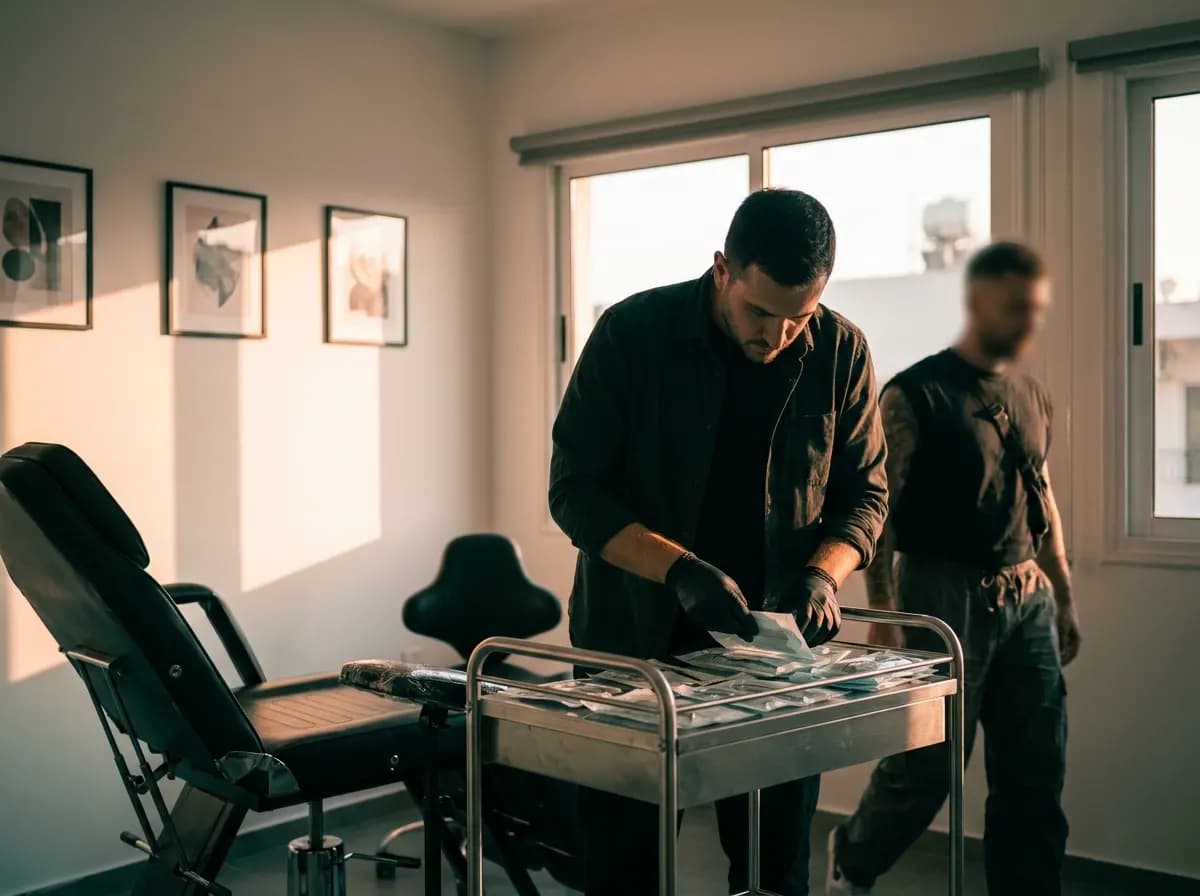
Nobody books a tattoo studio. They book Marios, because they have seen his work, and they are asking for six hours on a Saturday — not a half-hour appointment. A large piece is four of those sittings spread across months, with weeks of healing that have to pass between them. Base books the artist people asked for, holds a sitting for as long as it really takes, keeps the deposit as a recorded fact, and knows that the next session cannot be next Tuesday.

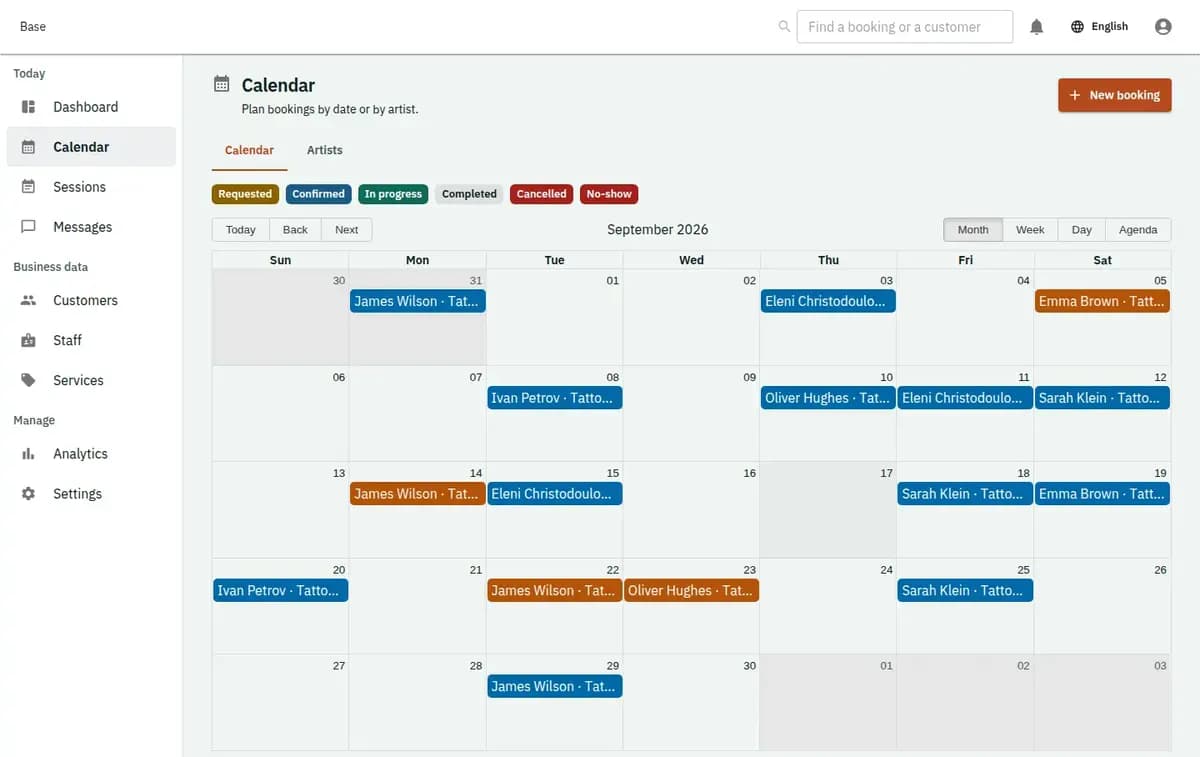
Base calendar showing long tattoo sittings by artist, a guest artist week and a multi-session piece
A real console. The records in it are invented.

Who this tattoo studio software fits

It fits a studio with two to six artists, each with their own following, their own days and their own style — plus piercing at the counter, which works nothing like a six-hour sitting. It is useful when the customer is choosing a person rather than a service, when a consultation comes before the booking, when a piece runs across several sittings that need spacing, when guest artists come for a fortnight and take bookings that end when they leave, and when a deposit is what stops a Saturday being lost to a no-show.

Tattoo booking app from consultation to final sitting

Consultation, deposit, sitting, and the sittings after it — one thread, in the order the work actually happens.

  1. 1. Set up artists, not services

    Enter each artist with the days they work, their break patterns and the periods they are away, plus the chairs or rooms where the room is genuinely the limit. Piercing is set up separately, because it is short, walk-in-ish and does not need the same chair for four hours. Guest artists are entered with a start and an end date so their bookings cannot run past their stay.

  2. 2. Take the consultation first

    A short consultation — in person or by message — is where the artist sees what is being asked for and estimates the hours. That estimate becomes the sitting length. Booking a six-hour sitting from a web form with no consultation is how a studio ends up with a client who wanted a portrait and an artist who allowed two hours.

  3. 3. Book the sitting and record the deposit

    The sitting is confirmed against the artist for its real duration, with the chair where that matters. The studio takes its deposit its own way and records that it was taken — the amount, when, by whom. That fact is what makes a no-show conversation short, and it is all Base needs to hold: no card, no payment, no refund logic.

  4. 4. Work the day

    The artist sees their own day: who is coming, for how long, and what the piece is. Arrival, completion and no-show are recorded as they happen. A client who does not turn up is marked as such against the booking and the deposit note, which is the record the studio will want the next time that name appears.

  5. 5. Plan the next sitting past the healing

    At the end of a session the artist says when the next one can be, and the following sitting is booked at or after that date, still on the same piece. The studio can see a piece that has stalled — two sittings done in March and nothing since — and decide whether to chase it. Base counts sittings; it does not judge whether the work is finished.

What a tattoo diary has to hold

Tattooing breaks a normal appointment calendar in three specific ways.

A sitting is measured in hours, not slots

A small piece is ninety minutes; a back piece is a day with breaks in it. The artist estimates the time from the design during the consultation, and that estimate is what gets booked — not a service duration from a price list. A studio that books everything in one-hour slots either splits a sitting across two entries or fills the day with fiction.
The next session cannot be next week

A piece that runs to four sittings needs healing between them, and the artist decides how long. That waiting period is part of the plan, not a gap in the calendar to be filled with the same client. Base keeps the sittings of one piece together so the studio can see the whole run, and so the second sitting is offered at a date the skin will actually be ready for.

The customer wants the artist, not the studio

Reassigning a booking to whoever is free is exactly the wrong move here. Availability is per artist, including the days they do not work and the weeks they are away, and a booking belongs to that person. When an artist leaves or a guest artist’s fortnight ends, the studio sees precisely which bookings are affected rather than finding out on the day.

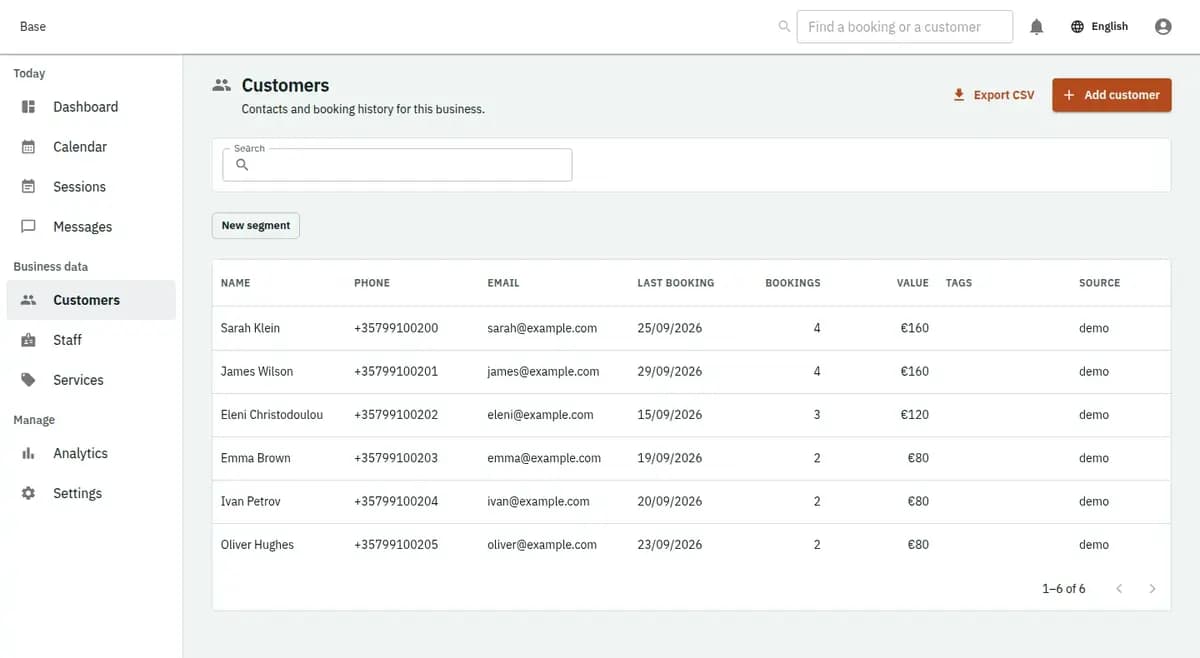
The booking console, with invented records: the customer list

Tattoo appointment scheduling software that protects artist hours

Long bookings against one named person are a different allocation problem from short appointments against a pool of staff.

A sitting takes the artist for its whole length

Six hours means six hours of that artist, plus whatever setup and clean-down time the studio configures between clients. Two bookings that would overlap on one artist cannot both be confirmed; the second is refused outright. The studio does not get to fill the middle of a long sitting with a quick piercing on the same person’s calendar.

A guest artist’s bookings end when they leave

A visiting artist is entered with the dates they are actually here. A booking cannot be confirmed outside those dates, which prevents the specific and painful failure of a client booked with someone who flew home a week earlier. The same applies to an artist whose last day is known.

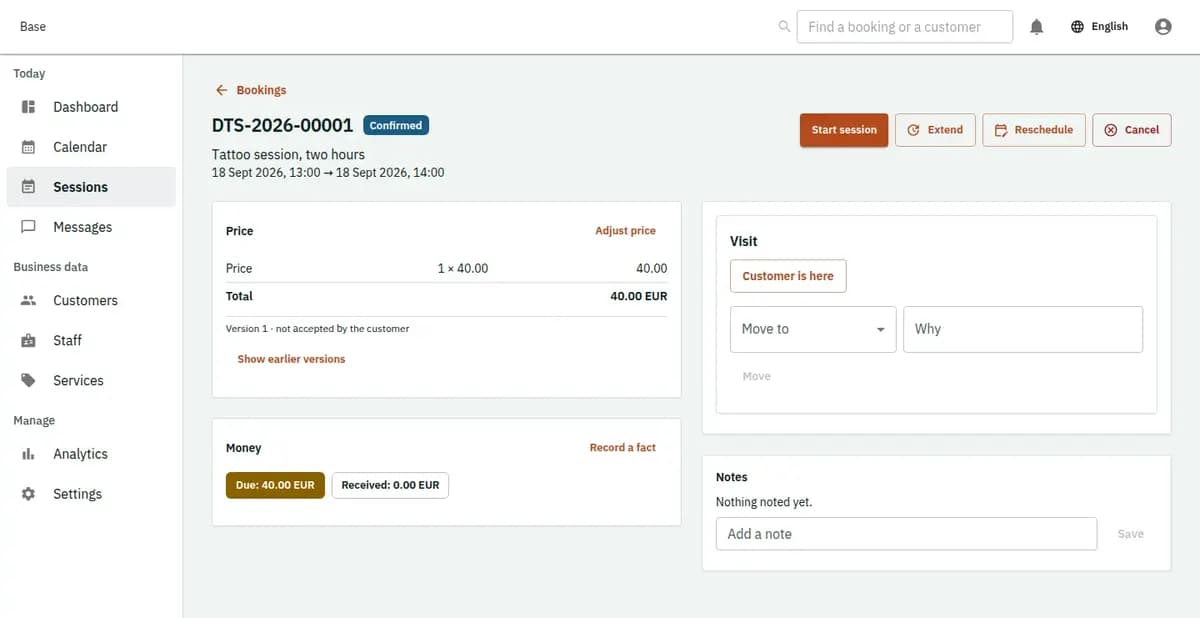
The booking console, with invented records: one booking with its price lines and history

Consultations, guest weeks and a near-empty Saturday

The consultation, the guest week and the Saturday that nearly went empty.

A half sleeve, planned properly

The consultation puts the estimate at four sittings of five hours. The first is booked for a Saturday; at the end of it the artist says four weeks. The second sitting goes in for five weeks out, on the same piece. In September the studio can see the whole run and knows what it has committed the artist’s Saturdays to.

A guest artist for two weeks

The studio publishes their dates and their days. Bookings fill up and every one of them sits inside the visit. On the last Friday there is no booking sitting three days past their flight, because the system would not confirm it — which is the only version of this that does not involve phoning a client to apologise.

A no-show on a six-hour Saturday

The client does not arrive. The booking is marked no-show, and the deposit note sitting on it says what was taken and when. That Saturday is gone either way; what the studio has is a clear record for the conversation and for the next time the same person asks for a booking. Base does not keep the money and does not decide whether it is returned.

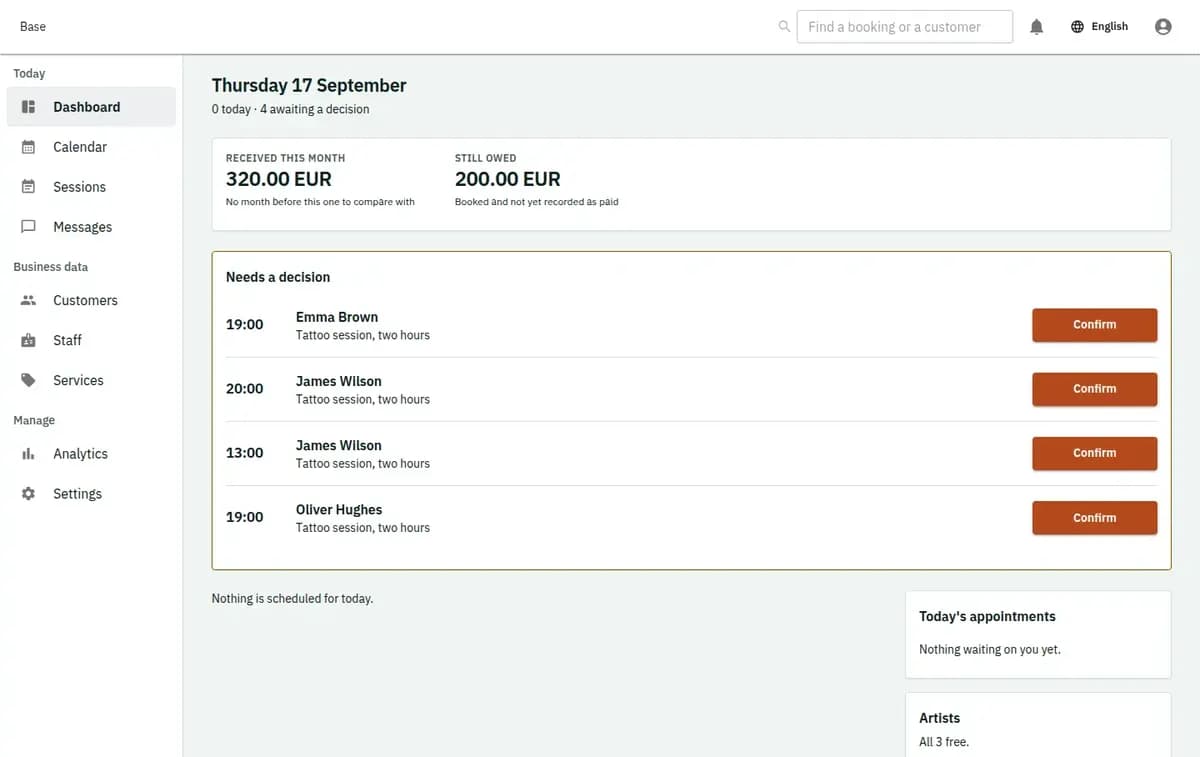
The booking console, with invented records: the day’s requests and money

Consent, age and health records kept elsewhere

Tattooing involves consent, age and health questions with real legal weight, and none of them belong in a booking calendar.

No consent forms, no age verification, no aftercare records

The studio checks identification and takes consent at the chair, on paper or in whatever system it has chosen, and keeps those records under its own retention rules. Base holds the client’s contact, the artist, the sitting and its length. It does not verify anybody’s age, does not store a signature and does not become evidence that a check was carried out.

Designs and references stay with the artist

Reference images, stencils, drawings and photographs of finished work live where the artist keeps them. They are the artist’s craft and often the client’s likeness, and a booking record is the wrong place for both. What the booking holds is a short description so the artist knows what Saturday is for.

Artists, days away and chairs to set first

Enter each artist with their real days, their breaks and the weeks they are away — including conventions. Decide whether chairs are a limit for you or whether the artist is the only constraint. Set up piercing separately from tattooing, with its own short durations. Write down your deposit rule and your cancellation notice, because they are the two things every no-show conversation comes back to. Decide who may book on an artist’s behalf and who may cancel. Then put the next two months of existing bookings in before you go live: the ones that will not fit are usually a sitting somebody underestimated.

Where the studio calendar stops

A studio runs on several things at once, and this is only the calendar.

When a different product is needed

Base does not host portfolios, does not run an Instagram-style gallery, does not store designs, references or stencils, does not take deposits or payments, does not keep consent forms, age verification, aftercare records or anything a health inspection would ask for. It is not a marketplace and does not send artists clients.

Not a portfolio or a marketplace

No galleries, no artist profiles for the public to browse, no lead generation, no reviews. Clients find artists through their work and their following; Base does not take part in that and does not claim to bring anybody in.

No money, no deposits held

The deposit is taken by the studio with its own method. Base records that it happened and what it was for. It does not hold funds, does not refund, does not apply a deposit to a final price and does not decide who keeps it after a no-show.

A refusal is a valid result

An artist already booked, a sitting that will not fit before closing, a date outside a guest artist’s visit or a second sitting proposed before the healing period stops the booking. The previous state stands, the reason is plain, and the studio offers a date that works instead of one that does not.

Tattoo booking questions

Can international clients request a sitting in their own language?

Yes. Your booking page is available in English, Greek and Russian, and each request reaches the studio by email or Telegram so the artist they asked for can review it. The tattoo appointment scheduling software then holds the sitting for as long as it really takes. Base is tattoo studio software, not a marketplace: it takes no commission and does not take deposits or payments.

Can a booking be six hours long?

Yes. The sitting is as long as the artist estimated at the consultation, and it holds that artist for the whole time plus any setup and clean-down you configure. It is not split into slots.

How are multi-session pieces handled?

The sittings of one piece stay linked, and the next one is booked at or after the date the artist says the skin will be ready. The studio can see a run that has stalled instead of losing it among unrelated bookings.

Can a client be moved to another artist?

Only deliberately. Availability belongs to the artist the client chose, and nothing reassigns a booking automatically — which is the correct behaviour when the person is the reason for the booking.

How do guest artists work?

They are entered with the dates of their visit, and bookings outside those dates are refused. That prevents an appointment being confirmed for a week after they have flown home.

Does Base take the deposit?

No. The studio takes it its own way, and the booking records that it was taken, when and by whom. There is no payment handling and no rule about who keeps it.

Are consent forms and age checks stored here?

No. Those are done at the studio and kept in the studio’s own process with its own retention. A booking record is not evidence that a check took place, and it should not be treated as one.

Next step

Open a workspace and set up one booking flow

Registration takes an email address. The operating model, services and resources are configured afterwards, in the console.