Field service scheduling

Repair shop software for counter intake and device custody

  • Device custody and bench time booked separately
  • A bench is booked for work, not for waiting
  • A device is in custody exactly once

No card asked for · nothing taken from a booking · your data exports

Operating model
Field service scheduling
What is booked
Service → Address → Team
Getting started
Benches, technicians and intake slots to set first

A phone repair is two different bookings pretending to be one. The bench is needed for the ninety minutes somebody is actually working on the device; the custody lasts from the moment it crosses the counter until it is collected, which might be next Thursday because the screen is coming from Nicosia. Base separates those, so a shelf full of waiting devices does not block your technicians’ day — and so the two identical black phones on that shelf are told apart by their serial rather than by the sticker that fell off.

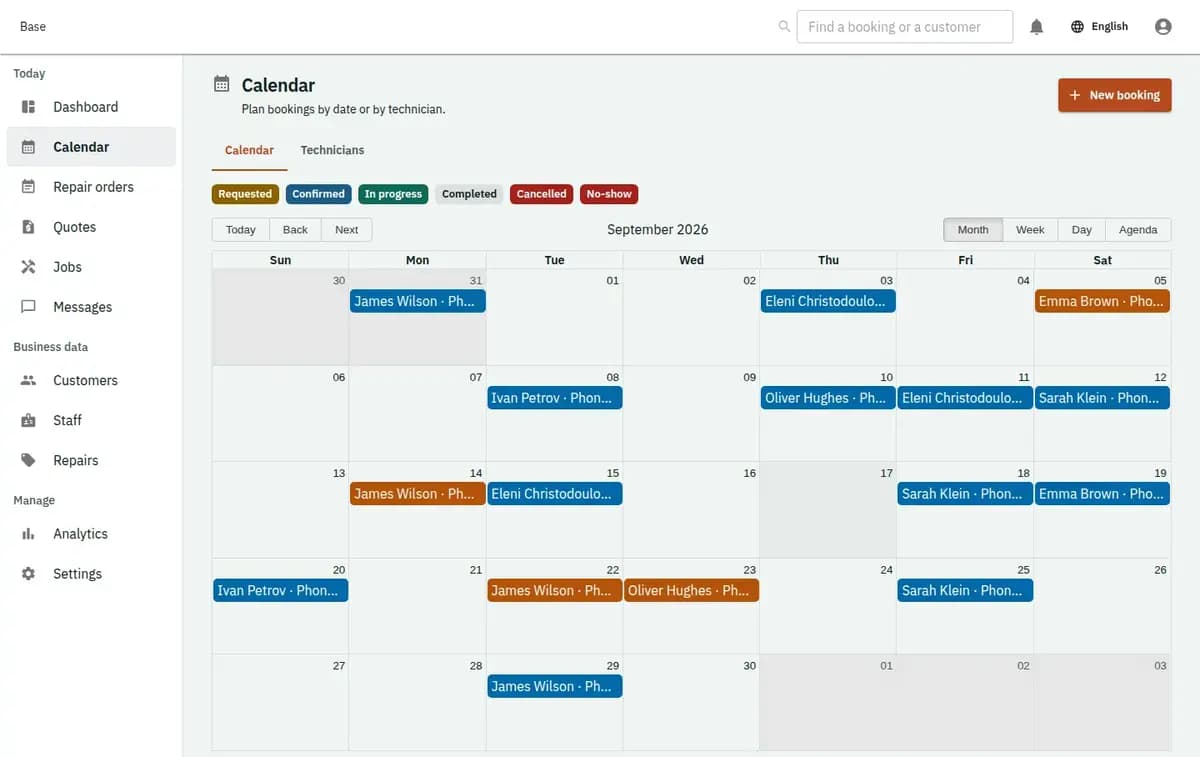
Base view showing counter intake slots, technician bench time and devices in custody awaiting parts
A real console. The records in it are invented.

Who this phone repair shop software fits

It fits a shop that takes phones, tablets, laptops and consoles over a counter: screens, batteries, ports, water damage, data problems. It is useful when a repair starts as a fault the customer describes and only becomes a price after somebody has opened it, when parts arrive on their own schedule, when a device that comes back is either a warranty job or a new one and staff need to know which, and when the shelf slowly fills with units nobody has collected.

Computer repair shop software from counter to collection

One record follows the device. Bench sessions, parts waits and warranty returns all hang off it.

  1. 1. Set up the counter, the benches and the technicians

    Enter short intake slots for the counter — taking a device in is ten minutes, not an hour — and the benches and technicians with their real hours. Set the repair types you offer with the bench time each typically needs. Decide your warranty period for a repair, because that is what makes a returning device answerable rather than arguable.

  2. 2. Take the device in

    Record the make, model and serial or IMEI, the fault as the customer describes it, the visible condition, and whether the device powers on. Note what the customer was told about timescales. The device is now in custody, and the record says who took it and when. No passcode is written down: if the repair needs the device unlocked, that is arranged with the customer, not stored.

  3. 3. Diagnose, then quote

    A technician takes bench time, looks at the device and writes the quote. The customer accepts, declines or asks for something in between. A declined repair still has an outcome — returned unrepaired, with a diagnostic fee if that is your policy — rather than sitting on the shelf as an open question.

  4. 4. Order, wait, and work

    If a part is needed, the device stays in custody and the record shows what it is waiting for. The bench is booked when the part arrives and the work is actually going to happen. That way a week of waiting does not appear as a week of workshop capacity, and the technician’s day reflects the jobs that can genuinely be done today.

  5. 5. Hand back, or chase

    Collection records who released the device and when, and closes the job with what was done — repaired, replaced, no fault found, unrepairable. A device that is not collected stays in custody with its age visible, and the contact attempts are recorded on it. That is how a shelf stops accumulating units whose story nobody remembers.

What a repair counter is really tracking

A repair shop does not lose appointments. It loses devices, agreements and the thread of what was promised.

The quote comes after the diagnosis, not before

A customer says the screen is broken; the technician opens it and finds the frame is bent too. The intake carries the fault as the customer described it, and the quote is a separate step written after somebody has looked. The customer accepts or declines, and that acceptance is on the record with its time. What is not acceptable is a different number appearing at collection, and this is the part of the job where that happens.
Waiting for a part is custody without a bench

A device waiting a week for a screen occupies a shelf, not a technician. If the calendar treats the whole repair as one long booking, the workshop looks fully booked while nobody is working. Bench time is reserved for the session of actual work; custody runs from intake to collection and is what tells you the device is still yours to look after.

Two identical black phones

Devices are identified by make, model and serial or IMEI recorded at intake, not by a name on a bag. That is what stops the wrong unit being handed over, what lets a repair that comes back in three weeks be linked to the job that did it, and what makes a shelf audit possible at all. A repair shop without device identity is a lost-property office.

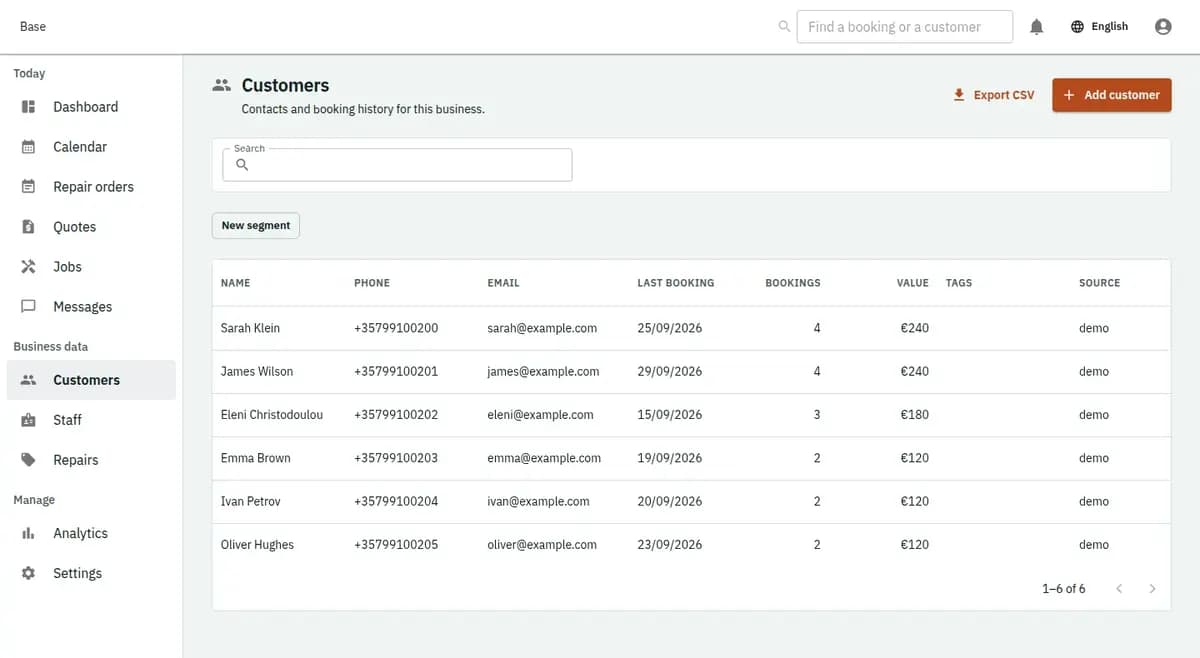
The booking console, with invented records: the customer list

Device custody and bench time booked separately

This is the structural decision the profile is built on, and everything else follows from it.

A bench is booked for work, not for waiting

Bench sessions reserve a technician and a workspace for the period somebody is at it. Two sessions cannot overlap on the same bench or the same technician, and a confirmation that would clash is refused outright. Meanwhile the device can sit in custody for days without consuming any of that capacity, which is what makes the workshop schedule mean something.

A device is in custody exactly once

From intake to collection, the unit is with you, identified by serial. It cannot be taken in twice, cannot be closed as returned while still on the shelf, and cannot be quietly lost between two staff members on different shifts. A repair that comes back within the warranty period is linked to the job it belongs to rather than opened as a new customer complaint.

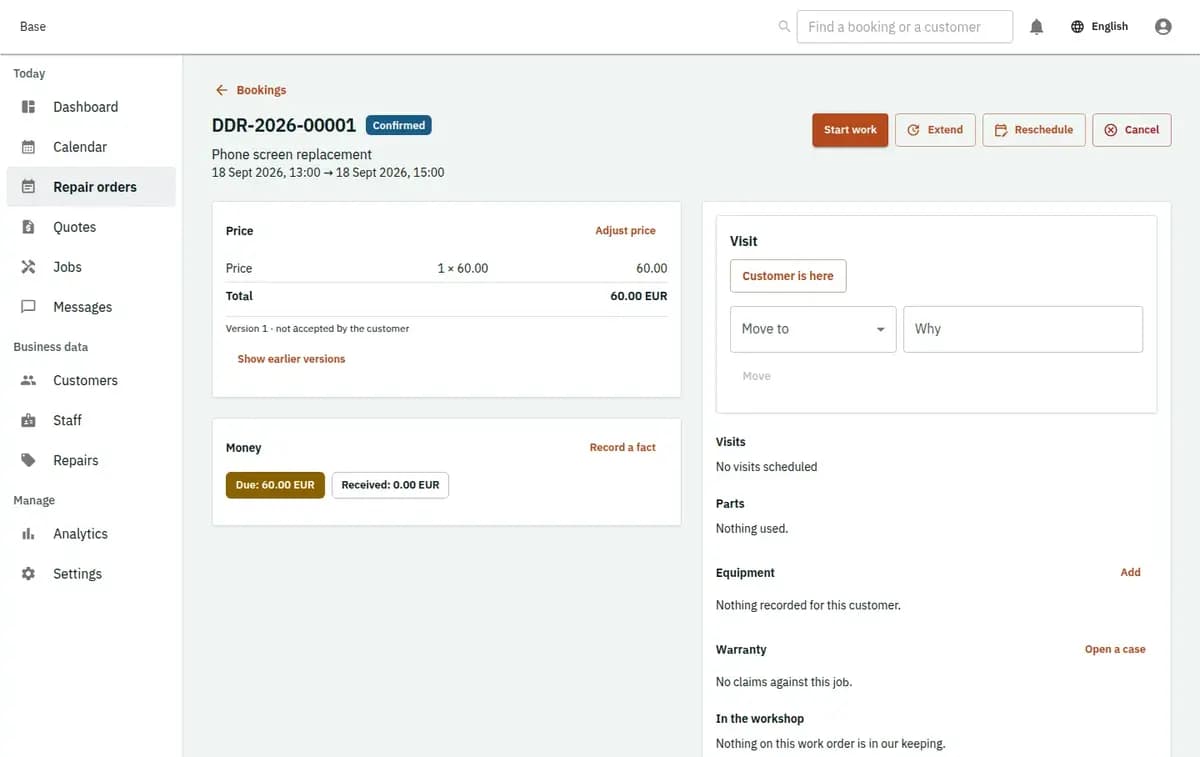
The booking console, with invented records: one booking with its price lines and history

Ordinary repairs, parts waits and warranty returns

The ordinary repair, the one that waits, and the one that comes back.

A screen replacement, done the same day

Taken in at ten with the fault and the serial, diagnosed on the bench at eleven, quoted, accepted, done by one. Collected at four by the person who left it, with the release recorded. The bench held ninety minutes and the customer was told a real time, because the technician’s afternoon was not already full of devices that are only waiting.

The part is a week away

The battery has to be ordered. The device stays in custody, the record shows what it is waiting for, and no bench is held. When the part arrives, a bench session is booked for the work. If the customer phones on Thursday, whoever answers can say where the repair actually is without walking to the back to look.

It comes back three weeks later

Staff find the previous job by serial, see what was done and when, and see whether it falls inside the warranty period the shop set. That turns an argument at the counter into a lookup: this is the same repair and it is covered, or this is a different fault and here is a new quote. Base does not decide the claim; it makes the facts available to the person who does.

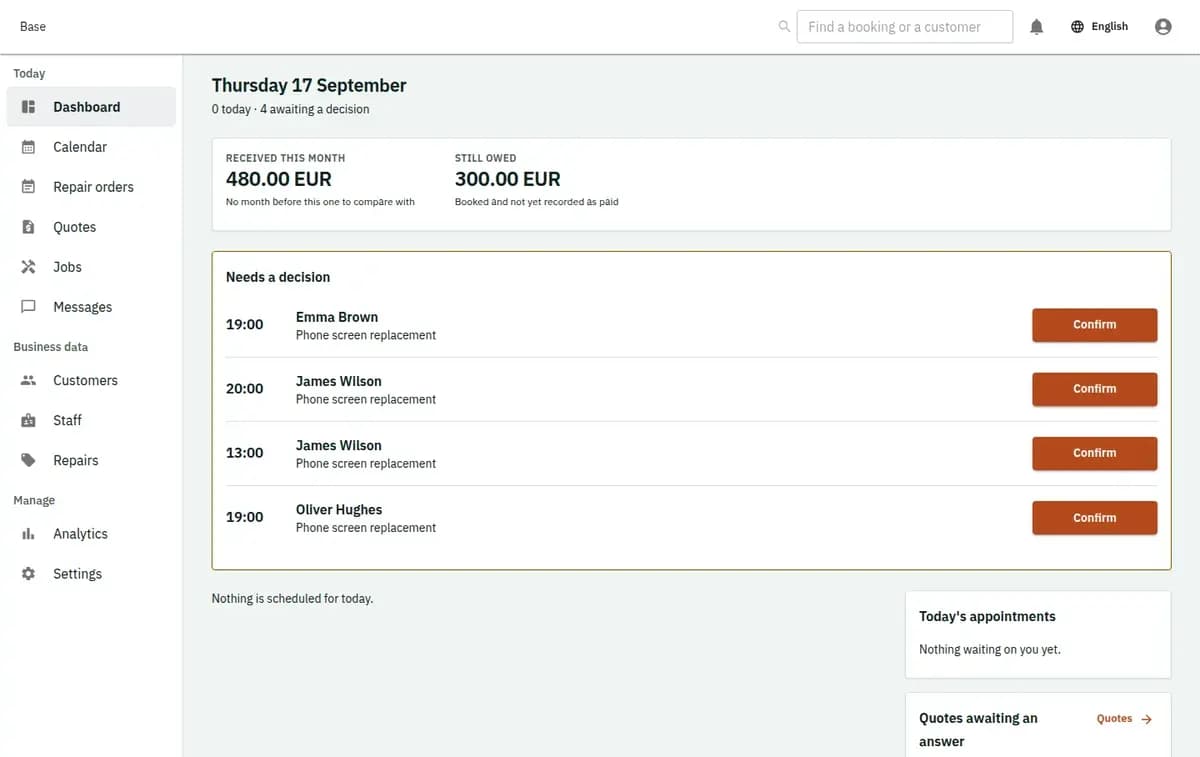
The booking console, with invented records: the day’s requests and money

Customer data held as little as possible

Repair shops handle other people’s data by the nature of the work, and the safest design is the one that holds as little of it as possible.

No passcodes, patterns or passwords, ever

There is no field for them and there never will be. A shop that writes an unlock code on a job card has created a record that outlives the repair, sits in a system several people can read, and is worth stealing. If a repair requires the device unlocked, arrange it with the customer at the counter or ask them to remove the lock — those are operational choices the shop makes, and Base stays out of them by having nowhere to put the secret.

What is on the device stays on the device

Base holds the device’s identity, the fault, the work and the outcome. It does not copy contents, does not index photographs or messages and does not describe personal data found during a repair. What a technician sees while working is governed by the shop’s own practice and by the law that applies to it — and it does not need to be written into a booking record to do the job.

Benches, technicians and intake slots to set first

Enter the benches and technicians with real hours, and set intake slots short enough to reflect what taking a device in actually costs. List your repair types with the bench time each usually needs, not the time you would like it to need. Decide your warranty period and write it down, because it settles the returning-device conversation. Decide who may write a quote, who may release a device and what happens to units that are not collected after thirty, sixty and ninety days. Then put the current shelf into the system before you go live: the devices you cannot identify by serial are exactly the ones that have been there longest.

What this profile refuses to do

Some of these are missing because they are other products. One is missing on principle.

When a different product is needed

Base does not unlock devices, does not do data recovery workflows, does not manage a spare-parts inventory or supplier orders, does not run trade-in or refurbishment pricing, does not handle payment and is not a marketplace. It also never stores a passcode, pattern or account password — that is a rule, not a missing feature, and the reason is in the section below.

No unlocking, no data recovery workflow

Base does not bypass locks, does not manage a recovery process and does not hold a customer’s account credentials. Those are services a shop may offer, with their own consent and evidence requirements, and they do not belong in a booking record.

No parts inventory or supplier ordering

The record can say a device is waiting for a part. It does not count your stock, does not raise a purchase order, does not track a supplier and does not price a component. Stock control is a separate job with separate arithmetic.

A refusal is a valid result

A bench already booked, a technician on another job, a device already in custody, a quote the customer has not accepted or a repair that cannot proceed will stop the next step. The previous state stands, the reason is in words, and staff can tell the customer something true instead of something optimistic.

Repair shop questions

What does Base cost for a small phone repair shop?

As phone repair shop software, Base has a Free plan at €0 with 2 staff accounts and 5 bookable items; Standard is €19 and Pro €39 a month per business. The same plans apply when it is used as computer repair shop software for laptops, tablets and consoles. There is no commission and no card payment: customers pay the shop directly, and staff record the payment in Base.

Does a device waiting for a part block a technician?

No, and that is the point. Custody and bench time are separate: the device sits in custody for as long as it needs, while bench sessions are booked only for work that is actually going to happen.

How is a quote handled when the fault turns out to be worse?

The intake carries the fault as described; the quote is written after diagnosis and waits for the customer to accept it. Both stay on the record with their times, so nothing new appears at collection.

Does Base store unlock codes?

No. There is no field for a passcode, pattern or password, by design. If a repair needs the device unlocked, that is arranged with the customer rather than written into a record that outlives the job.

How is a warranty return recognised?

The device is found by serial, the previous job and its date are visible, and the shop’s warranty period is on the record. Staff decide the claim; the system makes sure they are deciding it with the right job in front of them.

What happens to devices nobody collects?

They stay in custody with their age visible and the contact attempts recorded against them. They do not drop off the list because the repair was finished, which is how a shelf fills up with units whose story nobody remembers.

Can two identical devices be told apart?

Yes — by make, model and serial or IMEI recorded at intake. That identity is also what links a returning device to the job that repaired it.

Next step

Open a workspace and set up one booking flow

Registration takes an email address. The operating model, services and resources are configured afterwards, in the console.