
Appointment booking

Vet booking system for consultations, admissions and recalls

  • Consultations held against both vet and room
  • The person and the room are separate limits
  • Held-back capacity stays held

No card asked for · nothing taken from a booking · your data exports

Operating model
Appointment booking
What is booked
Service → Staff → Time
Getting started
Vets, rooms and theatre hours to enter first

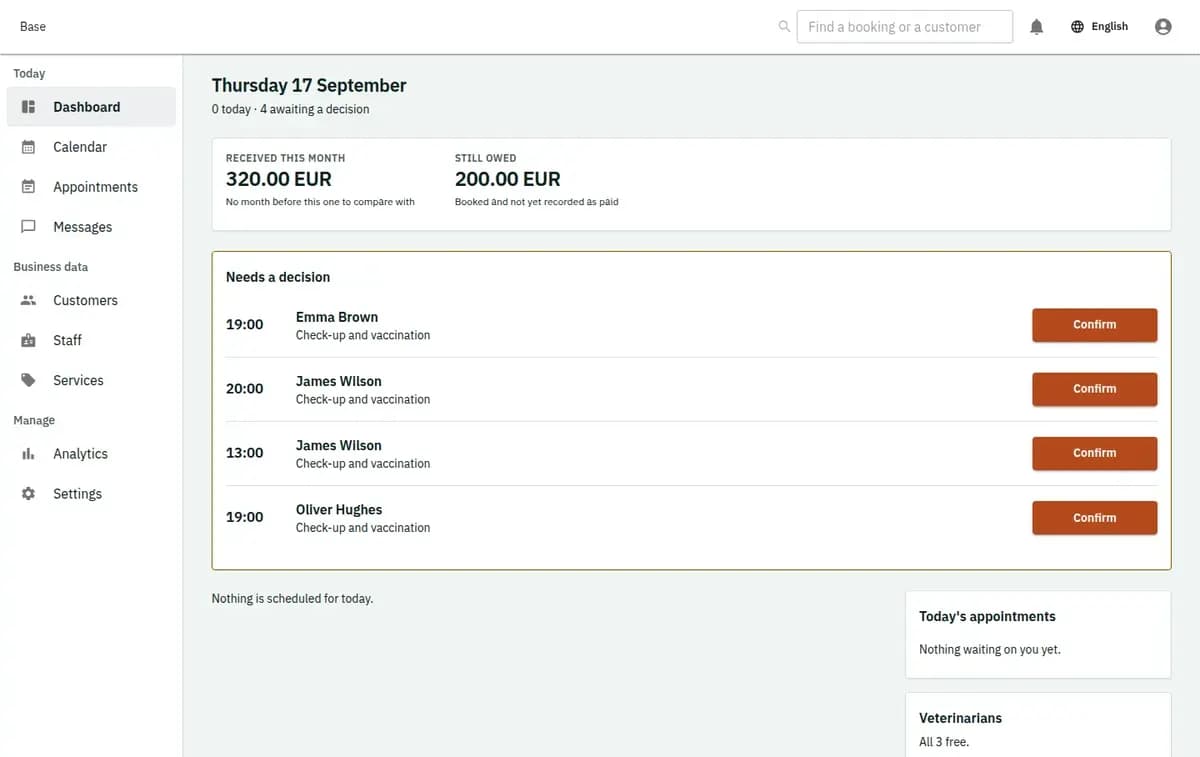
A veterinary day is three days stacked on top of each other: the consultations that were booked last week, the emergency that walks in at eleven, and the surgeries that were admitted at eight and are still asleep at noon. Base books the vet and the room a visit genuinely needs, keeps part of the day back for what has not happened yet, and carries a vaccination course from the first injection to the one due in three weeks. The clinical record stays in the practice system, where it belongs.

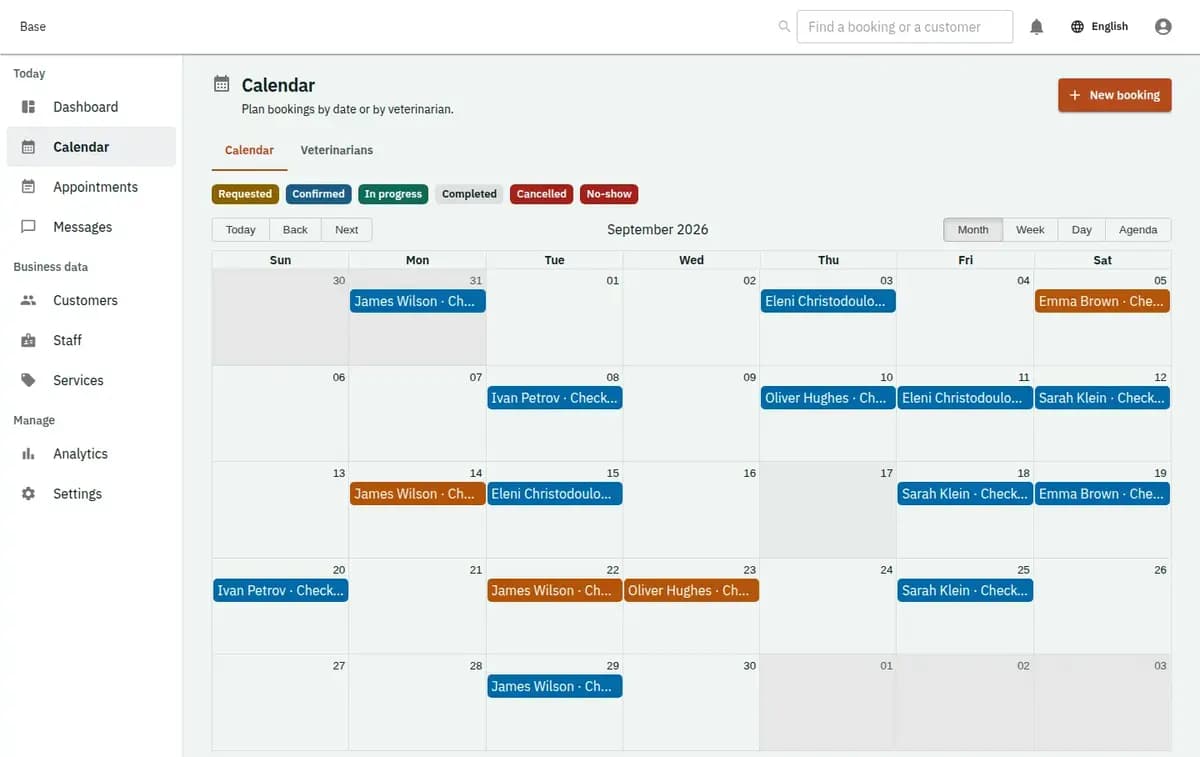
Base calendar showing veterinary consultations by vet and room, a morning admission block and held-back urgent capacity
A real console. The records in it are invented.

Who this vet clinic booking software fits

It fits a small-animal practice with one to five vets, one or two consulting rooms and a theatre that is used some mornings and not others. It is useful when the same household brings three different animals, when part of every day has to stay free for something that has not happened yet, when a puppy course means a second and third visit at set intervals, when surgery means an admission window rather than an appointment, and when a vet also does house calls and the travel between them is real.

Veterinary appointment scheduling software by vet, room and visit

The people, the rooms and the visit types first; then the day keeps the shape you gave it.

  1. 1. Enter vets, consulting rooms and the theatre

    Each vet goes in with their real hours, their surgery mornings and the days they are not in the building. Consulting rooms and the theatre are entered as their own resources, because two vets consulting at once need two rooms. Nurses are entered where a visit genuinely cannot run without one.

  2. 2. Describe visits by the time they actually take

    A routine consultation, a longer second opinion, a vaccination, a nail clip, a dental, a house call with travel either side. Each has the duration it really needs and the resources it really uses, so the calendar stops pretending everything is fifteen minutes.

  3. 3. Register the owner with their animals

    The client record holds the household; each animal is entered under it with its species and name. A booking names both, so the room knows what is coming in and a family with three pets can be seen as one household rather than three strangers who share a phone number.

  4. 4. Hold capacity back and release it

    Decide how much of each day stays unsold for same-day work, and when it opens. The held part is not a fiction — it cannot be booked in advance and it is there when the eleven o’clock arrives. What is left unused at the end of the day is simply a quiet day.

  5. 5. Book the next step before the owner leaves

    The second vaccination, the post-operative check, the recheck in ten days: booked while the owner is still at the desk, attached to the course it belongs to. That single habit is what turns a course into a completed course.

What a clinic day does to an appointment book

Four things separate a veterinary calendar from a diary of half-hour slots.

The patient and the client are two different things

A booking is for an animal, and the person who receives the reminder is the owner. One household can be three patients with three species and three very different visit lengths. When the calendar only knows the owner, the vet walks into the room without knowing whether to expect a cat carrier or a nervous shepherd, and a household with several animals turns into three unrelated entries nobody can see together.
A day with no room left is a day that overruns

Something will arrive today that nobody booked. A practice that fills every slot a week in advance meets that arrival by pushing every consultation back an hour and finishing late. Capacity that is deliberately held for the day itself, and released as the day approaches, is the difference between absorbing an emergency and losing the evening to it.

Vaccination is a course, not a visit

The first injection creates a second one three or four weeks later, and often a third. Booked as an isolated appointment, the second one depends on the owner remembering, which is how half a course goes unfinished. The follow-up belongs to the same course, planned from the visit that just happened rather than reconstructed from a spreadsheet at the end of the month.

Surgery is an admission, not an appointment

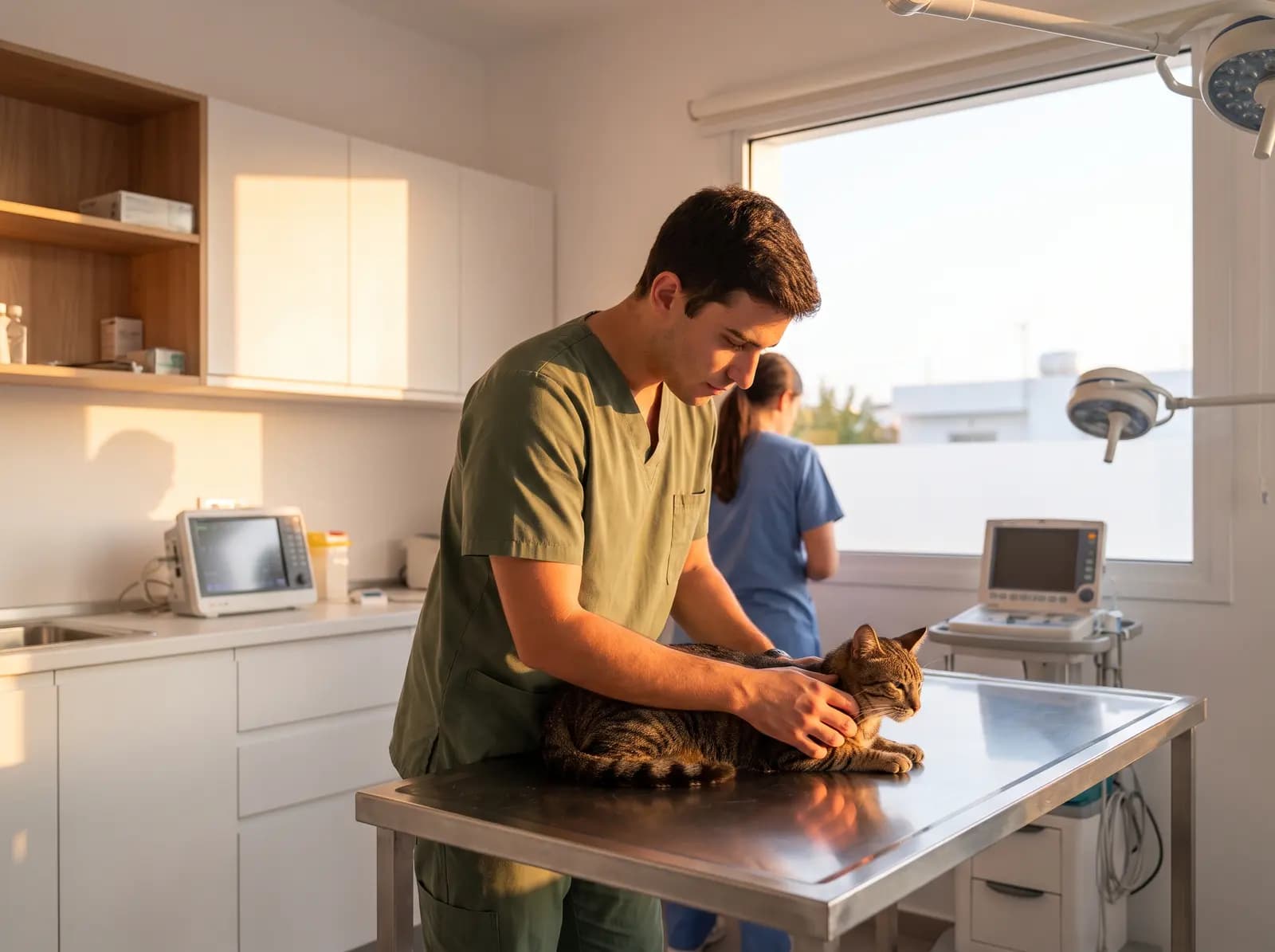
A neutering is not a thirty-minute slot: it is a fasted animal admitted at eight, a theatre and a nurse for a defined window, and a collection later that day. Treating it like a consultation is how two operations end up planned into one theatre, and how an owner is told to come back at a time when nobody is free to discharge the animal.

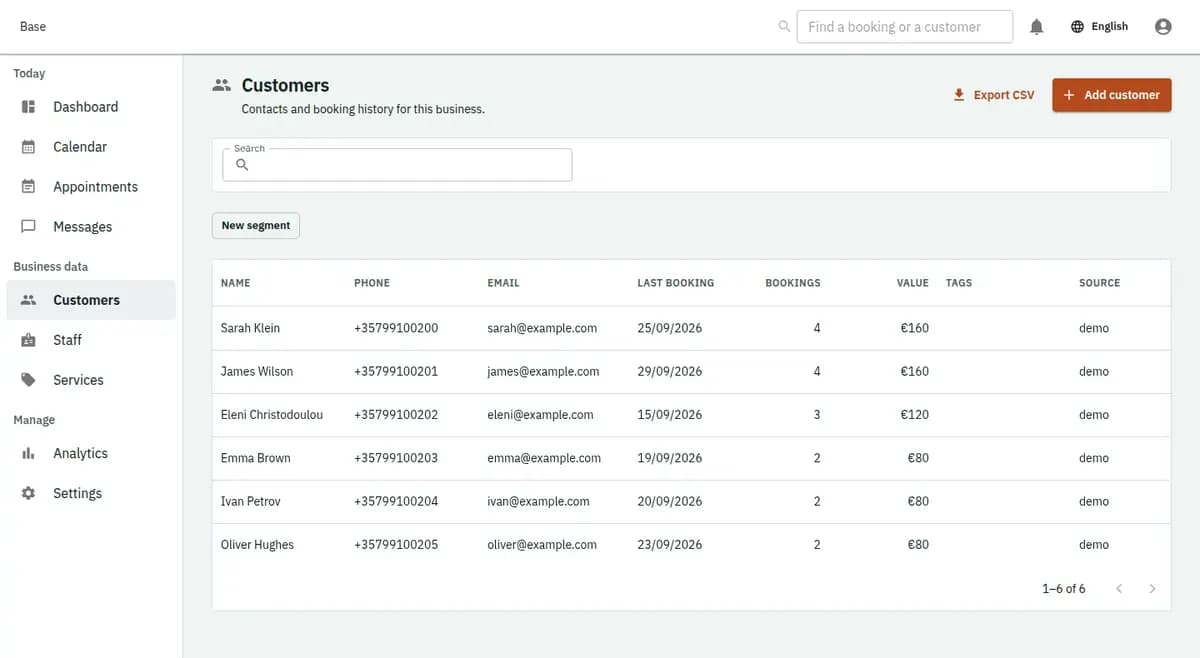
The booking console, with invented records: the customer list

Consultations held against both vet and room

A veterinary visit usually needs two scarce things at once, and both have to hold.

The person and the room are separate limits

A consultation needs a vet and a consulting room; a procedure needs the theatre and, where you have said so, a nurse. All of them are checked together, and a booking that has the vet but not the room is refused rather than confirmed in half. The refusal names which resource was missing.

Held-back capacity stays held

Same-day capacity is not a note on a whiteboard. It cannot be sold a week in advance, it opens when you said it opens, and the practice can see how much of it a typical day actually consumes — which is the only honest way to decide whether you are holding too much or too little.

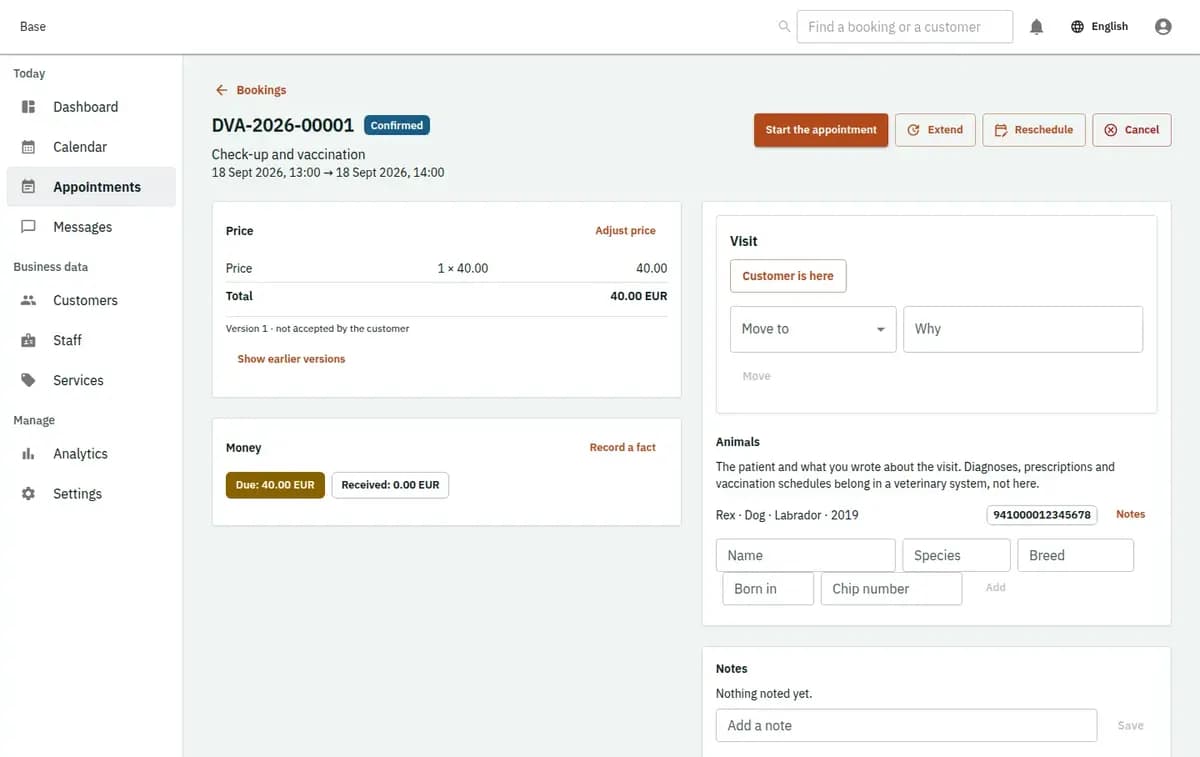
The booking console, with invented records: one booking with its price lines and history

Puppy courses, emergencies and a dental admission

A puppy course, a Tuesday with two emergencies and a dental admission.

A puppy, three visits

The first vaccination is given on a Monday and the next is booked before the owner leaves, three weeks out, as part of the same course. When the third is due the practice can see which puppies are mid-course rather than hoping the owners call. A course that stalls is visible while there is still time to finish it.

A Tuesday with two emergencies

Two animals arrive without appointments. Both go into the capacity that was kept back for the day, the booked consultations keep their times, and the practice finishes roughly when it planned to. The alternative — a full book at nine in the morning — is the same two animals and an hour of overrun for everyone else.

A dental admitted at eight

The owner is given an admission window, not a slot. The theatre and the nurse are held for the procedure, the animal is discharged in the afternoon, and the recheck goes in before the owner drives away. Nobody has to work out at four o’clock who is free to hand a dog back.

The booking console, with invented records: the day’s requests and money

Medical records stay in the clinical system

Veterinary work generates records that carry real weight, and a booking calendar is not the place for them.

No clinical record, no prescriptions, no results

History, examination findings, prescriptions, laboratory and imaging results live in the practice system under its own rules. Base holds the owner, the animal, the visit, the resources it used and how it ended. A booking note is a line for the vet about what the visit is for — it is not a medical entry and should not be used as one.

No judgement about urgency

Whether something is an emergency is a clinical decision made by the person who hears the case. Base can hold capacity for same-day work and record that a visit was urgent, but it does not triage, does not rank animals and does not tell an owner whether to come in now or on Thursday.

Vets, rooms and theatre hours to enter first

Enter every vet with their real hours, including the mornings that belong to surgery and the afternoons that do not. Enter consulting rooms and the theatre as separate resources, and say which visits need a nurse. Write the true duration of each visit type — the fifteen-minute consultation that is honestly twenty is worth admitting now. Decide how much of a day stays free for same-day work and when it opens, and be ready to change that figure after a month of watching it. Define your vaccination courses and their intervals. Decide who may book, who may cancel and what happens to a missed appointment. Then put next month’s existing bookings in before you go live.

What the vet booking system does not do

A practice runs on several systems, and this one owns the day, not the medicine.

When a different product is needed

Base does not keep clinical records, does not write prescriptions, does not hold laboratory or imaging results, does not track drug stock or controlled substances, does not handle insurance claims and does not decide how urgent an animal is. It is not a practice management system and does not replace one; it schedules the day and hands the visit over to the people who do the medicine.

Not a practice management or clinical system

No patient history, no treatment plans, no dispensing, no stock, no laboratory. Those belong to the software your vets already use, and duplicating them in a calendar produces two versions of a record that must never disagree.

No money, no insurance

Base does not price a consultation, does not take payment, does not submit or track an insurance claim and does not decide what an owner owes. It records that a visit happened and how it ended.

A refusal is a valid result

A vet already consulting, both rooms in use, a theatre held for another procedure or a missing nurse stops the booking. The previous state stands, the reason is plain, and the desk offers a time that exists instead of one that does not.

Vet booking questions

How much does Base cost for a small veterinary practice?

Base is vet clinic booking software for the appointment side of a practice only; clinical records stay in your practice system. The Free plan costs €0 and includes 2 staff accounts and 5 bookable items, Standard is €19 a month and Pro €39 a month per business. As veterinary appointment scheduling software it charges no commission and takes no card payments, and owners can book in English, Greek or Russian.

Can one owner have several animals?

Yes. The household is one client record and each animal sits under it, so three pets in one family are visible together and each booking names the specific animal coming in.

How is same-day and emergency work handled?

You decide how much of each day stays unsold and when it opens. That capacity cannot be booked in advance, so it is genuinely there when something arrives. Base holds the space; the clinical decision about urgency stays with your team.

Can vaccination courses be planned?

Yes. The next injection is booked as part of the same course while the owner is still at the desk, and a course that has stalled is visible instead of being discovered a year later.

How are surgery admissions scheduled?

As an admission window with the theatre and, where required, a nurse held for it — not as a consultation slot. Discharge and the post-operative check are booked in the same conversation.

Does Base store clinical records?

No. History, prescriptions, laboratory and imaging results stay in your practice system. Base holds the owner, the animal, the appointment, the resources used and the outcome.

Can it schedule house calls?

Yes, with travel time configured for the vet, so the calendar refuses a visit that only fits if nobody has to drive between two addresses.

Next step

Open a workspace and set up one booking flow

Registration takes an email address. The operating model, services and resources are configured afterwards, in the console.