
Booking models

Booking engine for apartments, villas and guest rooms

Accommodation is the only model measured in nights, and that one difference changes everything. The day a guest leaves is the day the next one arrives, so a calendar that treats a stay as a block of days will lose a night on every booking or refuse one that was perfectly possible. On top of that sits the work nobody sees: the hours between two stays when the place is being cleaned, and the two-night gap that no reasonable guest will ever book.

  1. Publish properties and nightly rules

  2. Collect dates, guests and extras

  3. Prepare the arrival

  4. Coordinate checkout and property work

Accommodation booking platform for properties, nightly availability, guests, extras and stay operations.

What it solves

  • Villas and apartments
  • Small accommodation portfolios
  • Guest services and property teams
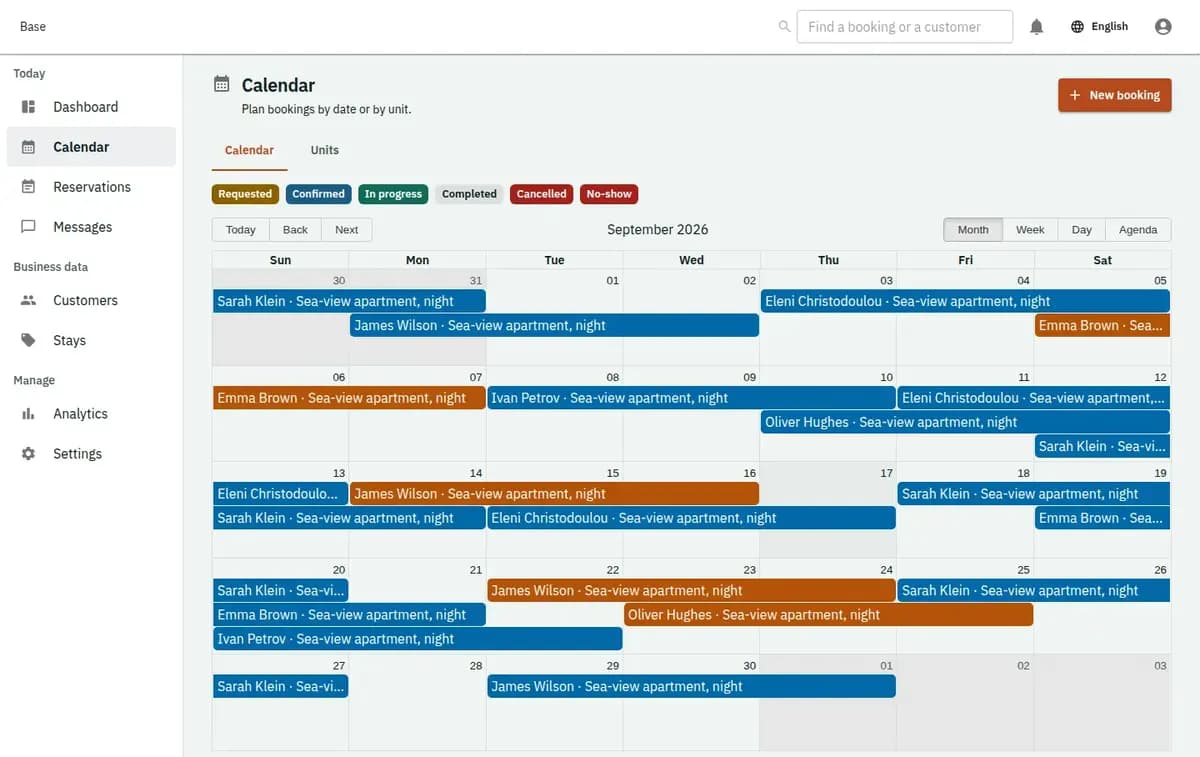
The booking console, with invented records — Accommodation booking
A real console. The records in it are invented.

When an accommodation booking system is the right fit

Use it for holiday apartments and villas, guest rooms, studios, cabins and long-term lets: anywhere a guest stays nights, arrives after a time and leaves before one. It suits an owner with a single apartment and a manager with a dozen units in three buildings, and it holds up when properties differ in capacity, when cleaning has to happen between stays, and when the same date is both a departure and an arrival.

When another model fits better

A visit measured in hours — a tasting, a tour, a treatment — is an appointment, a class or an experience, even when it happens at the same farm or hotel. A room hired for a meeting by the hour is a resource. Something the guest takes away is rental. Timed services for guests already staying belong to the hotel-services profile, which sits alongside your property system rather than replacing it.

What nights do to a calendar built for hours

Four differences, and the first one causes more lost bookings than the other three together.

A departure day is also an arrival day

A guest leaving on Friday morning and one arriving on Friday afternoon do not overlap. A calendar that books whole days will either mark Friday as taken and lose the night, or mark it free and put two parties in one apartment. Nights are the unit, and the boundary between two stays is a time on a single date, not a whole day thrown away.

The changeover is work, and it is not sellable

Between one stay and the next the place is cleaned, the linen is changed and something is always found. Those hours belong to the property, they cannot be booked by anybody, and they are the reason a same-day turnaround has to be a deliberate choice rather than an accident of an empty grid.

A minimum stay creates gaps nobody can use

Two nights between two bookings, with a three-night minimum in season, is a gap that will never sell. Owners either drop the rule at the wrong moment or lose the nights. The calendar has to make those gaps visible while there is still time to move a booking or open the rule for that window.

Guests are a constraint, not a detail

A property sleeps six, and a request for eight is not a rounding error. The count belongs to the booking and is checked against the property, along with the extras that actually depend on it — a cot, an extra bed, parking that only has two spaces.

Setting up a booking system for guest house owners

Four steps, and the second one is the one people skip and then rebuild in August.

1. Enter each property as itself

Name, capacity, bedrooms, the extras it offers and the ones it does not. Two apartments in the same building are two calendars, because the guest is staying in one of them and the cleaner needs to know which.

2. Set the rules that define a season

Check-in and check-out times, minimum and maximum stay, which days a stay may start on if you use that, notice period, and the changeover hours you need between guests. These are the rules the calendar will defend when somebody is trying to book the last week of August at nine at night.

3. Take bookings in nights, with the party

Arrival and departure dates, the number of guests, extras. The stay is confirmed against the property when every night is free, the changeover fits and the party is within capacity — otherwise it is refused with the reason, and the nearest possible window is offered.

4. Run the stay and close it

Arrival, departure, extras used, notes about what the next guest or the cleaner needs to know. A closed stay is what makes next season’s decisions about pricing, minimum stays and changeover time arguments about what actually happened.

Three checks specific to nightly stays

Three checks that are specific to nights, and are wrong in almost every generic calendar.

The boundary between two stays is a time, not a day

A stay ending on the fifteenth and one starting on the fifteenth are both valid when the changeover fits between them. The night is the unit, so no date is lost and no date is sold twice.

Changeover time is held against the property

The hours needed to clean and prepare are subtracted from availability and cannot be booked. A same-day turnaround happens because you decided the time is enough, not because the calendar failed to notice.

Capacity and extras are checked with the dates

A party larger than the property sleeps is refused rather than confirmed and negotiated later. Extras that are genuinely limited — a cot, a parking space — are held for the same nights as the stay.

A same-day changeover and a rescued two-night gap

A same-day changeover, and a two-night gap that was rescued.

One guest out, one guest in

Departure is at ten on Saturday, arrival at four. The four hours in between are the property’s changeover, held and unbookable. Both stays are confirmed, the cleaner has a window that exists, and the Saturday night is sold rather than written off.

A two-night gap in a three-night season

Two bookings leave the Tuesday and Wednesday empty, and the minimum stay means nobody can take them. The gap is visible in the calendar rather than discovered in September, so the owner can open those two nights as an exception and fill them at a lower rate — a decision made deliberately, once.

What a stay record holds and leaves alone

A stay involves guests, money and, in some places, a legal obligation. Only one of those belongs here.

The guest record stays small

A name, a contact, the party size and what they were told about the rules. Identity documents, guest registration required by law and anything an authority asks you to keep are your obligation and belong in whatever you use for it, with its own retention. Base does not file anything with anybody on your behalf.

Money stays outside

Deposits, balances, refunds, tourist tax and cleaning fees are calculated and taken the way you already do it. Base can record that a payment or a deposit happened as a fact; it does not hold funds, does not price a season and does not decide what a cancellation costs.

Preparing a direct booking engine before the season

Enter every property with its real capacity and the extras that genuinely limit it. Set check-in and check-out times, and set the changeover to the hours a proper clean actually takes rather than the optimistic version. Decide your minimum stay by season, and decide in advance how you will treat the awkward gaps it creates. Write the notice period and the cancellation terms you will actually apply. Decide who may confirm and who may cancel. Then enter the bookings you already hold before you publish, because the ones that will not fit are the nights that were promised twice.

Where the booking engine stops

The unit is a night in a property. Everything either side of that belongs somewhere else.

Not a channel manager

Base does not synchronise with listing sites, does not push rates or availability to them and does not import their bookings. If you let through a portal as well, that calendar remains a separate obligation you keep aligned yourself.

Not housekeeping or property management

Cleaner rotas, maintenance tickets, inventory and owner statements are a different product. Base holds the stay and the changeover window; the work that happens inside that window belongs to your own process.

A refusal is a valid result

A night already taken, a stay that eats the changeover, a party larger than the property, a length below your minimum or a request inside your notice period stops the booking. The previous state stands, the reason is named, and the nearest possible window is offered.

Accommodation booking questions

Can guests book directly from my own website instead of through a portal?

Yes. Base works as a direct booking engine: guests choose arrival and departure dates on your booking page or through the booking widget on your own website, in English, Greek or Russian, and Base takes no commission. The accommodation booking system checks every night, the changeover time and the party size before a stay is confirmed. There is no portal sync, so keeping any listings elsewhere aligned stays with you.

Can a guest arrive on the day another leaves?

Yes. Nights are the unit and the boundary is a time on that date, so the same-day changeover is possible as long as the hours you set for cleaning fit between the two stays.

Is changeover time protected?

Yes, per property. It is subtracted from availability and cannot be booked, which is what makes a same-day turnaround a decision rather than an accident.

Are minimum stays supported?

Yes, along with maximum stay and notice period, and they can differ by season. Gaps the rule creates stay visible so you can open them deliberately.

Does Base sync with listing portals?

No. There is no channel management. If you also let through a portal, keeping the two calendars aligned remains your process.

Does it handle deposits and the tourist tax?

No. Money is calculated and taken the way you do it now. A payment or a deposit can be recorded as a fact on the booking, and nothing more.

Next step

Open a workspace and set up one booking flow

Registration takes an email address. The operating model, services and resources are configured afterwards, in the console.