Accommodation booking

Rental property management software for long-term lets

  • Immutable contract versions and bounded obligations
  • Activation protects one named unit period
  • Obligations derive from a finite contract term

No card asked for · nothing taken from a booking · your data exports

Operating model
Accommodation booking
What is booked
Property → Nights → Guests
Getting started
What to prepare in tenant management software

Base helps a small landlord or property operator manage a long-term tenancy around one accepted contract version. Activation protects the named unit from an overlapping active term and generates a finite schedule of obligations inside the contract dates. External payment evidence, utility readings, move-in and move-out inspections, renewal versions and termination records stay connected without turning the platform into accounting software or legal advice.

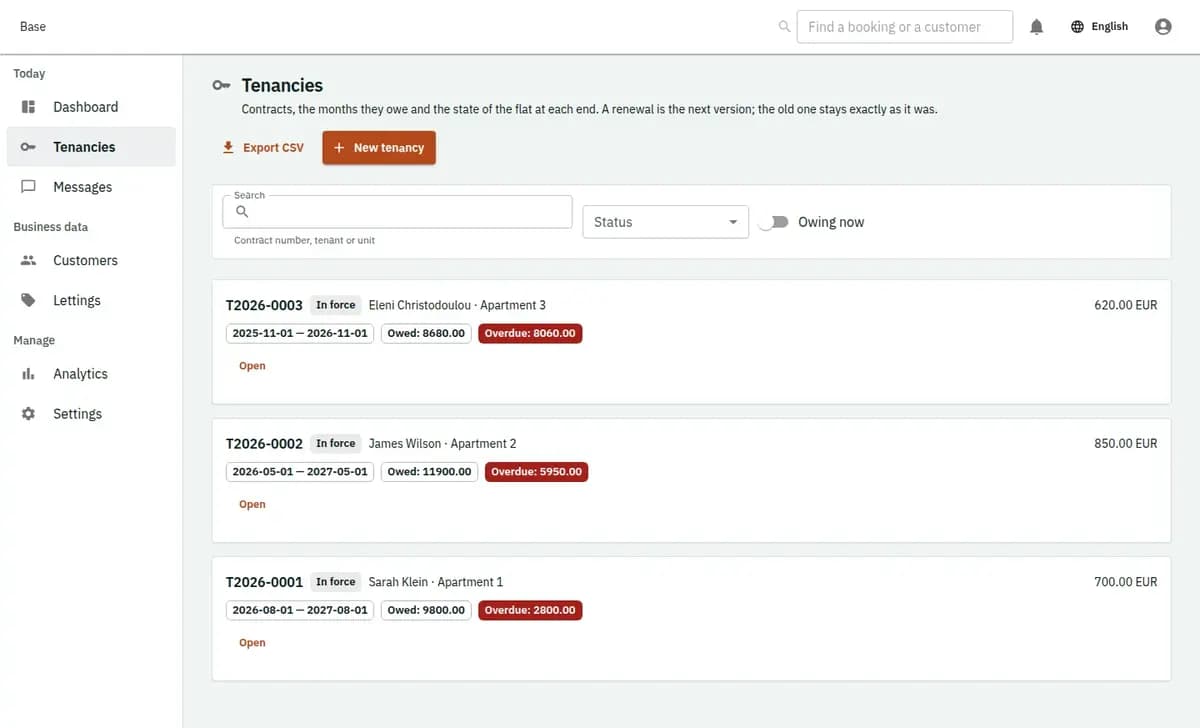
Base tenancy view with named unit immutable contract obligations inspections renewal and termination
A real console. The records in it are invented.

Landlord software for a small Cyprus portfolio

This profile fits a small Cyprus landlord or property manager that needs stable contract versions, one active tenancy period per named unit, scheduled rent and other obligations, manual external payment evidence, readings, inspections, renewal and termination history. It is useful when the team must know what agreement created each due item and what evidence closed it.

How a tenancy moves from draft to close

One versioned contract activates the unit period and generates the finite operational work that follows.

  1. 1. Prepare the unit, parties and draft

    Staff create the named property unit, tenancy offering, parties, intended dates, rent, deposit and mandatory charge terms. The landlord provides reviewed legal documents and privacy decisions. Base stores operational fields and references but does not generate legal advice or decide whether a clause is valid.

  2. 2. Accept one immutable contract version

    Changes during negotiation produce new draft versions. Acceptance points to the final selected version, actor, time and signed-document reference where used. Once accepted, rent terms and dates are not edited in place. A correction or renewal follows an explicit new versioned path.

  3. 3. Activate the tenancy and obligations

    Activation rechecks unit availability and the required evidence, creates the exclusive tenancy period and generates obligations only within the bounded contract horizon. If another active term overlaps, the transaction fails and no obligations are produced for a tenancy that does not exist.

  4. 4. Record external evidence and inspections

    Staff link factual external money entries to the appropriate obligations and record utility readings, move-in or periodic inspection evidence under role and retention controls. An overdue status means evidence has not satisfied the obligation; it does not prove non-payment outside the recorded information.

  5. 5. Renew, terminate and close without erasure

    A renewal creates the next contract version and a new bounded obligation schedule after overlap checks. Termination records the authority, reason and effective date while keeping earlier obligations. Move-out evidence, final readings and deposit outcome close the operational trail without deleting the original tenancy.

Tenancy records that must stay historically true

The contract owns the period and obligations; later events append evidence instead of rewriting the agreement.

A renewal overwrites the signed term

Every draft and accepted contract has its own immutable version and acceptance or signature reference. A renewal creates the next version and dates; it never edits the earlier term. Staff can therefore see which agreement applied to an obligation, inspection or termination decision.

The same unit is promised for overlapping dates

A named unit is exclusive capacity. Contract activation checks the approved parties, policy evidence and tenancy dates, then protects the full period in one transaction. A concurrent or existing active tenancy that overlaps causes a refusal and creates neither a second term nor its obligations.

Rent due and money received become one editable number

An obligation records what the contract expects for a bounded period. A separate immutable manual fact records external payment evidence and links it to the relevant obligation. Corrections use an auditable void and replacement, so staff do not erase what was previously entered or confuse expectation with collection.

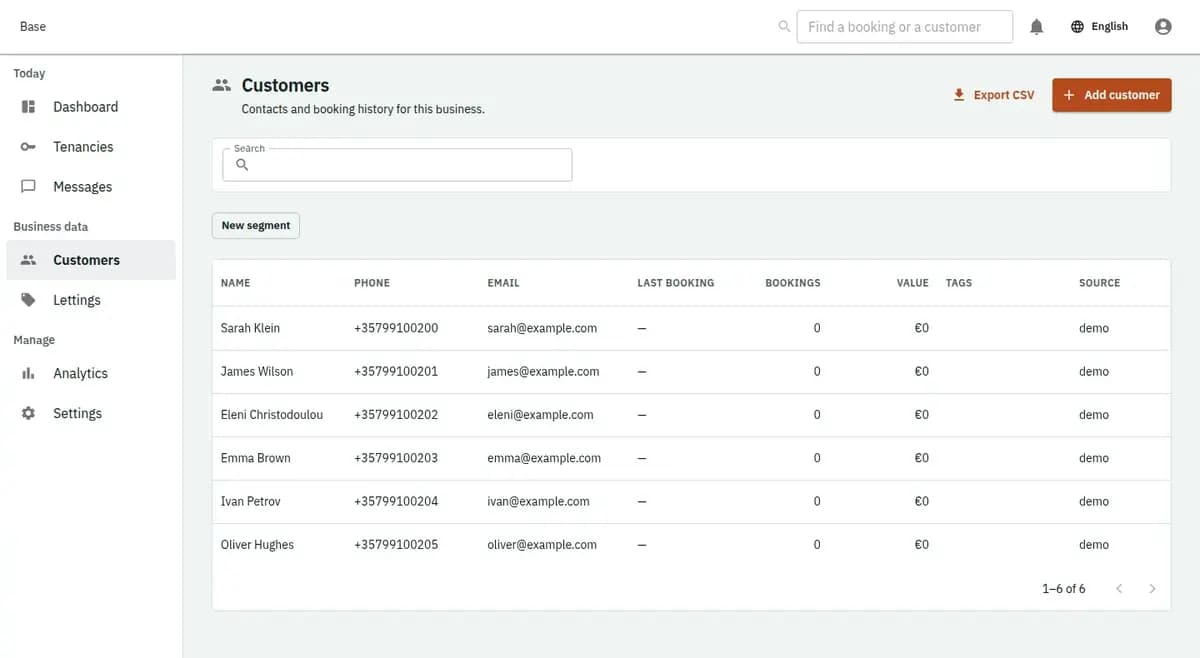
The booking console, with invented records: the customer list

Immutable contract versions and bounded obligations

The tenancy contract is the lifecycle owner, not a booking that can be freely edited after confirmation.

Activation protects one named unit period

Unit availability, dates and required acceptance evidence are checked atomically. Database protection refuses overlapping active contracts even when two staff actions race. The failed activation leaves the accepted draft available for correction but creates no partial reservation or obligation schedule.

Obligations derive from a finite contract term

Expected rent or other approved charges are generated only for dates covered by the accepted version. Each item can link to immutable external evidence. Generation is idempotent, and a renewal adds a new version and schedule rather than extending the old term invisibly.

Activation, payment evidence and renewal in practice

Activation, external payment evidence and renewal show how the contract remains the stable source.

A tenancy activates after contract acceptance

The manager selects the final contract version and signed reference for a named unit. Base confirms that no active tenancy overlaps, reserves the agreed period and creates the finite monthly obligations. Move-in readings and inspection evidence are then attached to that tenancy.

A second contract overlaps the unit

Another staff member tries to activate a term that begins before the current tenancy ends. Base refuses the activation at the shared protection. The competing draft remains available to amend or decline, but no second active tenancy and no duplicate obligation schedule are created.

A tenant renews for another fixed term

Staff create a renewal version with the new dates and terms, retain the earlier agreement, recheck unit availability and generate only the new bounded obligations. If acceptance or required evidence is incomplete, renewal activation waits instead of changing the existing contract.

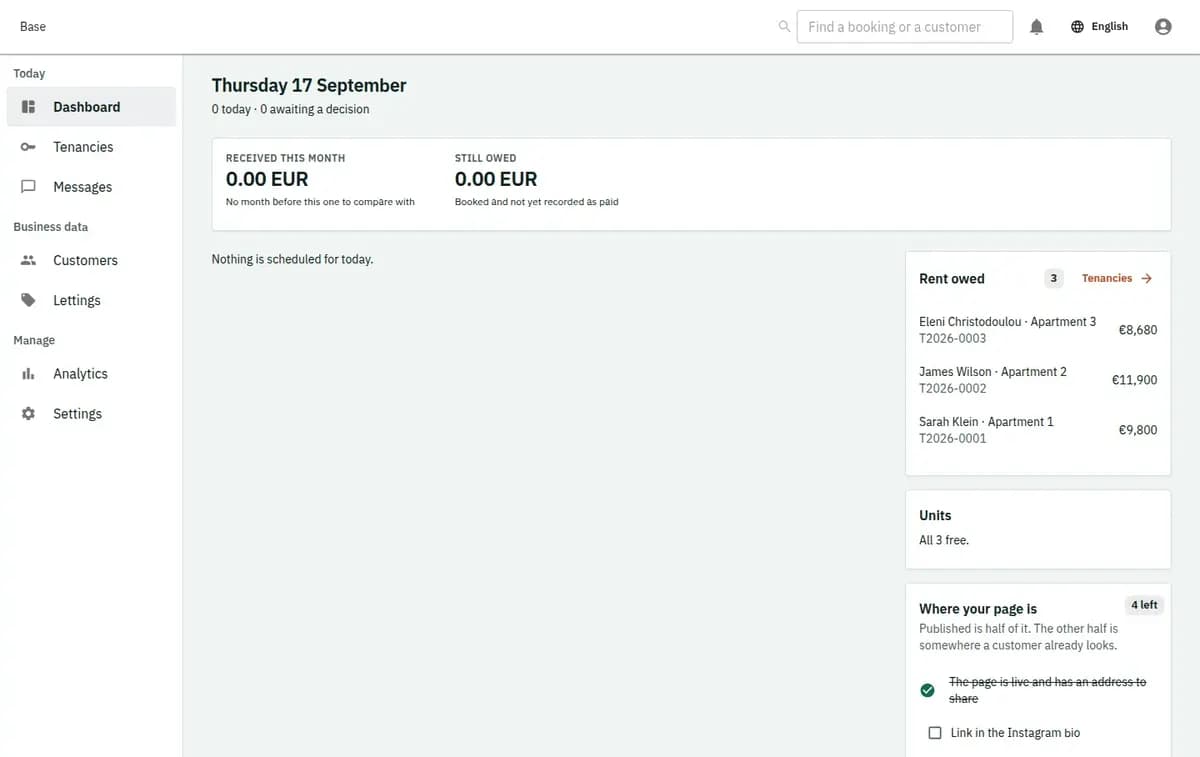
The booking console, with invented records: the day’s requests and money

Evidence for property operations without legal conclusions

The history shows what the operator recorded and under which contract, while law and financial judgment remain external.

Versions and corrections are attributable

Drafts, acceptance references, activation, obligations, external money facts, readings, inspections, renewals, notices and termination events retain actor and time. Money entries are immutable; correction preserves the voided record and replacement. Uploaded documents use approved access and attachment controls.

The landlord owns legal and privacy decisions

Base does not advise on contract wording, notice validity, deposit deductions, rent disputes or retention periods. The organisation and its advisers decide what evidence is necessary, who may view it and how Cyprus requirements apply. The record supports that decision rather than replacing it.

What to prepare in tenant management software

Create each named unit, tenancy offering and authorised staff roles. Prepare reviewed contract, privacy, notice, inspection and deposit documents; define rent and approved charge terms, contract dates, obligation cadence, external evidence methods and move-in or move-out requirements. Decide access and retention for signed references, readings and photos. Preview imports for missing parties, mutable source records, overlapping active terms, obligations outside the contract and broken evidence links.

Where this rental property management software stops

The profile preserves tenancy operations without claiming accounting, legal service or property-marketplace breadth.
What this property profile does not replace

Base is not an accounting ledger, bank reconciliation service, property marketplace, legal adviser, maintenance ERP or card-payment system. It does not draft authoritative tenancy clauses or decide notices, deposit outcomes or disputes. Those responsibilities stay with the landlord and qualified advisers.

No accounting or bank reconciliation

Obligations show what is expected under the contract, while immutable manual entries record external evidence. Base does not access bank accounts, reconcile statements, produce an accounting ledger or infer that money was paid when evidence is absent.

No marketplace, maintenance ERP or legal advice

The profile does not advertise units to a marketplace, rank applicants, dispatch maintenance trades or draft authoritative legal clauses. The landlord decides parties, documents, notices, renewals, termination and any maintenance process.

No card payment or editable contract history

Tenants pay the landlord outside Base using the method the landlord and applicable rules require. An accepted contract version and manual money fact cannot be rewritten. Invalid evidence or an overlapping term is refused while the last valid record stays intact.

Property management questions

How much does Base cost for a landlord with a few units?

Base landlord software has a Free plan at €0 with 2 staff accounts and 5 bookable items; Standard is €19 and Pro €39 a month per business. As tenant management software it keeps contract versions, rent obligations, readings and inspections in one record. It is property management software for the operational side only: it takes no commission and no card payments, and rent moves between tenant and landlord outside Base.

Can an accepted tenancy contract be edited?

No. The accepted version remains immutable. A negotiated change or renewal creates a new version so earlier terms, obligations and evidence remain historically accurate.

How are overlapping tenancies prevented?

Activation protects the named unit for the accepted term in one transaction. An overlapping active contract is refused without creating a second reservation or obligations.

Does Base collect rent?

No. Rent moves between tenant and landlord outside Base. Staff can record immutable external evidence and link it to the obligation it satisfies.

What happens during renewal?

Staff prepare and accept a new contract version, recheck the unit period and generate a new finite obligation schedule. The original contract is never extended by editing it.

Does the system provide legal or accounting advice?

No. Contract wording, notices, deposits, disputes, tax and accounting remain with the landlord and qualified advisers. Base keeps the operational record only.

Next step

Open a workspace and set up one booking flow

Registration takes an email address. The operating model, services and resources are configured afterwards, in the console.