
Accommodation booking

Holiday rental software for direct bookings and short stays

  • Nights in one unit plus the changeover
  • The stay and its turnaround are one reservation
  • Minimum stay and capacity are checked, not suggested

No card asked for · nothing taken from a booking · your data exports

Operating model
Accommodation booking
What is booked
Property → Nights → Guests
Getting started
Setting up vacation rental booking software for direct bookings

A stay is not a period on a calendar. It is nights in one named unit, a check-out at eleven and a check-in at three with a changeover in between that somebody has to do, and a party that has to fit what the unit actually sleeps. Base holds the unit across the stay and its turnaround so the flat cannot be promised to the next guest before it is ready, keeps direct requests and phone enquiries in one place, and shows the two-night gaps that a minimum stay will never fill.

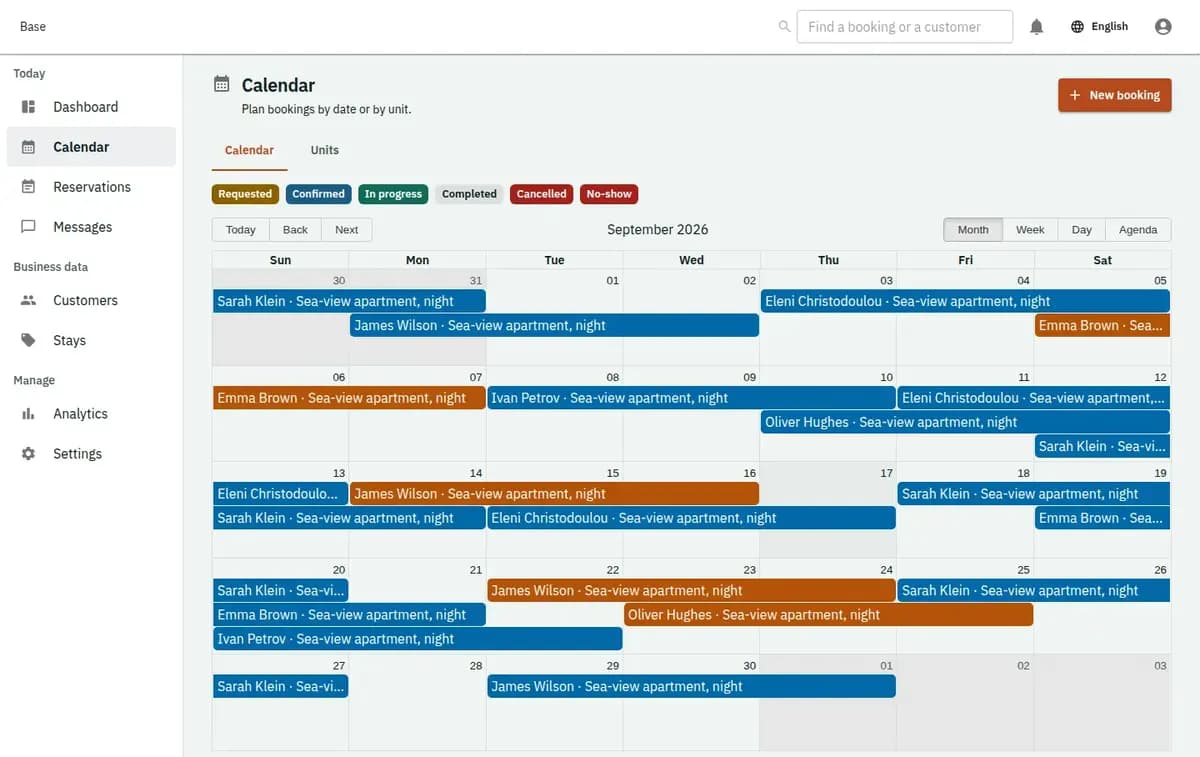
Base calendar showing named stay units with arrivals, departures and changeover blocks
A real console. The records in it are invented.

Who this vacation rental software fits

It fits a host with a handful of units taking direct bookings: apartments, villas, studios, a small guesthouse. It is useful when each unit is a distinct thing with its own rate, minimum stay and number of sleepers, when the changeover between one departure and the next arrival is real work by a real person, when guests arrive at all hours and somebody has to meet them or leave a key, and when the same host answers a message, blocks a week for family and updates a listing elsewhere by hand.

How the holiday let booking system handles a stay

One record from the first message to the last check of the flat, including the people who do the work between guests.

  1. 1. Set up units as they really are

    Enter each unit with what it sleeps, its bedrooms, its minimum stay, its changeover time and its own blocked periods — the week the owner uses it, the fortnight the bathroom is being redone. Set rates by season and the check-in and check-out times you actually hold to. Where you must record a registration reference for a unit, that is a field on the unit; Base stores what you enter and does not check it with any authority.

  2. 2. Take the request with the party in it

    Nights, adults, children, cot, expected arrival time. A message from a returning guest and a form from the website enter the same queue, and neither takes the unit until it is confirmed. That matters most in the week when three people ask about the same fortnight in August.

  3. 3. Confirm the unit for the stay and the changeover

    Confirmation checks the whole run of nights plus the turnaround, the minimum stay, the party against what the unit sleeps, the blocks you entered, and the price and terms as accepted. It succeeds as one action or not at all, so a stay is never half-taken across a block you forgot was there.

  4. 4. Arrival, and the work around it

    The changeover is assigned to whoever does it, and the arrival carries what the guest was told: the time, the key arrangement, the contact. Staff record when the unit was ready and when the guest actually arrived. A late arrival at midnight is a fact on the record, not a missed phone call that nobody else in the team knows about.

  5. 5. Departure, and the state the unit is in

    Check-out records the time and what was found: something broken, something left behind, the flat fine. That closes the stay, releases the unit after its changeover and gives the next arrival a starting point. Deposits, damages and refunds are handled by the host outside Base and recorded here as facts after the fact.

What direct hosting costs in lost nights

The three failures below cost a night each, and none of them is a mistake anyone would call careless.

The changeover is not free time

Check-out at eleven and check-in at three do not make a four-hour cushion — they make one changeover that has to be cleaned, checked and reset. Base holds the unit for the turnaround you configure, so a same-day arrival is only offered when the gap is genuinely long enough, and the cleaner assigned to it is on the same record as the arrival rather than in a separate message thread.
Orphan nights are how a season leaks

A three-night minimum and two nights between two bookings means an empty flat and nothing to do about it. The gaps are visible as gaps rather than as white space on a calendar, so a host can drop the minimum for that window on purpose, or leave it and know why. It is the difference between a decision and a discovery in September.

The party is bigger than the flat sleeps

Four adults and two children in a unit that sleeps four is a conversation to have at the request, not at the door. The party is entered with the enquiry and checked against what the unit sleeps, with the cot and the extra bed as things the host has actually got rather than things a guest assumed. The refusal comes while another unit can still be offered.

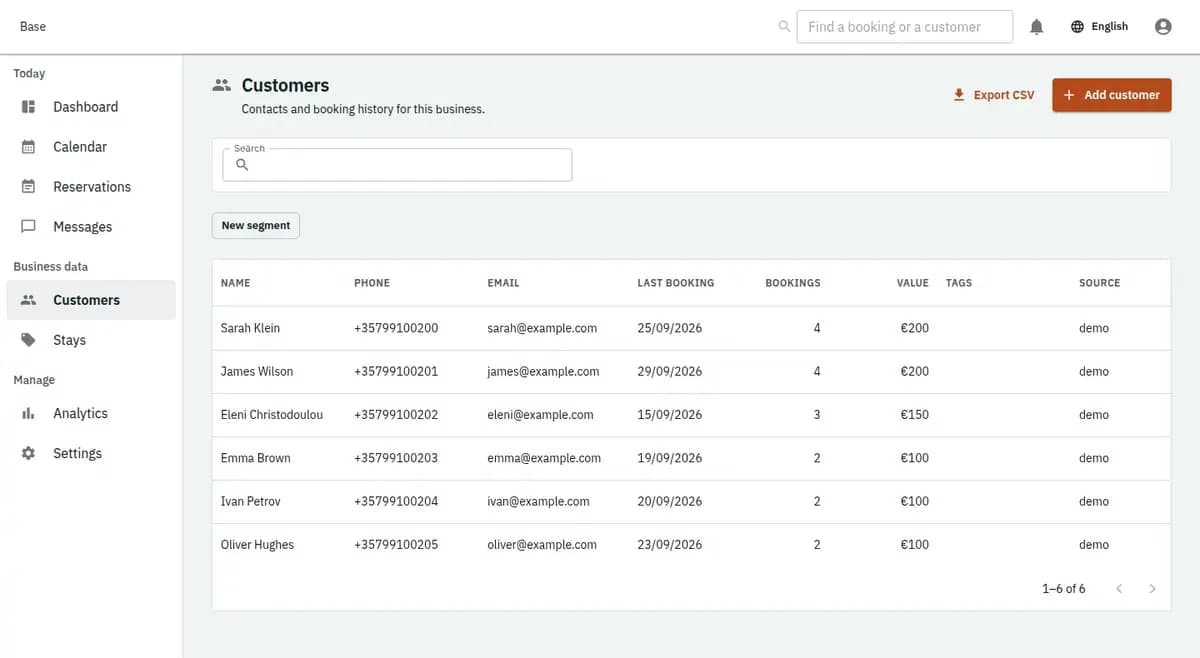
The booking console, with invented records: the customer list

Nights in one unit plus the changeover

The allocation is a run of nights on a named unit, extended by the changeover — which is what makes it different from a day-rate calendar.

The stay and its turnaround are one reservation

A confirmed stay holds the unit from the first night to the last, and then for the changeover window on top. Two bookings that would meet inside that window cannot both be confirmed: the first takes it and the second is refused outright. A host who cleans between eleven and three can say yes to a same-day arrival; a host who cleans on Tuesdays cannot, and the calendar should not offer what the cleaner cannot deliver.

Minimum stay and capacity are checked, not suggested

The minimum nights for the unit and the season are enforced at confirmation, and so is the number of people against what the unit sleeps, including the cot or extra bed if you have entered one. These are the rules you set; Base does not decide that six is fine in a flat for four because the guest promised the children are small.

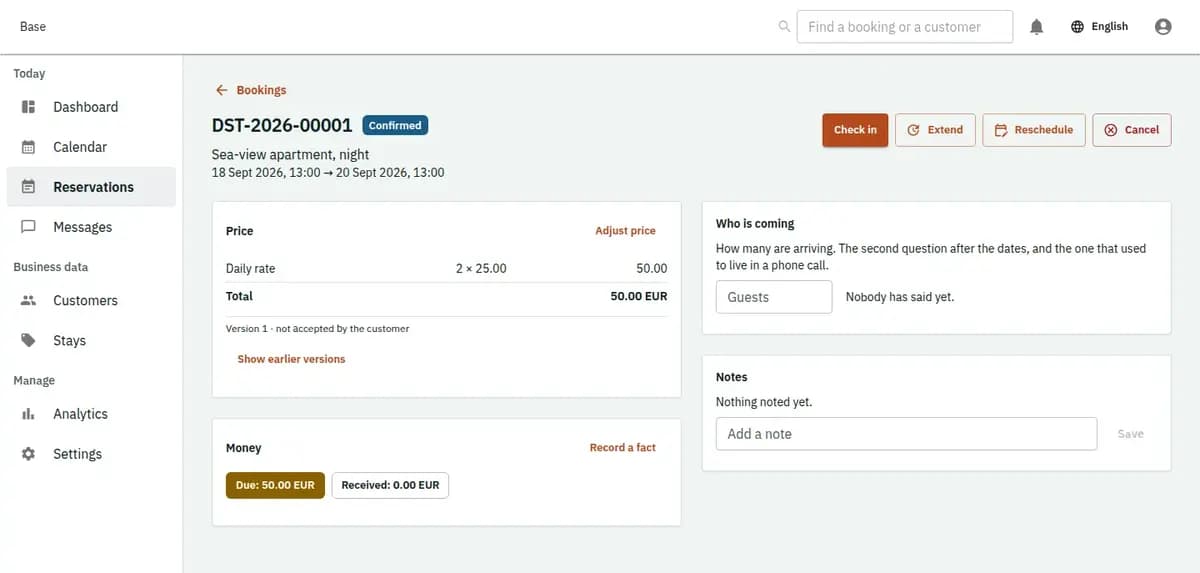
The booking console, with invented records: one booking with its price lines and history

Double bookings and late arrivals in a host's summer

A normal booking, the double promise, and the arrival that comes in the middle of the night.

A returning guest asks for the same fortnight

The message goes into the queue with the party and the dates. The host confirms the unit for the nights plus the changeover, at the rate for that season, and the cleaner is assigned to the Saturday. The guest gets the arrangement they had last year, and nobody has had to check a spreadsheet against a phone.

Two enquiries meet on the same week in August

One is confirmed and takes the unit; the other is refused with the reason plainly stated, and the request stays where the host can answer it. The second guest is offered the other unit or the week after — instead of both being told yes because one message was read on a phone and the other on a laptop.

The flight is delayed and the guest arrives at one in the morning

The arrival time on the record is updated, and whoever is meeting the guest sees it. If the changeover has not been done because the previous guest left late, that is visible too, in the same place, before the guest is on the doorstep. Base does not solve the night, but it stops two people solving it separately without knowing.

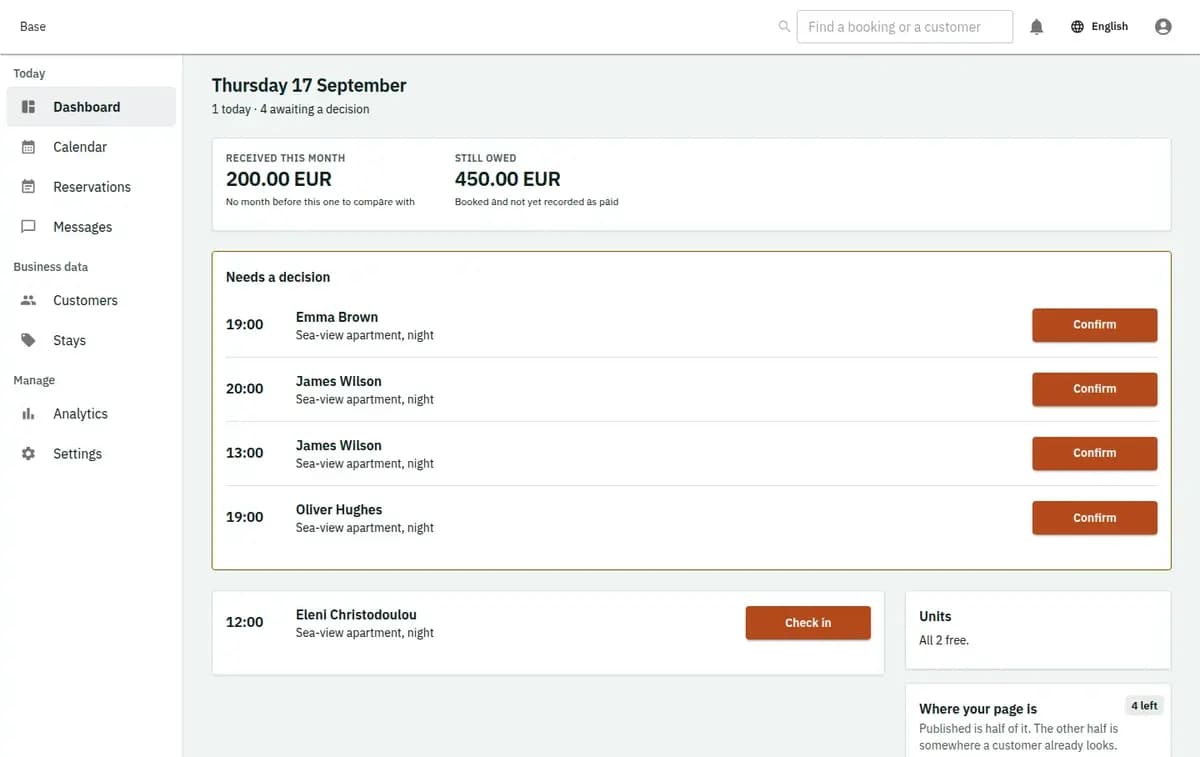
The booking console, with invented records: the day’s requests and money

What guest data a host should keep

Guest data is the part of hosting where it is easiest to keep too much, for too long, for no reason.

Enough to run the stay, no more

Name, contact, party size, dates, price and the arrival arrangement. If your obligations require a registration reference or a guest record, you configure that and remain responsible for it: Base stores what you enter, does not verify it against any register, and makes no claim that keeping it here satisfies a legal duty. Passport scans and identity documents are not asked for and have no place to live.

What was found is written by whoever found it

A broken blind, a missing towel set, a stain on a sofa: recorded at check-out with the person and the time, so the conversation about a deposit is about a written observation rather than a memory. Base does not price damage, does not hold or release a deposit and does not decide who is responsible.

Setting up vacation rental booking software for direct bookings

Enter each unit with what it genuinely sleeps, its bedrooms, minimum stay by season, changeover time and the periods already blocked — including the weeks the owner keeps. Set the check-in and check-out times you actually hold to, not the ones on an old listing. Decide who does changeovers and put them in as staff, because assigning the work is half of what the calendar is for. Write the cancellation policy you will apply and the arrival instructions guests receive. Then import the season you have already sold before you go live: the rows that fail to import are the double bookings you have not found yet.

Where this holiday rental software stops

Direct hosting is a narrow job and this is the narrow tool for it.

When a different product is needed

Base is not a channel manager and does not connect to booking sites, does not price a night for you, does not do trust accounting or payouts, is not a smart-lock platform and does not file guest data with any authority. It has no marketplace and takes no payment. Blocks that come from a listing site are entered by the host; if that is the main way the units sell, a channel manager is the tool for it and this is not.

No channels, no listing sites

Base does not connect to any booking platform, does not import or push availability and does not reconcile a channel’s commission. Blocks from a listing site are entered by hand. If most of your nights sell through a platform, a channel manager is the right tool and this profile is not a substitute for one.

No pricing engine, no accounting

Rates are what you set by season. Base does not adjust a price for demand, does not forecast occupancy, does not issue an invoice, does not hold a payment and does not do trust accounting. Money is handled by the host and recorded here only as something that already happened.

No legal or registration authority

Where a unit must be registered, that duty is the host’s. Base can hold a reference you enter and can show it to your team, but it does not check it, does not report anything to anyone and does not make you compliant by holding a field.

Holiday rental questions

Do guests pay through Base, and is there a commission?

No to both. Base is vacation rental software for direct bookings and takes no card payments and no commission on stays: guests pay you directly, and you record those payments in Base. Your holiday let booking system page works in English, Greek and Russian, and the plans are Free at €0, Standard at €19 and Pro at €39 a month per business.

Can a same-day changeover be blocked when there is not enough time?

Yes. Each unit has its own changeover window, held after every stay. A same-day arrival is only offered when the gap is genuinely long enough, so the calendar never sells a flat that will not be ready.

Does Base connect to listing sites?

No. It handles direct bookings. Blocks from a platform are entered by the host, and if most nights come from a channel, a channel manager is the tool for that job.

How is minimum stay handled?

As a rule on the unit and the season, enforced at confirmation rather than shown as advice. The gaps too short to fill are visible as gaps, so you can lower the minimum for a specific window on purpose.

What happens when a party is larger than the unit sleeps?

Confirmation is refused with the reason, while another unit or another week can still be offered. The cot and extra bed count only if you have actually entered them.

Can cleaners be assigned to changeovers?

Yes. The changeover is work with a person on it, on the same record as the arrival it precedes, so a late departure and an early arrival are visible to everyone who has to do something about them.

Does Base store guest identity documents?

No. It keeps the contact and stay details needed to host, plus any reference field you configure. There is no document vault, and holding a field here does not satisfy an obligation you owe elsewhere.

Next step

Open a workspace and set up one booking flow

Registration takes an email address. The operating model, services and resources are configured afterwards, in the console.